

Hojojutsu: Arresting Rope of the Samurai
Text by Robert R. Gray
Photos by Paul Richardson
History
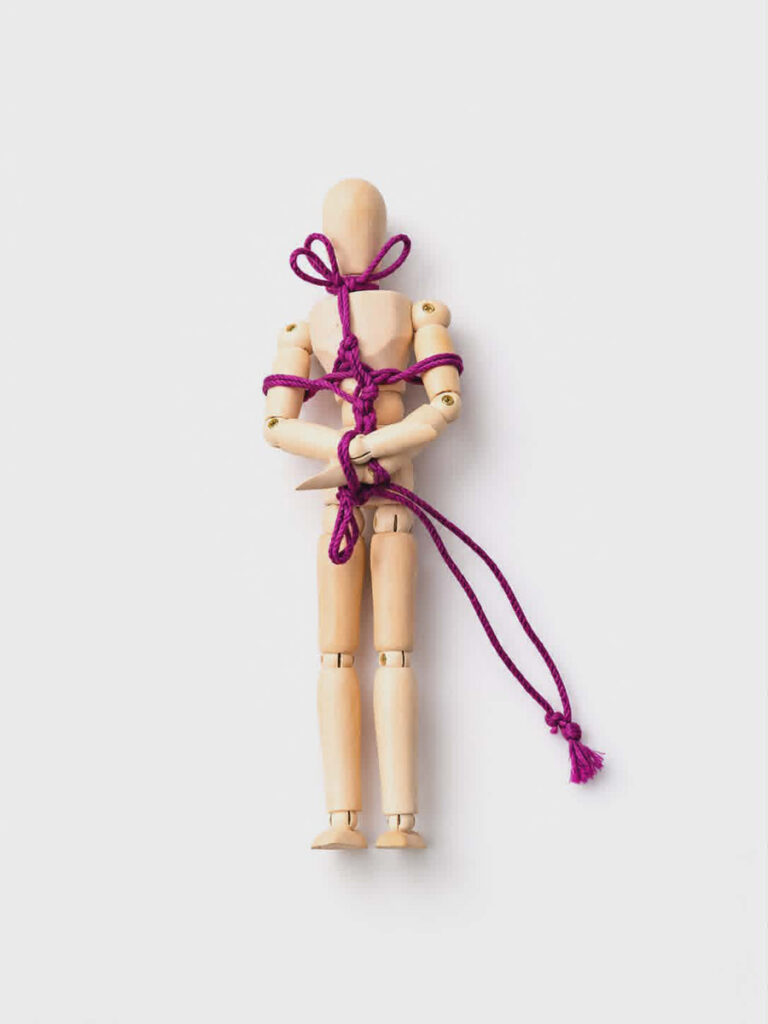
Hojojutsu (also read torinawa-jutsu) is a traditional Japanese martial art of restraining, capturing, and transporting prisoners with rope. Considered one of the classical bugei juhappan—the eighteen martial arts of the samurai—hojojutsu combined practical arrest techniques with social symbolism and aesthetic presentation. Although it is best known as an art of arrest and restraint, its roots lie within a much older Japanese tradition in which rope held practical, spiritual, and symbolic significance.
This connection can be traced back to Japan’s prehistoric Jomon period (縄文時代, c. 14,000–300 BCE), which contains the same kanji for “rope” (縄) found in the term hojojutsu (捕縄術). The name “Jomon” literally means “rope markings,” referring to the distinctive cord patterns impressed into pottery. These designs were not only practical for grip and texture, but also appear to have held symbolic and aesthetic significance, suggesting that rope already occupied an important place in the spiritual and artistic culture of ancient Japan.
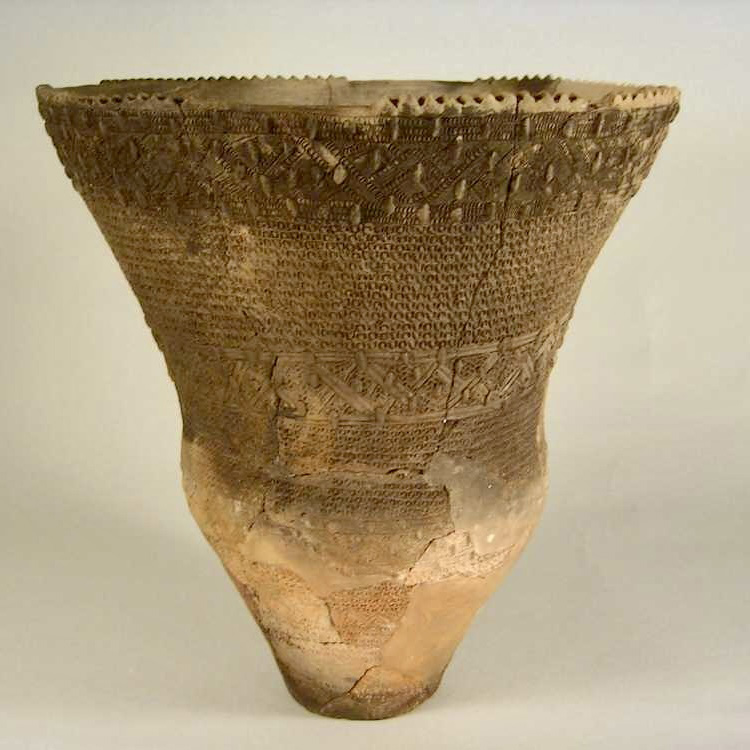
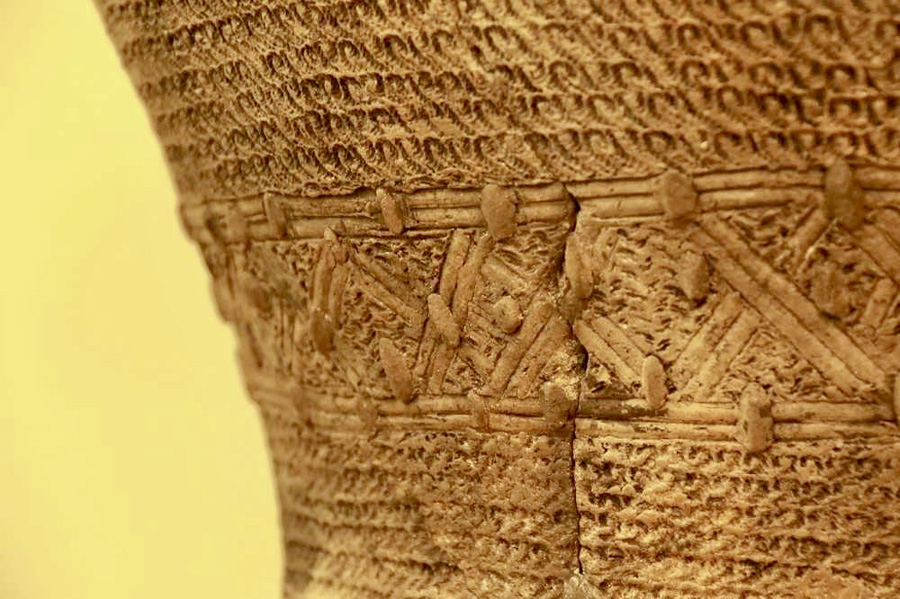
Jomon pottery excavated from the Haneo Shell Mound. Collection of the Odawara City Board of Education. Image via Odawalab (https://odawalab.com).
In later centuries, rope and knot-tying became deeply connected to Japanese ritual and aesthetics through objects such as shimenawa shrine ropes and ceremonial mizuhiki cords. This cultural and spiritual relationship with rope would eventually influence the development of hojojutsu itself.
By the Heian and Kamakura periods, illustrated scrolls already depicted restraint methods such as kubinawa (neck tying), ushiro-te (hands bound behind the back), and gyaku-ebi (binding someone so they formed the shape of a “reversed shrimp” ). During the Onin War (1467–1477) and the Sengoku period, these techniques developed further as practical battlefield methods for capturing prisoners and restraining enemies. As the art evolved, numerous schools emerged, including the Sekiguchi-ryu and Ittatsu-ryu. More than 150 schools of hojojutsu are said to have existed, with over five hundred known tying methods.
With the establishment of peace under the Tokugawa Shogunate, hojojutsu gradually shifted from the battlefield to law enforcement. During the Edo period, officials attached to the bugyosho magistrate offices and the subordinates of the hitsuke-tozoku-aratame (special arson and theft investigators) studied the art extensively. Edo police such as yoriki and doshin used hayanawa for quick arrest tying and honnawa for formal restraint and prisoner transport.
As hojojutsu became integrated into the policing system, binding methods grew increasingly elaborate. Tying techniques varied according to the prisoner’s social class, gender, crime, and even the season, reflecting both social hierarchy and Japanese aesthetic sensibilities.
Unlike many other countries, Japan continued relying heavily on rope rather than metal restraints because hojojutsu had already become highly sophisticated. Although modern metal handcuffs were introduced during the Meiji era, police continued to use rope restraint methods well into the twentieth century. Traditional hojojutsu was only phased out after World War II as Western-style handcuffs and modern policing methods became standardized. Today, stand-alone hojojutsu schools are rare, with most techniques surviving within jujutsu schools and other classical martial arts lineages.
At the same time, hojojutsu developed a second identity beyond law enforcement. Although erotic ukiyo-e (woodblock prints) depicting bound figures already existed during the Edo period, rope tying was still primarily viewed as an arresting technique. This began to change through the work of the Meiji-era artist Ito Seiu, whose paintings and photographs helped transform rope ties into an erotic medium. After World War II, and especially during the 1960s, kinbaku (erotic rope bondage) gained recognition through magazines, film, and television as a form of artistic expression. Emerging directly from earlier battlefield and police restraint methods, it eventually became a distinct element of Japanese visual culture.
Symbols and Religious Ties
The use of rope in Japanese culture has long been intertwined with religion, ritual, and aesthetics. From sacred shimenawa shrine ropes to decorative mizuhiki cords, rope and knot-tying carried symbolic meaning far beyond practical use. In Shinto, shimenawa represented spiritual power, purification, and the boundary between the sacred and the ordinary. Yet it was Buddhist symbolism that most strongly influenced the development of hojojutsu, where binding a criminal came to represent the subduing of evil on behalf of the gods and Buddhas.
Many schools of hojojutsu were grounded in the principle of haja kensho. Originating in Buddhism, the term means “defeating ignorance” (haja) and “revealing truth” (kensho), ultimately referring to the attainment of enlightenment. When the term was adopted into martial arts, the meaning shifted slightly, coming to symbolize the idea that a warrior’s skills should be used to “vanquish evil and uphold justice.”
This symbolism was reflected in Edo-period policing. The sword of the Buddhist deity Fudo Myoo was likened to the police jitte (restraint weapon), while his kensaku (rope for binding one’s demons) was compared to the onawa (arresting rope). The kensaku was traditionally woven from five colored threads: blue, red, white, black, and yellow. This rope also had a vajra-shaped fitting at one end and a metal ring at the other. It was said to be used for capturing and restraining demons, desires, and any other obstacles to enlightenment.
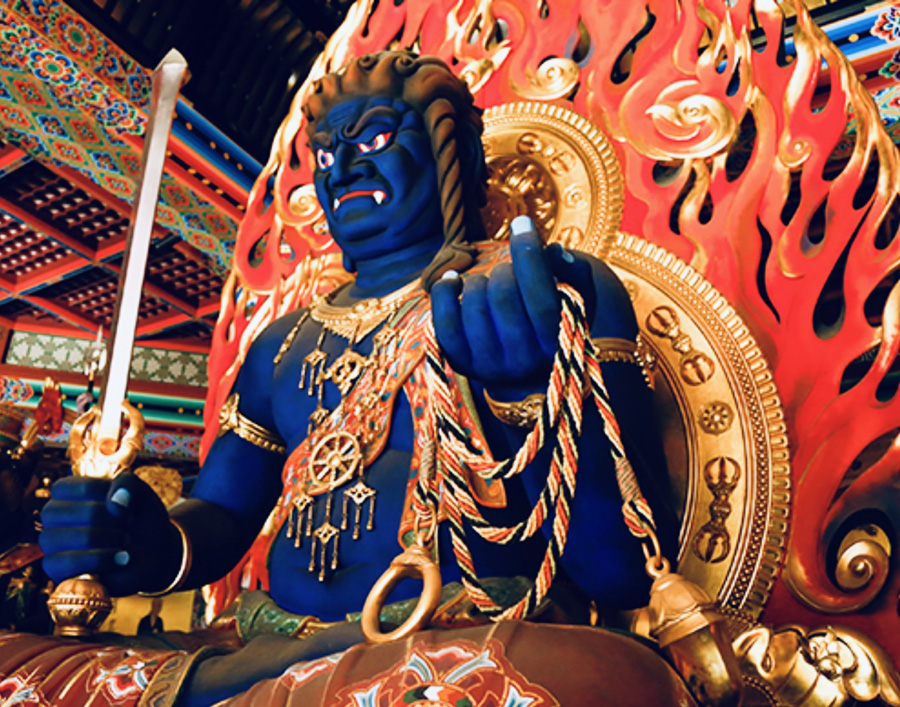
Source: Naritasan Shinshoji Temple (Fudo Myoo with Kensaku Rope)
Edo society also placed great importance on formality and social rank. As a result, different restraint methods were developed according to a suspect’s status, gender, and crime. A samurai, for example, would be bound differently from a commoner, while priests and monks were restrained using yet another tying configuration.
Formal Edo Restraint Types Based on Social Status and Gender:
|
Status |
Gender |
Rope Binding |
|
Samurai |
Male |
Nijuhishi-nawa (Double-Diamond Binding) |
|
Commoner |
Male |
Jumonji-nawa (Cross-shaped Binding) |
|
Commoner |
Female |
Chichikake-nawa (Breast-hanging Binding) |
|
Priest or Monk |
Male |
Taka-no-hane-kaeshi-nawa (Reverse Hawk-Feather Binding) |
|
Criminals sentenced to death or severe crimes |
Male |
Kiri-nawa (Cut Binding) |
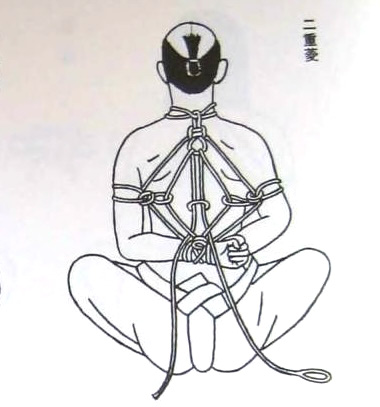
Source: Inokuchi Matsunosuke, Hyoho Yomu Budo Zukai Hiketsu: Jujutsu Kenbo Zukai Hiketsu Kohen, National Diet Library Digital Collections.
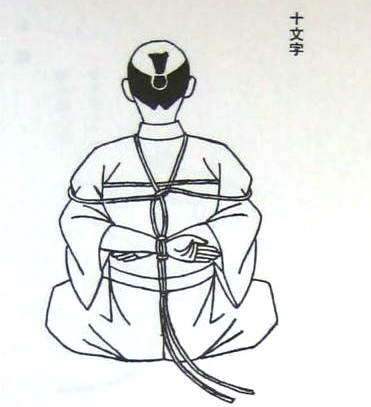
Source: Inokuchi Matsunosuke, Hyoho Yomu Budo Zukai Hiketsu: Jujutsu Kenbo Zukai Hiketsu Kohen, National Diet Library Digital Collections.
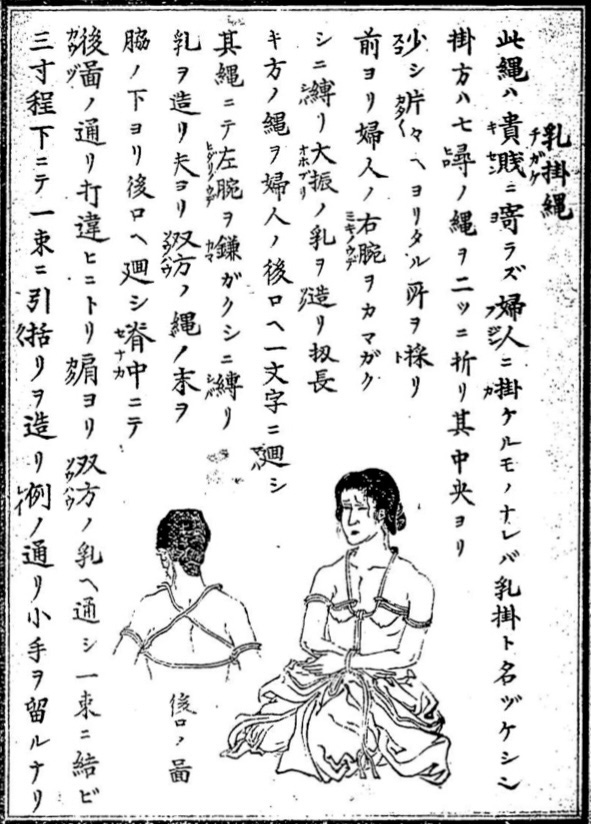
Source: Inokuchi Matsunosuke, Hyoho Yomu Budo Zukai Hiketsu: Jujutsu Kenbo Zukai Hiketsu Kohen, National Diet Library Digital Collections.
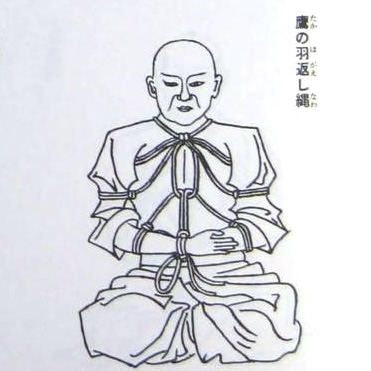
Source: Inokuchi Matsunosuke, Hyoho Yomu Budo Zukai Hiketsu: Jujutsu Kenbo Zukai Hiketsu Kohen, National Diet Library Digital Collections.
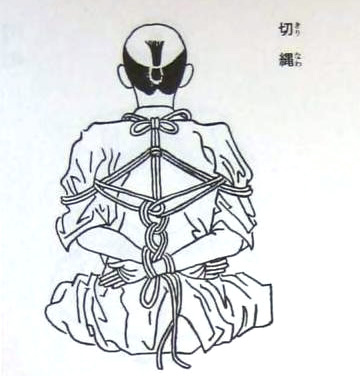
Source: Inokuchi Matsunosuke, Hyoho Yomu Budo Zukai Hiketsu: Jujutsu Kenbo Zukai Hiketsu Kohen, National Diet Library Digital Collections.
Hayanawa and Honnawa
During the Edo period, hojojutsu was broadly divided into two categories: hayanawa (quick binding) and honnawa (formal binding). When Edo-period police officers arrested suspects, they first used hayanawa to restrain them quickly and efficiently. These methods frequently relied on pre-formed loops that could rapidly tighten around the wrists, arms, or body. Hayanawa generally favored speed and simplicity, often avoiding the use of knots entirely. Some methods also employed a kaginawa (hooked rope), which could be quickly attached to a suspect’s collar or clothing to facilitate rapid restraint.
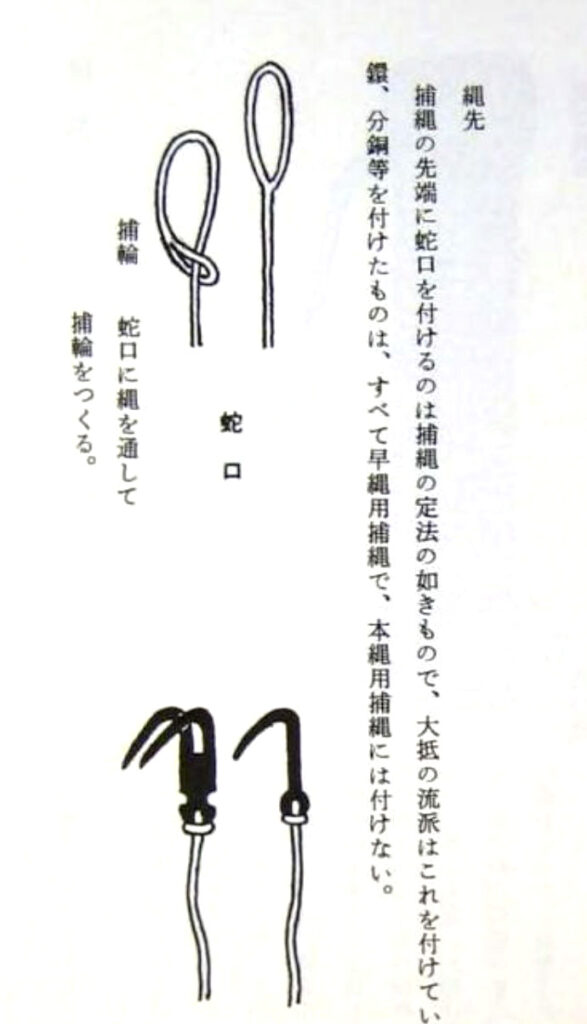
Source: Inokuchi Matsunosuke, Hyoho Yomu Budo Zukai Hiketsu: Jujutsu Kenbo Zukai Hiketsu Kohen, National Diet Library Digital Collections.
Once the charges had been formally determined, the prisoner would then be bound using honnawa, a more elaborate and symbolic form of restraint used for transport, interrogation, and public display. All of the bindings named in the chart above are examples of honnawa.
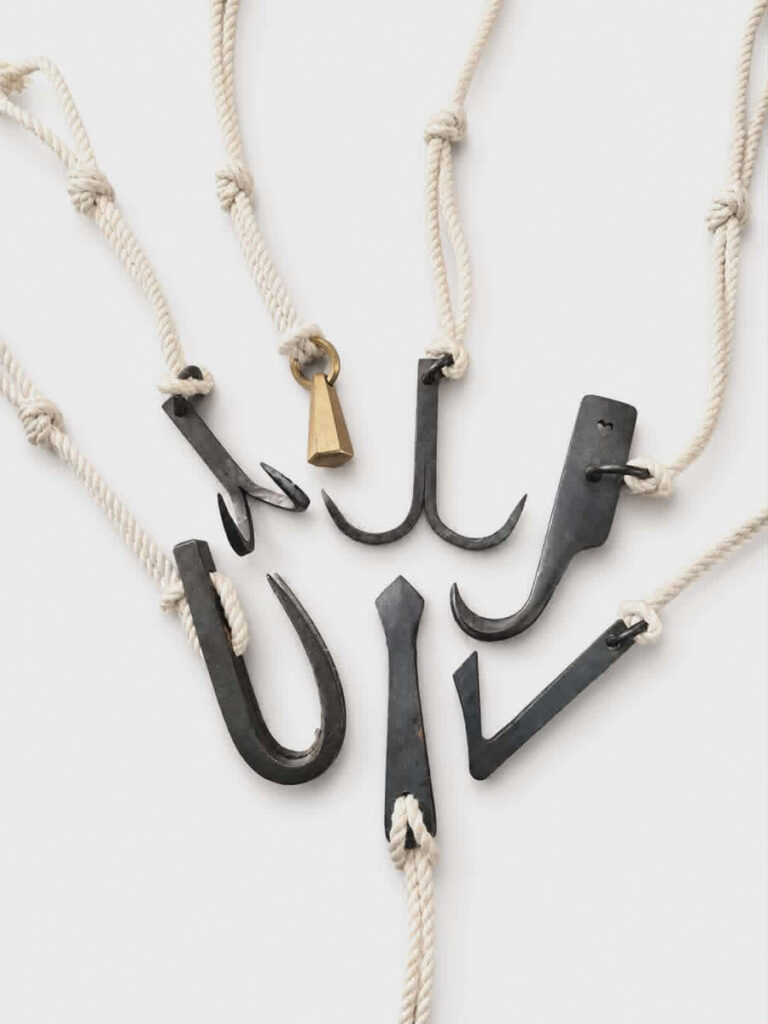
Photos by Paul Richardson
While hayanawa prioritized practicality and control, honnawa placed equal importance on appearance and presentation, helping explain how these techniques later influenced the aesthetics of erotic kinbaku.
According to Yasuhiko Itazu’s historical study “Yoriki, Doshin, Jitte Torinawa,” the four principles of honnawa are:
- The prisoner must not be able to escape.
- The method of tying must not be discernible.
- Even when bound for long periods, nerves and blood vessels must not be damaged.
- The binding must be visually beautiful.
Seasonal Colors of Arresting Rope
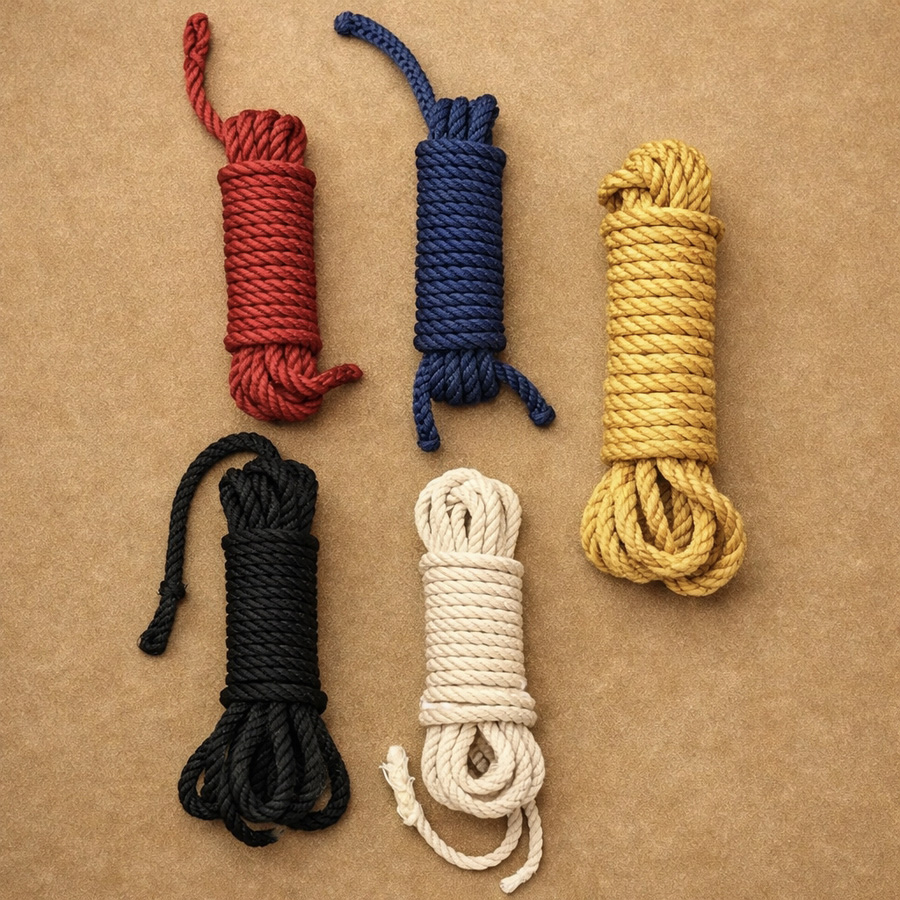
Photos by Robert R. Gray
At the height of Edo-period formality, even the color of arresting ropes could change with the seasons. The system formally known as 捕縄四季弁色の制 (hojo-shiki benshoku-no-sei), or “the seasonal color system of arresting ropes,” reflected a worldview in which governance, ritual, and cosmology were intertwined like the threads of the rope itself. According to Edo machibugyo magistrate records, there was even a period when arresting ropes changed color with the seasons, much like seasonal fashion colors at Uniqlo.
The practice was influenced by the Chinese philosophy of gogyo (五行), the Five Elements system, which associated each season with a particular color, element, direction, and mythological guardian. The system was organized as follows:
- Spring: blue, wood, east, dragon
- Summer: red, fire, south, vermilion bird
- Autumn: white, metal, west, white tiger
- Winter: black, water, north, black tortoise
- Seasonal Transitions: yellow, earth
These associations extended into Edo law enforcement, where arresting ropes were color-coded to match the season. Blue rope would be used in spring, red in summer, white in autumn, black in winter, and yellow during the transitional periods between seasons. The system illustrates how deeply symbolic thinking permeated Edo-period society. Even practical tools of policing were expected to reflect broader ideas about cosmic balance, harmony, and proper order.
The practice is believed to have faded during the Tenmei famine of the 1780s. As starvation, unrest, and crime increased, authorities likely had more pressing concerns than maintaining an elaborate seasonal color system for arresting ropes.
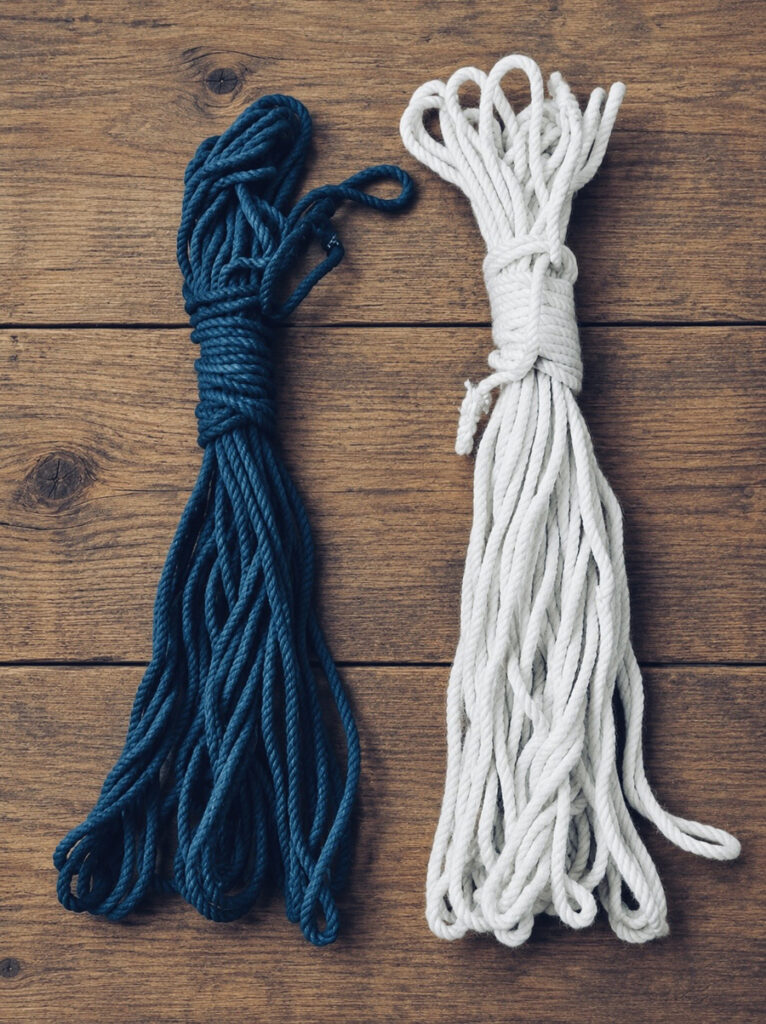
Photos by Paul Richardson
After the system fell out of use, the magistrate offices adopted simpler standards. The North Magistrate’s Office, which oversaw investigations of arson and theft, used plain white hemp rope, while the South Magistrate’s Office, which was more closely connected to the prison system, adopted blue rope. This distinction between white rope in the north and blue rope in the south continued into the Meiji era.
Making Arrest Rope
Official Edo arrest rope was typically a three-strand twisted rope made from high-quality hemp. Rope lengths were not standardized and could vary from roughly eight to thirteen hiro depending on the intended use. A hiro (尋) was a traditional Japanese unit of length equal to about 1.8 meters (six feet), meaning some arresting ropes could exceed 20 meters (65 feet) in length.
One end of the rope typically formed a small loop known as the jaguchi (snake mouth). The opposite end was tightly braided into a short, rigid rod-like tip, allowing it to pass smoothly through the jaguchi and tighten quickly during restraint. In some cases, a small metal ring was added to help the loop slide more easily. Certain ropes were also fitted with a kaginawa (hook).
Before use, the rope was traditionally boiled in vinegar for about two hours, dried, and then beaten with a mallet to make it more pliable. This practice was upheld under Tokugawa Shogunate laws, but, like the seasonal color-coding system, the elaborate preparation process gradually fell out of favor and was simplified during and after the Tenmei era.
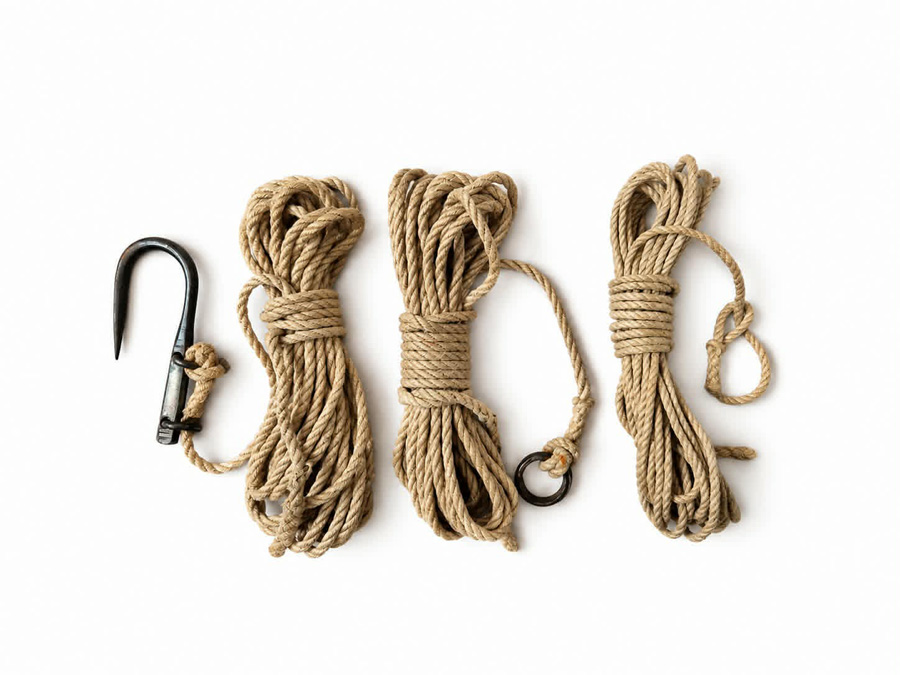
Photos by Paul Richardson
Hojojutsu primarily used hemp rope, which carried symbolic significance in Japan. Hemp was traditionally believed to possess sacred properties capable of warding off impurity and evil influences. Binding a criminal with hemp rope was therefore understood not only as a means of restraint, but also as a form of ritual purification. This connection between rope, spirituality, and aesthetics has continued throughout Japanese culture, from the sacred ropes of Shinto shrines and the arresting ropes of hojojutsu to the hemp rope and visual aesthetics of modern kinbaku.
Summary
Hojojutsu emerged from a much older Japanese tradition in which rope held practical, spiritual, and symbolic significance. This connection can be traced back thousands of years to the prehistoric Jomon period, whose name is written with the same kanji for “rope” (縄) found in hojojutsu itself. In later centuries, rope became closely associated with religious practice through sacred shimenawa shrine ropes and Buddhist imagery such as Fudo Myoo, who holds a rope used to bind demons and ignorance. By the Sengoku period, rope restraint techniques had developed into practical methods for battlefield capture before later evolving into the sophisticated arresting systems of the Edo police.
During the Edo period, hojojutsu became highly formalized, with different tying methods based on social class, gender, and crime. Influenced by the Chinese-derived gogyo (Five Elements) cosmology, arresting ropes were even color-coded by season to reflect larger ideas of harmony and order. The visual and symbolic aspects of these restraints eventually contributed to the development of modern kinbaku, Japan’s erotic rope bondage.
Although only a small number of hojojutsu traditions survive today, traces of the art can still be found in the Japanese language. The expression “onawa ni naru” (to get arrested) is one clear example. Historically, “onawa” (rope) referred to the rope used to bind prisoners, and the term gradually became synonymous with arrest itself.
About the Author
Robert R. Gray moved to Japan in 2001 to study martial arts and meditation. In 2013, he received menkyo kaiden in Jinen-ryu jutte-jutsu under Manaka Unsui. For information on other articles and translations, please see www.robertrgray.com.