

Interview with Robert Mark Kamen, Screenwriter of The Karate Kid– The second part
Special Support: Roy Kenneth Kamen
Interview and text by: Yannick Schultze
Read the first part of the article here!
INTERVIEW
9. Between The Karate Kid I and II, you visited Okinawa. Could you tell us more about that trip? Which masters did you meet, and who influenced you the most?
RMK: I went to Okinawa planning to stay for ten days, but I ended up staying for three months. I had the good fortune of meeting a lot of people—the doors were open to me because I had put Okinawan Gōjū-ryū Karate on the map. Two Okinawan masters in particular welcomed me. One was a Godan in Shōreikan who had left the school and was just playing golf, but he brought me in. Every door was open because these people felt I had done Okinawan Karate a great service.
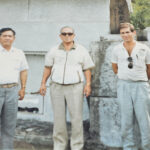
I was met at the airport by Yagi Meitoku sensei and Matayoshi Shinpō (又吉眞豊) sensei, a Kobudō master. They greeted me with flowers—it was really touching—and brought me directly from the airport to Miyagi Chōjun’s grave, where we took pictures. These were older gentlemen, and they expressed how grateful they were for my sensitive portrayal of Okinawan culture and karate.
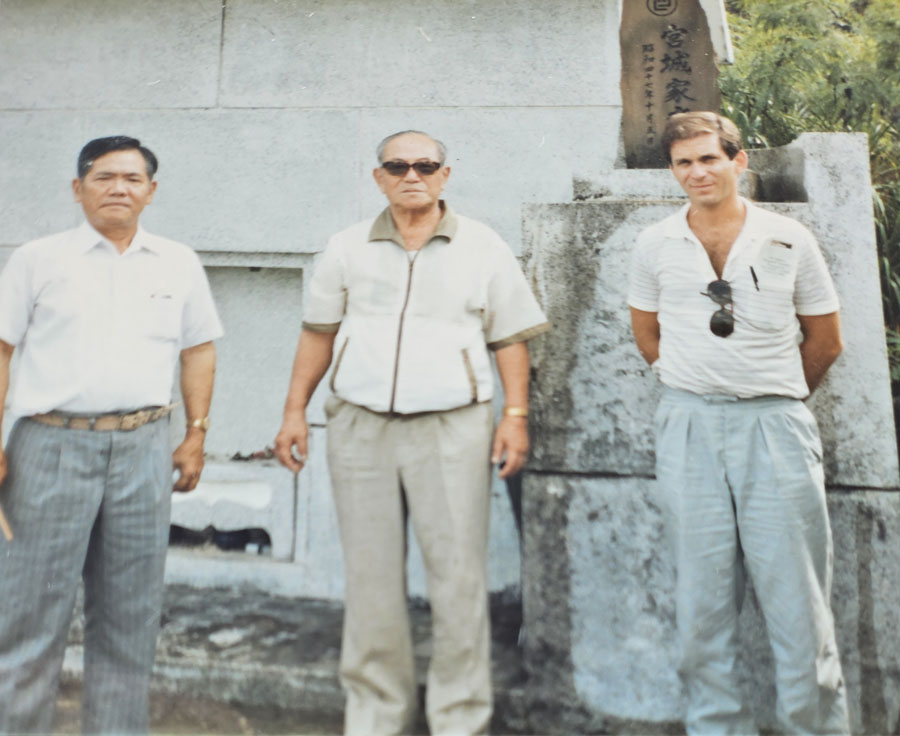
From left to right: Matayoshi Shinpō, Yagi Meitoku and Robert Mark Kamen – at the tomb of Miyagi Chōjun
I spent a lot of time with Yagi sensei and his dōjō. He was very influential in terms of The Karate Kid 2. I was drawn to his openness, unlike Toguchi sensei in Okinawa, who was a bit guarded. I showed Yagi sensei all my kata; he corrected me, let me work out with his students, and I learned a great deal from their training.
I also met Kishaba Chōkei, a great Shōrin-ryū stylist, and Shinzato Katsuhiko sensei, who was a professor of English but also a distinguished Shōrin-ryū practitioner. They were students of Nagamine Shōshin (長嶺将真) sensei. I met people in the Uechi-ryū (上地流) system as well, and if I hadn’t studied Gōjū-ryū, I probably would have studied Uechi-ryū. It’s a fascinating style, very close to the original forms taught by Uechi Kanbun (上地完文) when he brought it from China. I spent a lot of time with Takamiyagi Shigeru (高宮城繁) sensei, who was compiling a comprehensive research book on Uechi-ryū and its authenticity in China. I gained tremendous knowledge from him.
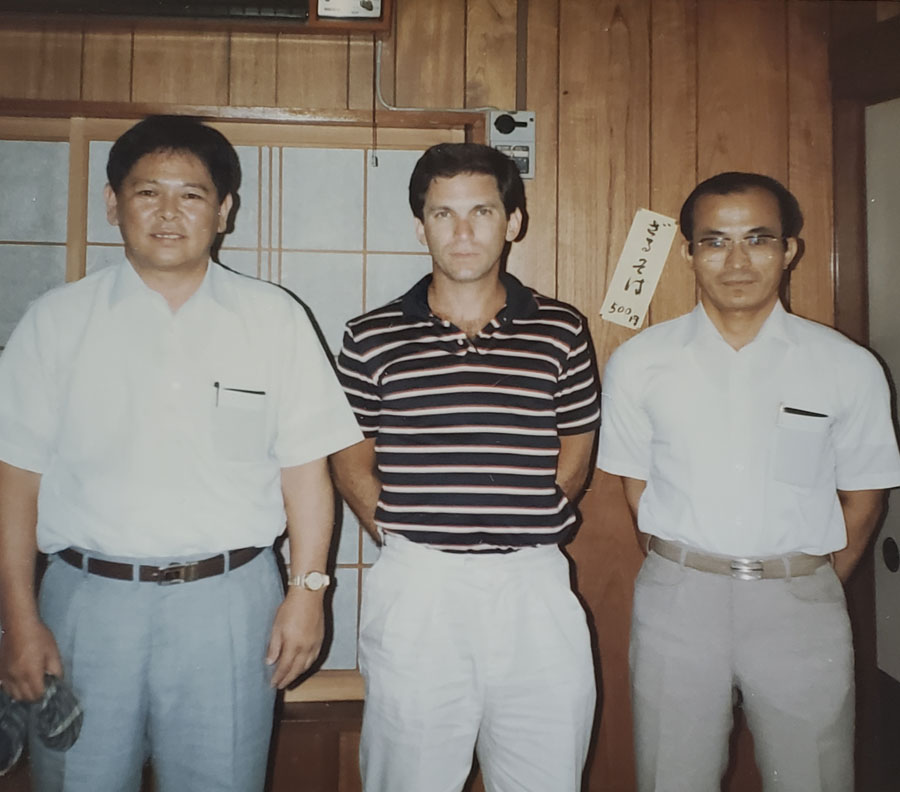
From left to right: Takamiyagi Shigeru, Robert Mark Kamen and Shinzato Katsuhiko
But most of my time was with Yagi sensei and his two sons, who are wonderful people. They treated me with courtesy and respect and pushed me hard in training. Yagi sensei gave me a deep understanding of Gōjū-ryū—his teacher was Miyagi Chōjun. He was incredibly open, and if I asked him a question, he would answer honestly. If he didn’t know, he would tell me that too. I learned a lot about both the philosophical and practical aspects of the system. He showed me things in kata that I had never learned from Tamano sensei and explained how they applied to both the practical and intellectual philosophy of Gōjū-ryū Karate.
You can spend your whole life practicing Gōjū-ryū and still never understand everything. But if you follow the basic precepts of the hard/soft style and apply them in kata, you can discover very interesting, even revolutionary insights. I’ve been studying this for many years by myself—every single day, repetition, repetition. One of the things Yagi sensei emphasized was to just keep doing kata. You don’t have to stand in one place and throw punches, and you don’t have to move up and down the floor—that’s all conditioning. Do kata. Do the koryū kata. If you have in your mind the guiding principles of the hard/soft Gōjū style and apply them, you will come up with interesting things. And I’m not focused on lineage or heritage—I’m focused on the practice and the principles themselves.
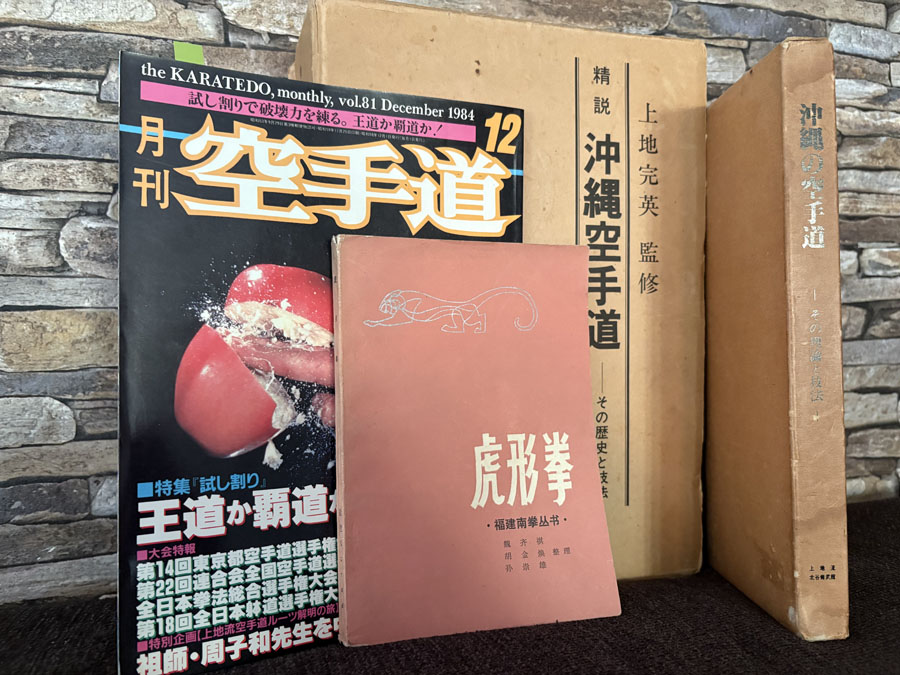
The book “Okinawa no Karate-dō – Sono Riron to Gihō” 沖縄の空手道 – その理論と技法 written by Takamiyagi Shigeru and published in 1984 represents a significant milestone in research on Uechi-ryū. Its particular importance lies in the fact that it appeared after the publication of “Seisetsu Okinawa Karate-dō – Sono Rekishi to Gihō” 精説沖縄空手道 – その歴史と技法 and after the Uechi-ryū Kyōkai’s 1984 expedition to Fuzhou, incorporating the new insights gained during that journey.After China gradually opened its doors to foreign visitors under Deng Xiaoping in the years following the Cultural Revolution, a delegation of Uechi-ryū practitioners traveled to Fuzhou for the first time in 1981 to investigate the historical origins of the style. The corresponding research conducted by Chinese scholars was completed in 1983. In the spring of 1984, a larger group, led by Uechi Kan’ei, made the journey to Fuzhou. Among the participants was Takamiyagi Shigeru, who carefully documented his impressions, observations, and newly gained insights in the aforementioned book, as noted by Robert Mark Kamen.
|
10.The ancestor of Mr. Miyagi is named Miyagi Shinpō. Is there any connection to Matayoshi Shinpō sensei?
RMK: Yes, that’s his first name, and I used it. I also used “Miyagi” as a name because he was the founder of my system of karate, and I wanted to honor him. As for Shinpō sensei, I was studying Kobudō with him, and he paid me a great compliment. He said, “You know, as a Kobudō student, you are very good at karate.”
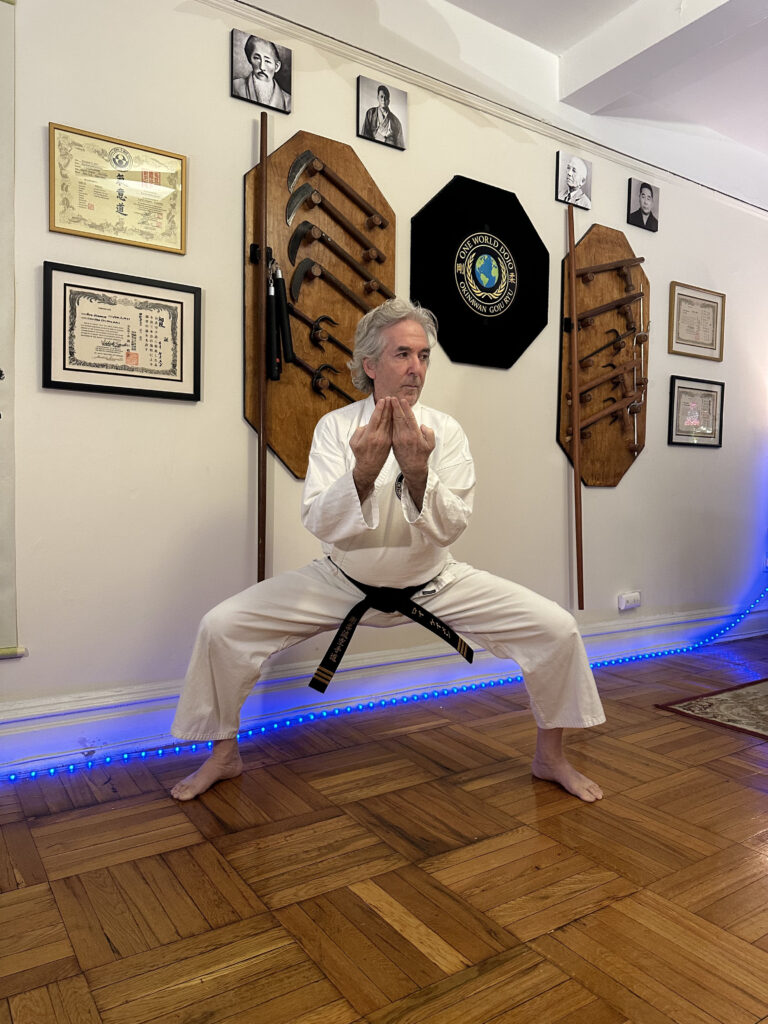
Roy Kamen practicing the Seiyunchin kata
11. In the third film, the kata Seiyunchin is presented as a special technique. What significance does this kata hold?
RMK: In real life, there is a lot of significance in it—but I just made that up. I wanted to use a kata that would be very cinematic. I had the great benefit of working with Mr. Miyagi’s stunt double, Fumio Demura sensei. He was amazing—so open and really respectful about the work I did. We exchanged techniques. His style was Shitō-ryū, which comes from Shōrin-ryū, but he also knew a lot about Okinawan Gōjū-ryū. We trained together—I have a bunch of pictures of us doing kata together.
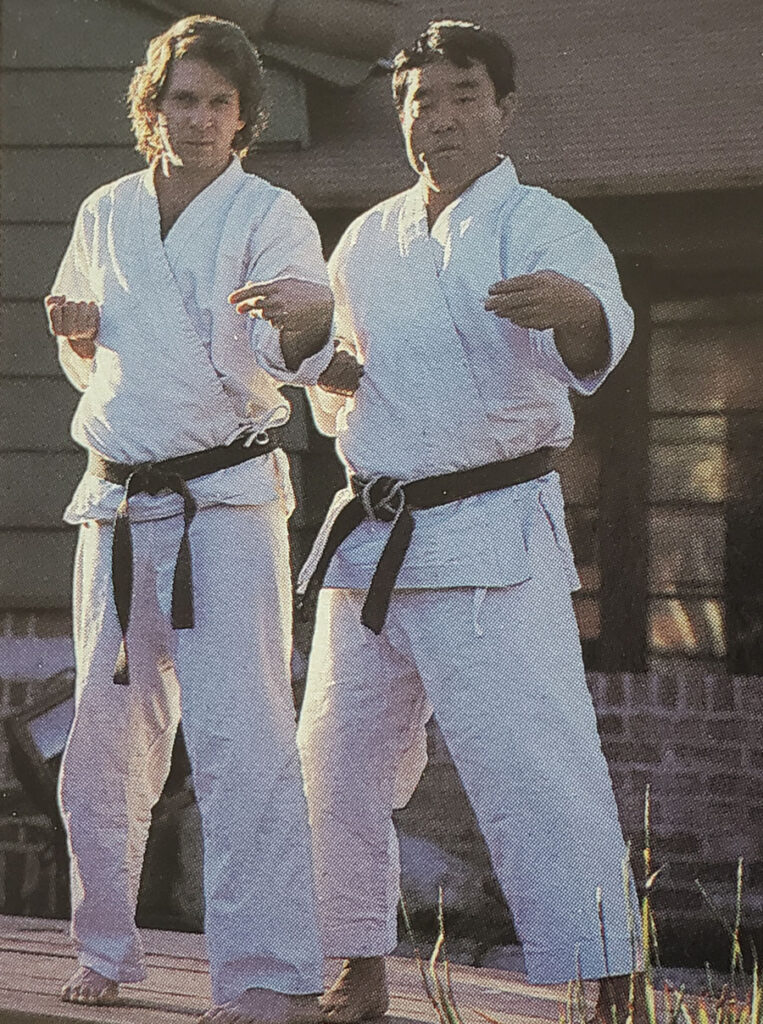
Robert Mark Kamen and Demura Fumio Tenshō
I told him I wanted to use this kata, and we tried to figure out how to train Ralph so he could perform it without looking silly. We exchanged techniques, and he understood the philosophical underpinnings of the kata—of all kata. He was wonderful. Some people say he was my inspiration for Mr. Miyagi, but I didn’t meet Demura sensei until four years after I created the character. Still, he was a true karateka—truly.
12. Apart from the Karate Kid films, another movie of great interest to me is Kiss of the Dragon with Jet Li. Could you tell us a bit about that project?
RMK: I met Jet Li while I was working with the great French filmmaker Luc Besson. Luc said, “We’re going to meet Jet Li,” and this was when Jet was at the height of his fame. To me, he represented everything a martial artist on film could be—he was just amazing. Luc said he wanted to present a film to him. Jet’s English wasn’t very good, and neither was Luc’s, so there was a bit of a language challenge. We got on a plane, five hours later we arrived, and we met Jet right off the plane. I had this idea about using acupuncture needles as weapons. I told Jet, and he laughed, saying, “That’s pretty silly, but on film it looks great.” It was just another thing I made up.
I spent a lot of time with Jet. I did three films with him, and I spent six weeks with him on the Tibetan Plateau, where he was seeking enlightenment. I just went to hang out—I wasn’t there for enlightenment myself.
It was fascinating. We were in the middle of nowhere, on the Tibetan Plateau in Qinghai Province, 14,000 feet up, in a monastery full of monks. There was nothing around except monks and a lot of yaks. Jet would disappear every day with the Rinpoche to learn and exchange knowledge, and I would hang around, exploring the plateau with yaks and nomadic Tibetans. Nobody spoke English, and I barely spoke Tibetan—but it was amazing. I had a great time.
Every morning I would wake up and do my Tai Chi Chuan forms. At 14,000 feet, it’s kind of hard to breathe and get acclimated, so I also did my Bagua walking forms and everything else. Jet would sit there, smoking a cigarette, watching me. One day I asked him, “Why don’t you teach me something?” He said, “I’m going to teach you everything you need to know.” And he showed me just six moves—and that was it. He never showed me anything else.
13. How would you describe your collaboration with Jet Li, and how impressed were you after seeing the final scene in the police dojo?
RMK: That’s all silly. Jet was a great stunt performer—he could do all that stuff—but he had stopped because he knew it all. This guy had a repertory of so much martial arts knowledge that he understood it on an incredibly high level. And he became a devoted practitioner of Tibetan Buddhism. So he didn’t want to talk about martial arts anymore.
Do you know what he liked to talk about? Buddhism. I wrote a film for him called A Monk in New York for Miramax. In it, a monk comes to New York right after 9/11 and heals the city—but he also does all this amazing Kung Fu, fights all these bad guys, and everything else. Jet read the script and said, “The monk doesn’t fight.”
At that point, the producers had paid me a lot of money to write a script for Jet—he was at the height of his fame. But he refused to fight in the film. He wanted to bring the message of Buddhism to the screen. I said, “Jet, they’re not going to pay to make a movie where the monk doesn’t fight.” And he wouldn’t budge. The project went into limbo.
Two years later, he called me. “Robert, how are you?” he said. “The monk fights.” He had seen his Rinpoche, his master, who told him that if he wanted to bring Buddhism to the world through peace, he needed to fight. The master literally hit him on the head and said: “You must fight. The violent people will come to see your movie. The peaceful and Buddhist people already know the message—you need the violent people to hear it. And in the fighting, you must bring the message.”
So he called me up and said, “The monk fights.” I re-wrote the script, and the monk fought—but by that point, nobody wanted to make the movie.
14.What are you working on next?
RMK: I have a book coming out from Simon & Schuster a year from this spring—this coming spring, actually. It’s essentially a memoir of my life. I’ve lived a life before life before life, and I was encouraged by my youngest daughter and my screenwriting friend to write down all my stories before, as my daughter said, I might develop dementia. So I wrote them down, and Simon & Schuster is publishing the book.
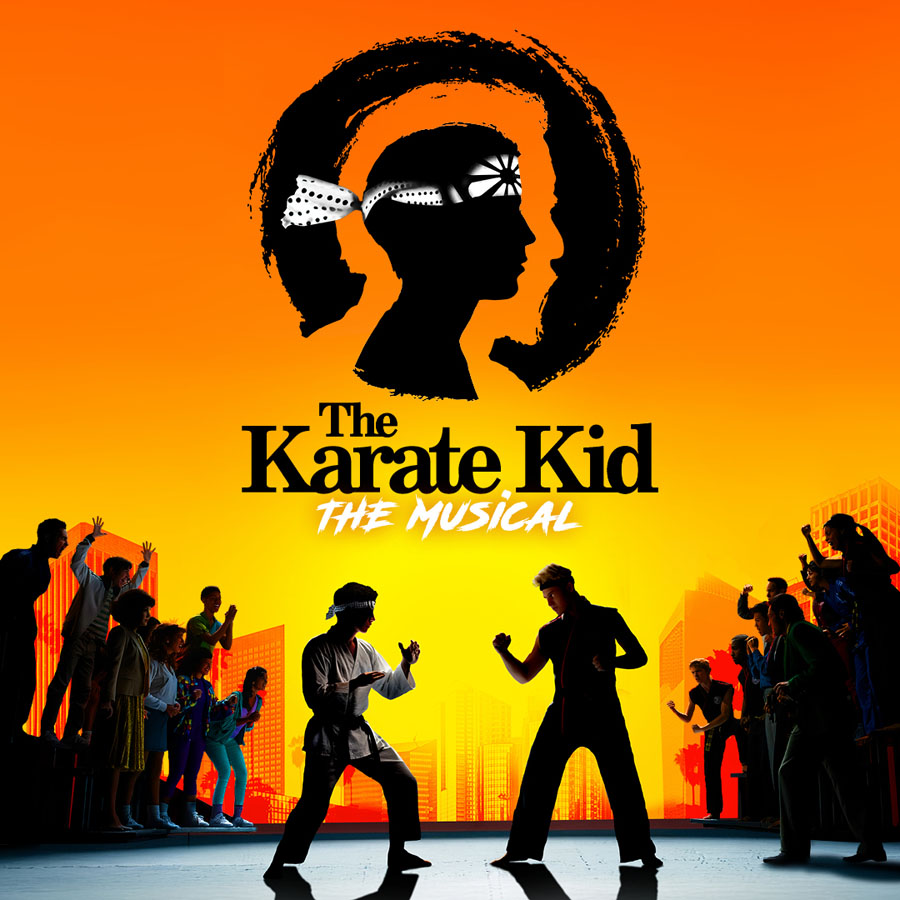
I’m also turning The Karate Kid into a Broadway musical, which will open in England next April—this coming April. It will run in England for several months before coming to Broadway.
And I’m currently adapting the film A Walk in the Clouds into a Broadway musical as well. That’s what I’m working on—and I’m still doing kata every morning.
Thank you very much
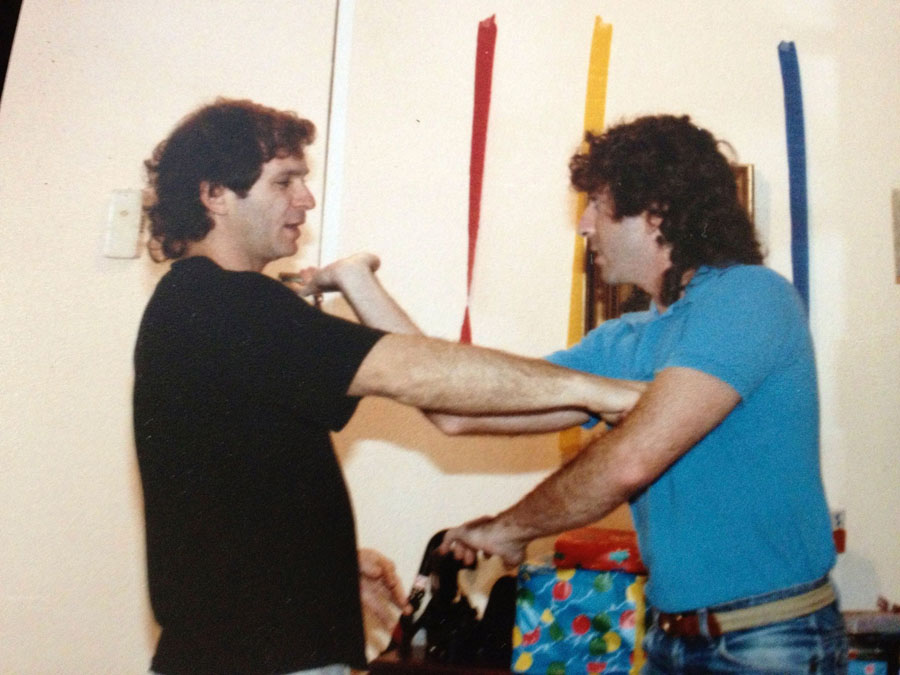
Roy and Robert Kamen
It should also be noted that not only does Robert continue to practice Karate daily, but his brother Roy likewise remains deeply rooted in the art. Roy began practicing Karate at the age of 13 under his brother Robert, initially training in Shotokan for two years under Miyazaki Toyotarō (1972–1974), before switching in 1974 to Gōjū-ryū—a style he has continued to practice to this day. Roy founded the free online training program One World Dojo during the COVID-19 pandemic, through which he guides Karate practitioners from around the world. With great dedication, he supports his students on their martial journey, offering valuable insights and providing guidance whenever needed.
Website of Roy Kamen: https://www.oneworlddojo.com/
In addition to his online instruction, Roy has also authored a book on Karate, which can be purchased via the following link – Karate: Beneath The Surface: Emotional Content of Kata
Website of Yannick Schultze: www.karate-kenkyu.com