

Ittō-ryū: Philosophy of the Sword (Part 2)
Author: Yoshimine Yasuo, Researcher on Kobudō
(Translated by Mark Hague. All rights reserved.)
The Lesson of Gunshin Mihai-no-Shiki Tachi and the Meaning of Kinshichō Ōken
The Unknown Essence of Ono-ha Ittō-ryū
Ittō-ryū, which was systematized by Ono Jirōemon Tadaaki, was transmitted through both the Tsugaru and Yamaga families and passed from both to Sasamori Junzō, the author of the book Secrets of Ittō-ryū (Ittō-ryū Gokui) starting from the Taishō era.
Sasamori Takemi took over the art from his father, Sasamori Junzō, and since then has been an instructor of Ittō-ryū in Tokyo’s Daizawa district. Below, we asked Sasamori Sōke about the history and technical principles of Ono-ha Ittō-ryū, which is considered the mainline of Ittō-ryū.
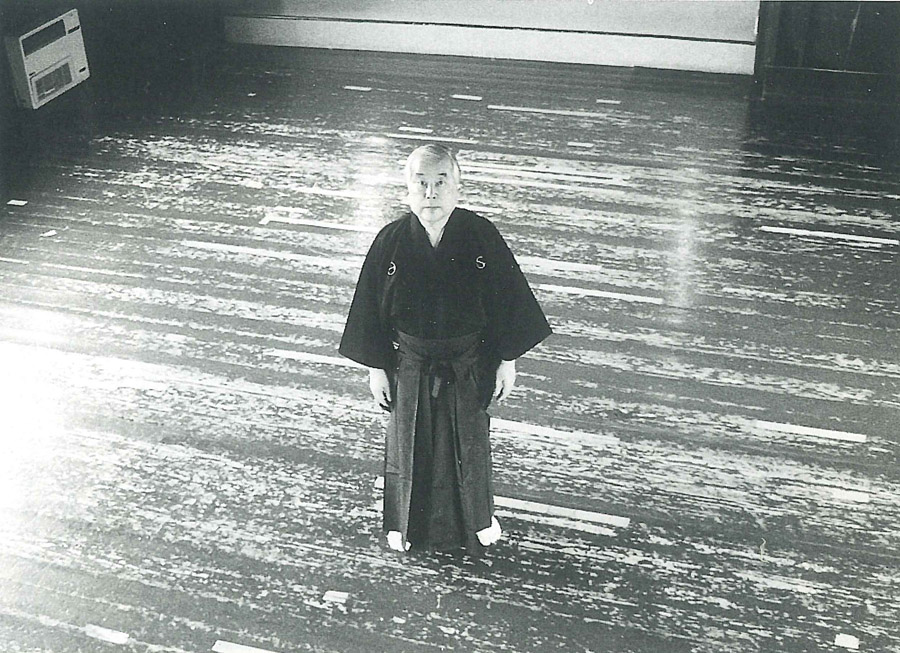
We spoke at Reigakudō, which was soon to be demolished for renovation work at the time.
Details of Ittō-ryū Within the House of Tsugaru
Hiden: In the system of Ono-ha Ittō-ryū currently being taught at the Reigakudō, the previous sōke, [Sasamori] Junzō, combined together what he received from four different lines of teachers, including the Yamaga and Tsugaru lines (refer to lineage chart on page 17), but were there any technical discrepancies among them?
Sasamori: It is true that my father had studied four different lines, but, in fact, what he taught was the teachings passed down from the Tsugaru line. Regarding the other lines, it would be more accurate to say that he compared and cross-referenced them with what he learned from the Tsugaru. Technically speaking, there were no major differences between them, but it seems that each of his teachers had different ways of thinking and habits of movement unique to them. In budo—unlike the tea ceremony and flower arranging—you never know from where or how an opponent will attack, so you can’t simply say, ‘This is the only way to do it.’ Therefore, individual quirks and personal creativity inevitably enter into the mix. Students pick up their teachers’ habits as they learn the techniques from them. As this builds up over several generations, even those in the same school will start to have different ideas and ways of practicing.
Hiden: Until about when was instruction in Ittō-ryū actually carried out by the Ono family?
Sasamori: There are various views on this, but, in fact, it seems that it stayed in the Ono family until the 5th Sōke (Ono Jirōemon Tadahisa). After that, the actual instruction of Ono-ha Ittō-ryū was taken on by the Nakanishi family, which came to be widely known as the Nakanishi faction [Nakanishi-ha], but the content they taught was none other than Ono-ha Ittō-ryū. In short, the Nakanishi faction started to prosper and grow, and while those from the Ono family maintained the title of sōke, the actual instruction became centered on the Nakanishi. At the time, the Nakanishi family maintained a relationship with the House of Tsugaru, and there was a robust technical exchange of information between them.
Hiden: How was it that Ittō-ryū came to be passed on by the Yamaga family?
Sasamori: The details are somewhat complicated, but starting from the beginning, the Yamaga family originally began with Yamaga Sokō. A man named Obata Kanbei, who was a teacher of military science, was a mentor to Ono Jirōemon Tadaaki. The Takeda school of military science he taught was adopted by the Tokugawa, and when Ono Jirōemon Tadaaki, on the recommendation of Itō Ittōsai, became the martial arts instructor to the second Shogun, Tokugawa Hidetata, Obata also became Tadaaki’s adviser. It was Yamaga Sokō who took over teaching Obata Kanbei’s school of military science, and it was due to this connection that Yamaga Sokō also mastered Ono-ha Ittō-ryū. The Lord of Tsugaru also received a license in Yamaga Sokō’s military science and, around the same time, also received the full transmission of Ittō-ryū from the Ono family. As the Lord of Tsugaru, he invited Yamaga Sokō to relocate to the Tsugaru Domain, but not wanting to serve in any government, Sokō sent his son there in his place. From that time onward, the House of Yamaga, generation after generation, served as karō—hereditary elders—to the Tsugaru fiefdom. They held licenses in Ono-ha Ittō-ryū, of course, but also in military science, castle construction, and other disciplines. This is how the mainline of Ono-ha Ittō-ryū came to be transmitted within the Yamaga and Tsugaru families separate and distinct from the Ono family, but the technical content of the school’s curriculum was taught by the Yamaga and Nakanishi families.
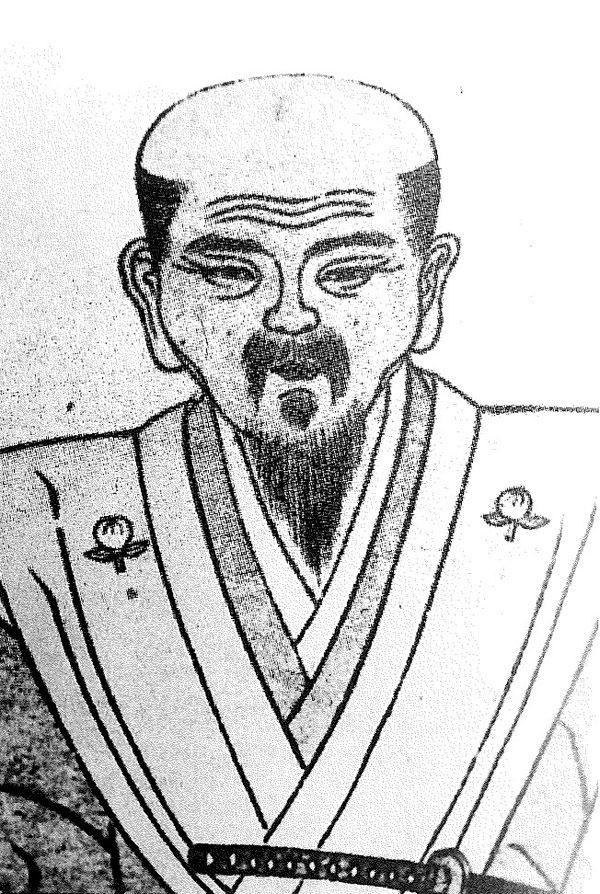
Yamaga Sokō
Not One Single Thing Was Changed Within the House of Tsugaru
Hiden: Ono-ha Ittō-ryū spread far and wide until the end of the Edo period, but I think that a large part of it was made up of competitive practice with the bamboo sword, especially near the end of the Bakumatsu period.
Sasmori: Yes, that’s true. When they first practiced Ittō-ryū, they used swords with sharpened edges, but since this was dangerous, they started to use the habiki [a sword with a blunted edge]. And then they started to use both the habiki and wooden practice swords. And then, to supplement this practice, they used a bamboo sword made from sixteen staves of bamboo and covered in cloth, but this later evolved into the prototype of the four-stave bamboo sword [modern-day shinai]. In other words, from the outset, they used wooden swords and habiki when they practiced kata, and the bamboo sword as a way to put to the test what they had learned in kata practice. The four-stave shinai started to become common, particularly within the Nakanishi faction; however, in a letter addressed to the Yamaga, there is a passage that says that sparring practice with shinai should be done only after students can do the kata properly. These kinds of discussion were already taking place at that time.
Hiden: One effect of that, I think, is that a vital part of the practice became competition with bamboo swords. Meanwhile, it’s a miracle that, in that era, the structure of the art was passed on completely intact.
Sasamori: This can be said of many things, but because Hirosaki (in Aomori prefecture) is at the northern tip of the main island of Honshu, it was, so to speak, the ‘end of the line’ for the culture of that era. In other words, the culture that made it up to there had nowhere else to go, so it simply stopped there and stagnated. This wasn’t limited to budo; it was true of all of the cultural arts. For example, even the original forms of such cultural practices as the shamisen and koto remained unchanged in Tsugaru, but you can see how they evolved elsewhere.
Hiden: Now that you mention it, there wasn’t just Ittō-ryū in Tsugaru, there were, in fact, several other styles of martial arts there, too?
Sasamori: For example, there was Chokugen-ryū O-naginata and the Shin Musō Hayashizaki-ryū schools that I do, as well as the Hozoin-ryū sōjutsu, Bokuden-ryū kenjutsu, Shibukawa-ryū jutte-jutsu, Hongi Kokki-ryū jujitsu and others. Due to this situation, it is believed that elements of Ittō-ryū that the Ono family neglected to pass on remained preserved there.
Hiden: In the transmission documents of Ono-ha Ittō-ryū that can be viewed today, all you can see are techniques related to the Goten and Hoshatō katas, so should we consider the other techniques not related to them as being added later?
Sasamori: It was more like that transmission was preserved within the Tsugaru family. If you look at the lineage chart of the Ono family, you can see that there is a period starting from the fourth generation onward where there is a complete gap in the transmission. So, even though it survived in the Tsugaru family during that time, it’s quite possible that the tradition had died out in the Ono family by then.
Hiden: I also suspect that in the early days of Ittō-ryū, its content was simpler and easier to understand and not so bewilderingly complex. Various refinements were added over time until it evolved into the form we see today, but I believe one of the drivers of that evolution was the need for a methodology to effectively pass on the techniques. What are your views on this?
Sasamori: Looking at how the history of Ittō-ryū evolved, the Goten kata is something that Itō Ittōsai learned from Kanemaki Jisai. And it is thought that after Itō Ittōsai Kagehisa and Ono Jirōemon Tadaaki’s research and innovations were added, the basic philosophy and overall structure of Ono-ha Ittō-ryū was finalized by the time of the 3rd Sōke, Ono Jirōemon Tadao. During actual instruction, however, the important points were not written down in the transmission documents—they were conveyed orally. Those who learned them gathered the lessons later and wrote them down in the form of Written Records of Oral Traditions (Kuden Kikigaki). Within these notes are explanations of how to practice the basic kata as well as the different variations related to them. For instance, the Juniten Makikaeshi is a comprehensive interpretation of Goten. Goten itself has different versions, like Shin-no-Goten and Shin-Shin-no-Goten but, in reality, these were originally passed down as oral traditions related to Goten. So, when these are converted into physical form, they become the Juniten Makikaeshi, Hakiriai, and Tachiai Battō kata. Therefore, while they were organized into cohesive, formalized kata only later, substantively, they were by no means a later addition.
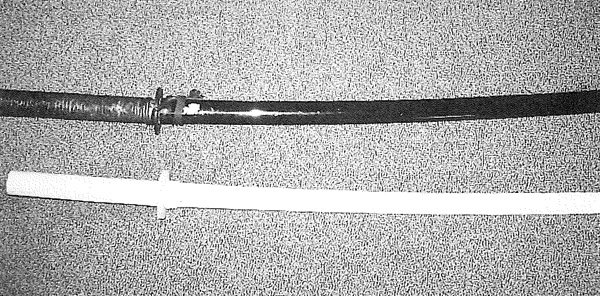
A habiki (blunted steel sword, top) and a wooden sword used in Ono-ha Ittō-ryū. Note the tsuka (hilt) of the habiki, which is wrapped in sendan-maki style.
Hiden: On that subject, the Tachiai Battō kata has parts in common with the fifty basic techniques of the Ōdachi kata, doesn’t it?
Sasamori: The length of the sword we use in Tachiai Battō is 2 shaku, 8 sun, but this was the length of the sword even as far back as the beginning of the Edo period. In the kata of Habiki, Kuka-no-Tachi, and Sanjū, we use a long sword too, but these are also relics from the past. The 2 shaku, 2 sun, 5 bu sword came about because you couldn’t carry a long sword inside the grounds of a castle, so this became the standard length instead.
Hiden: The tsuka of the katana is also normally wrapped in the sendanmaki (千段巻) style, which is different from others, isn’t it?
Sasamori: It is an extremely practical accoutrement. You would understand if you were to actually practice striking with a katana with a tsuka wrapped in the usual way because it would feel loose. If you were to train using the vigorous cutting techniques like we do in Ittō-ryū’s kumitachi, you would find the sendanmaki style of tsuka to be the most effective.
Hiden: Japan became more peaceful around the middle of the Edo period and it became the norm to wear shorter swords, but that kind of 2 shaku, 8 sun katana with the sendanmaki style of tsuka came from an earlier era when swords existed purely as weapons.
Sasamori: That’s true. That katana remained unchanged in Tsugaru.
Hiden: Currently, is Ono-ha Ittō-ryū still done in Hirosaki?
Sasamori: I don’t have many details, but I hear that, though few in numbers, there are some students of my father who get together and practice.
Techniques Included in Hoshatō
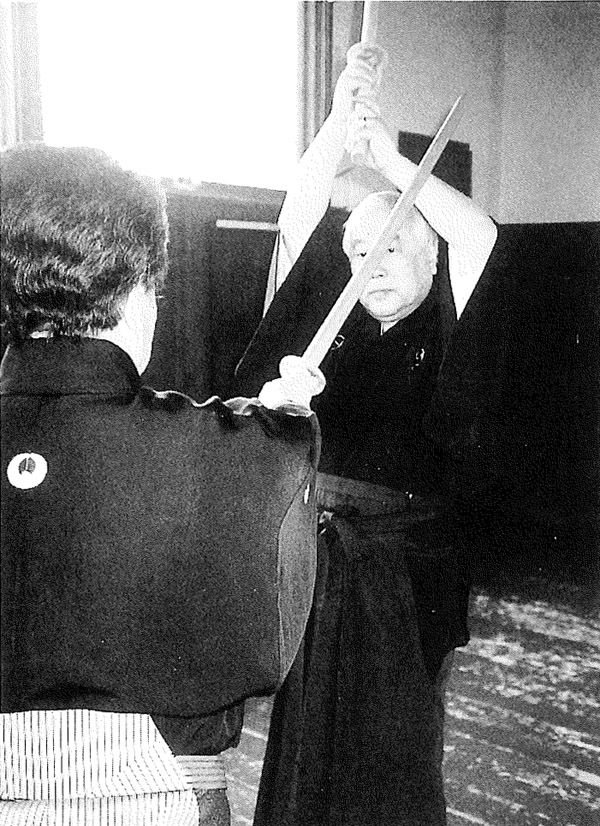
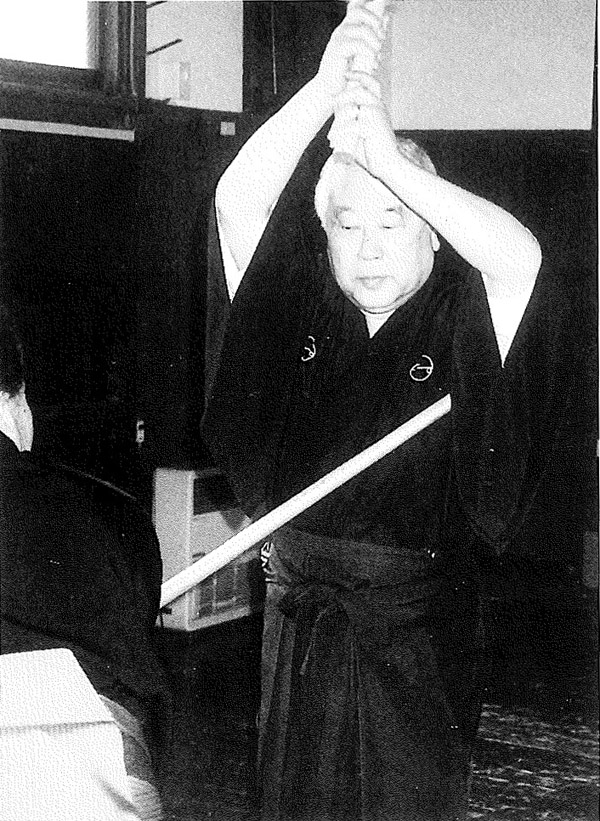
This is a technique where Shitachi pushes into Uchitachi’s (right) kote to cut and off-balance him, and then slashes his midsection down the length of his blade as he escapes out to the side. It is the only technique in Ittō-ryū only where they cut the trunk of the body.
The Influence of the Five Phases, the Lotus Sutra, and Zen on Ittō-ryū
Hiden: The kata of Goten is composed of techniques that model the Five Phases, but were these concepts there from the very beginning?
Sasamori: Yes, they were. The Goten kata is comprised of five kata that encompass the meaning of each of the five phases of wood, fire, earth, metal, and water, and you will start to understand this when you get actual instruction. For example, the first move of Myōken belongs to the category of wood, and when we teach students, we tell them to do it with the feeling of a tree that is starting to grow so they can get the gist of this movement. This must have been the wisdom of the masters of long ago. Back then, it was not permissible to write down the details of what they learned, so they probably came up with this as a way to convey the essential principles of the moves. And, because the martial arts were originally a technology for killing others, it is conceivable that they became oriented toward a higher spiritual dimension. In other words, they moved from the issue of pondering why to kill an opponent toward the notion that the true purpose of the martial arts was to give life, so philosophical elements became a necessity.
Hiden: Within the Goten kata, there is the move called Kinshichō Ōken, but this Kinshichō seems to be another name for the Garuda that appears in the Lotus Sutra. Doesn’t giving it that name connote a connection to Buddhism?
Sasamori: Early in their history, the House of Ono was connected to the Nichiren sect of Buddhism, so that may have played a small part. There’s no doubt that Ittō-ryū was influenced by Chinese philosophy, such as the Five Phases. But in the move of Kinshichō Ōken, the Kinshichō is considered to be a symbol of righteousness and refers to good destroying evil in the world. This is tied to the lesson that you should always use the sword for the purpose of pursuing justice.
Hiden: The very last kata one learns, Gunshin Mihai-no-Shiki Tachi, was also influenced by Chinese philosophy, wasn’t it?
Sasamori: That kata is a blend of Chinese philosophy and Japanese Shinto. The moves of the Gunshin Mihai-no-Shiki Tachi kata are taken from the Big Dipper, which reflects a cosmological worldview reached by military strategists of old. I think this kata was also influenced by the military theories of the Yamaga and Takeda schools of military science.
Hiden: It’s remarkable that something so complete was finalized in the early years of the Edo period. To put it another way, this speaks volumes about how the culture of the era in which Ittō-ryū emerged was under the influence of the Five Phases, the Lotus Sutra, and Shinto.
Sasamori: Aside from those, I would say there was also the influence of Zen. The martial artist of that time sought a higher-level spiritual dimension. For example, Hoshatō was devised by Itō Ittōsai based on his experience of being ambushed one night, and to this he added the spiritual notion that one should sweep away their own wickedness.
The First Move of Goten: Myōken
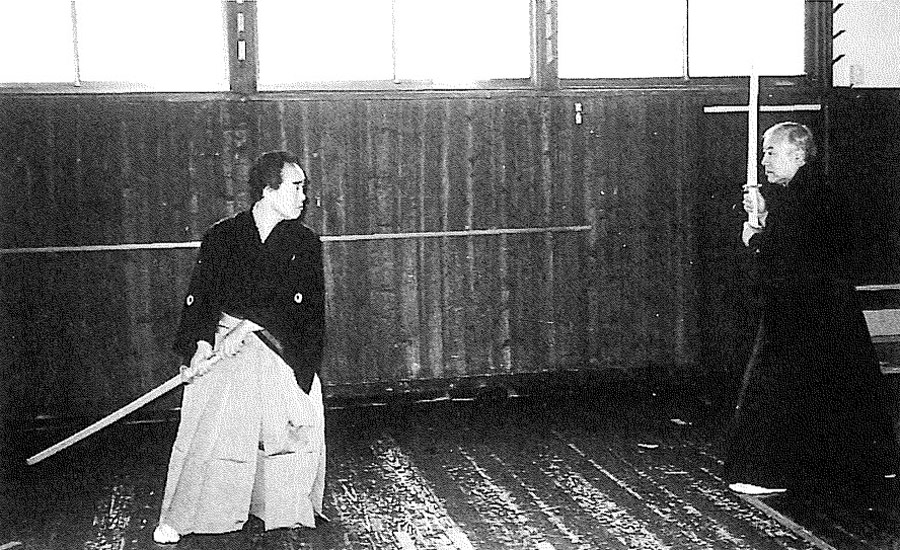
1. From seigan, Uchitachi (right) raises his sword and cuts past Shitachi’s shoulder toward his head. Shitachi starts in wakigamae and then shifts to the onken kamae.
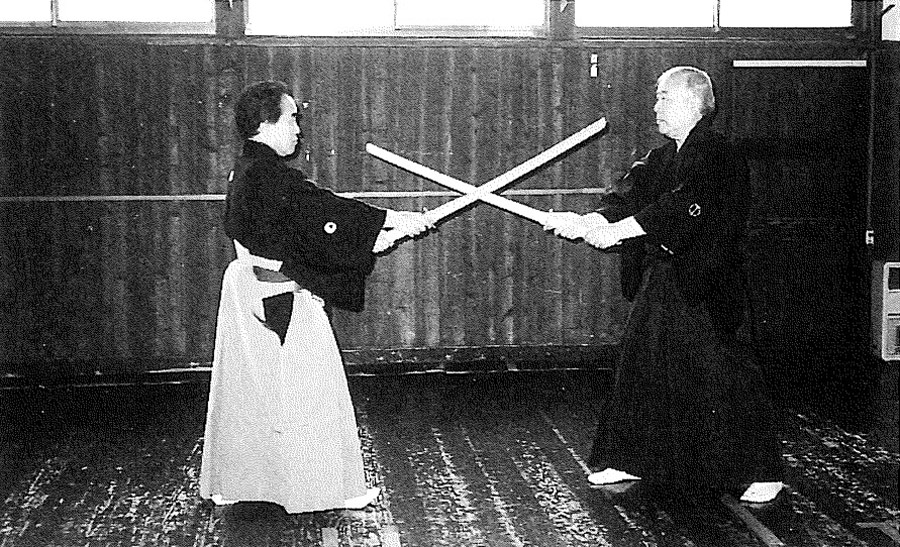
2. Just as Uchitachi steps in to strike, Shitatchi steps forward and shifts his sword from right to left to deflect Uchitachi’s sword.
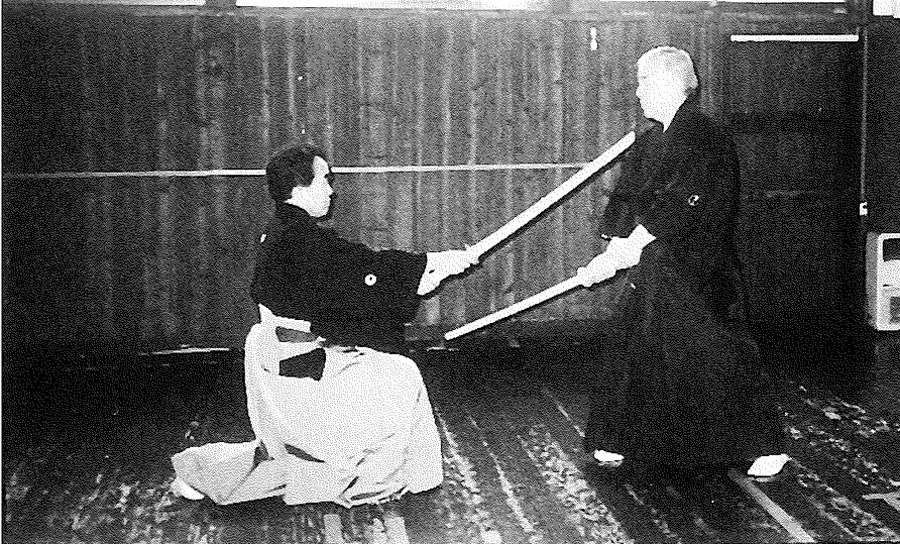
3. Shitachi kneels down
Meeting the Needs of the Times While Preserving the Old Kata
Hiden: This is something that is surprisingly misunderstood regarding the old kenjutsu schools, but in fact, while doing the kata, they are actually striking each other. In other words, they move to get into range to strike, and all kenjutsu schools developed various, unique tactics to make that possible. But in the case of Ittō-ryū, the use of such protective gear as the onigote makes it possible to deliver actual strikes. I believe it noteworthy that this very ability to practice hitting is what allowed the high technical level of the art to be maintained to the present day.
Sasamori: It is true that even today there are areas where old-school kenjutsu and modern kendo do not necessarily see eye-to-eye. However, today’s kendo emerged from these old schools and, in the final analysis, there should be no difference between them at all. If you do the old-school martial arts correctly, it can also enliven today’s kendo, and if you take a hard look at modern kendo, it’s impossible to ignore these old schools. There are many people in Daitō-ryū as well who learn Ittō-ryū in order to master the body mechanics that are inherent in kenjutsu. But, the reason Ono-ha Ittō-ryū, those practitioners included, survives to this day and continues to be practiced isn’t just because it preserved the old kata, but also because it has adapted to the demands of the times, from the past to the present. In other words, it provides something tangible that meets the needs of society. I think this is critically important.
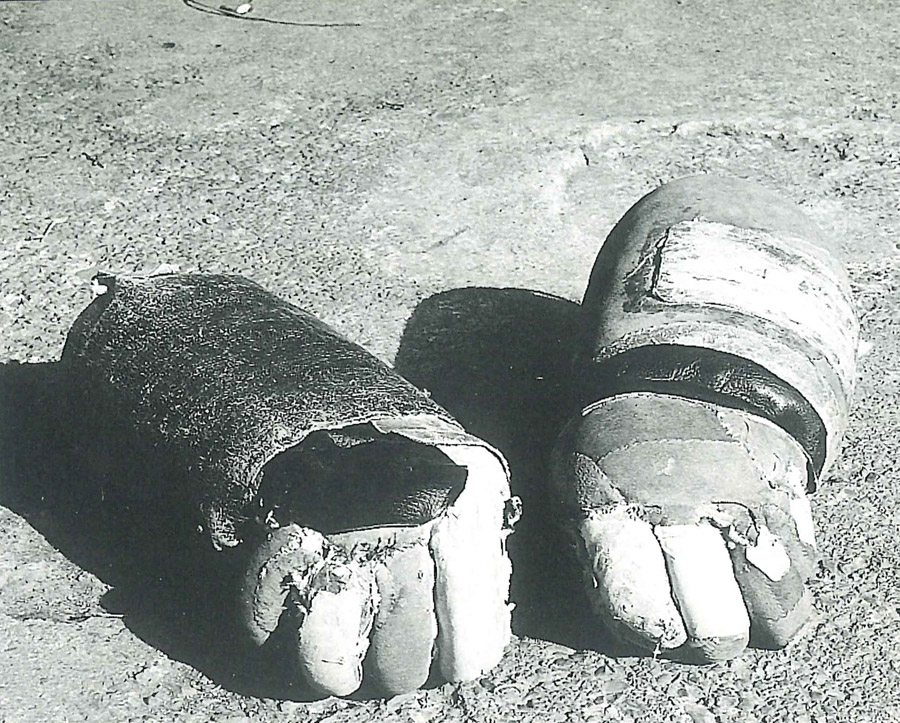
Oni-gote (reinforced training kote) from the Edo period. Traces of repair offer a glimpse into the rigors of training in those days. (Collection of the Sasamori Sōke)
Hiden: In other words, no matter what angle you approach this from you, will definitely get something out of it. I think that point should certainly be reconsidered.
Thank you very much for your time today.
Lineage Chart for Ittō-ryū