

“The Sword and the Chrysanthemum” by Paul Martin Part11 : Sword Maintenance
Text by Paul Martin

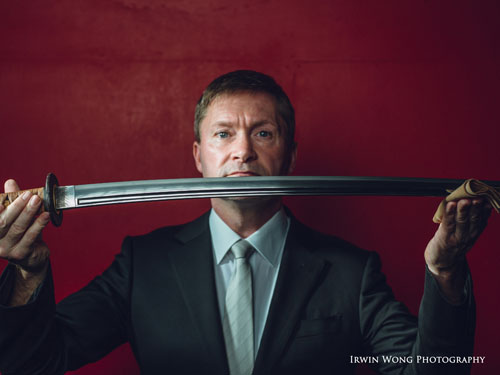
Paul Martin and his Kamon(Photo/Steve Morin)
Each installment of this series is available for a limited time only—don’t miss it!
(Publication period: September 14, 2026 – October 13, 2026)
Tools Required for Japanese Sword Maintenance
When handling and maintaining Japanese swords it is imperative that certain rules and guidelines are followed not only for the preservation of the sword, but also for the safety of oneself. It is also very important that you keep your cleaning materials clean and separate from each other. Traditionally, hosho-gami paper has been used, but these days, camera lens cloths are much more user friendly as they are washable. Soft tissue paper is also very convenient as a single use material, but they must be soft and not contain any additives such as aloe vera.
First you will need to prepare an environment that is safe and conducive for maintaining and viewing Japanese swords. If possible, this is best done whilst sitting on the floor in an area that has been covered in a soft material, like a felt blanket for instance.
Next you must prepare the tools necessary for the task at hand. For this you will need Some soft tissues, a powdered application called uchiko which used to assist the removal of old oil and moisture from the blade, sword approved oil commonly referred to as choji-oil, a small piece of brushed cotton called neru (or a clean folded tissue) to be used to apply the new oil and a small tool called a mekugi-nuki to assist in removing the retaining peg.

Removing the Sword from the Scabbard
Before beginning maintenance on your sword, it is essential that you remove any pieces of jewellery or watches that you are wearing as it is possible that these may come into contact with and scratch the blade.
As an act of appreciation make a solitary bow to the blade, not only to the blade itself, but in honor of all the previous owners for caring and passing down the blade through history its present condition so that we can appreciate it today.

Next remove the shirasaya (or koshirae) partially from the bag, enough to be able to draw the blade from the scabbard. However, before drawing the blade secure the bag to the scabbard using its string so that there are no loose pieces of material on which to snag on.
Next, remove the mekugi (bamboo retaining peg) from the handle before drawing the blade out of the scabbard. This can be done by using the mekugi-nuki (these often come in the form of a small brass hammer). Make sure that you put the mekugi in a safe place.

Next, hold the hilt of the sword in your right hand and the scabbard in your left, put the thumb of your right hand onto the base of your left hand and gently push to break the (air)seal and ease the first 3 cm of the sword out of the scabbard. Important Note* ensure that your thumb is NOT over the cutting edge, but to the left-hand side of it.

Do not do draw the sword out on the side as it will cause scratches in the blade.
Or draw the sword out upside-down with the cutting-edge below as it is dangerous, and will causes scratches on and close to the cutting edge, as well as make cuts in to the mouth of the scabbard, therefore breaking the air-tight seal.
Paying attention to the curvature of the blade, draw the sword out of the scabbard by slowly pulling with your right hand and extending your left. While doing this ensure the mune (spine) of the blade stays in the base groove of the scabbard.
When you get to the tip of the blade, turn the scabbard downwards and raise the blade straight up. And then put the scabbard down out of the way.

Removing the Hilt
Next, you need to remove the hilt. To do this, take the hilt in your left hand and hold it towards the base. Tilt the blade to about a 45-degree angle over your left shoulder. Make a fist with your right hand and gently thump the base of your left hand and the blade should pop up out of the hilt slightly.

Point of note* If you hold the blade too vertically, it will drop straight back into the hilt again.
Depending on how tightly the blade is in the hilt, you may have to repeat this procedure several times, or engage a small mallet and wedge like tool to free the blade from the hilt. The first order when using any tools is to ensure that you do not damage the blade. It may be necessary to put a soft cloth between the wedge and the blade before attempting this procedure. Next, sharply tap the wedge with the mallet once or twice. This should resolve the problem.
Then grip the exposed part of the nakago and the habaki to remove the blade from the tsuka and place the tsuka with the scabbard.
Next, remove the habaki by holding the in your left hand nakago close to the bottom, and gripping the habaki on the broad sides with your thumb and forefinger.

Keep your hands and fingers below the top of the habaki at all times when performing this procedure.
If the habaki will not move, use the wooden mallet to tap the mune of the nakago close to the habaki, or a slight tap directly on to the mune of the habaki.
Point of Note* Not recommended for habaki covered in gold or silver foil.
Replacing the Sword Oil
Next, using plain soft tissue, or traditional Japanese hosho-gami paper, remove the old oil. First fold the tissue over the blade from the mune about 8 cm from the base of the blade. Hold it gently with your thumb and forefinger (see photo). By using this technique you are completely aware of the position of all of your fingers. Gently squeeze, but do not apply any pressure. First wipe towards the nakago, so as not to take any impurities from the nakago onto the blade, then wipe upwards towards the tip.

Point of Note* When you get to the point section to do wipe backwards and forwards. For your own safety you must only wipe in one direction away from the tip of the blade. Or you could impale your hand onto the tip of the blade.
Once the majority of the old oil has been removed it is time to apply the uchiko. First, tap the uchiko ball on the back of your hand to remove any larger particles and get a smooth flow of powder. Then while holding the blade at a slight angle, gently tap the uchiko ball along the length of the blade in the shinogi-ji, taking care as to not strike the ji directly. This reduces the chances of causing hike, or minute scratches in the blade. By striking on the shinogi-ji, the finer particles flow across the surface of the ji. Also apply a small amount to the mune. It is important not to strike too hard as this can force out larger particles and also cause hike. Point of Note* Do not go too close to the tip, or the cutting edge, as this may make small holes in the silk ball of your uchiko applicator and allow larger particles of uchiko to come out.
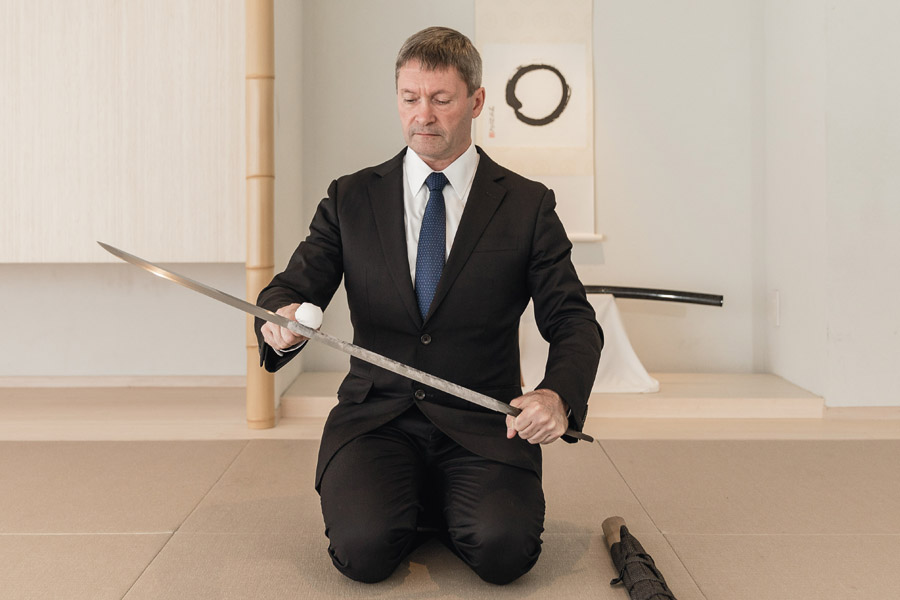

Using a fresh tissue or a separate piece of hosho-gami, remove the uchiko from the blade in the same manner used before when removing the oil. This process may need to be repeated a couple of times to ensure that all of the oil is removed. Also, take care to wipe the mune.


When viewing or appreciation is over and the sword is ready to be returned to its scabbard it is advisable to repeat the previous steps once again. Once this has been completed a protective coat of oil must be re-applied. It is advisable to have piece of brushed cotton called neru or a clean folded piece of tissue and stored in a sealed plastic container at all times for convenience. Apply a small amount of oil to the cloth and once again working from the mune, apply the oil to the blade in the same manner that you removed the old oil. There are various techniques in which to do this, but avoiding working from the cutting edge is the safest method.

Once the oil has been applied, it may require one last wipe with a fresh sheet of tissue to remove excess oil. If you return the sword to the scabbard with too much oil, you may shorten the life of your scabbard as it will absorb the excess oil. Also, excess oil inside the scabbard may congeal and become sticky, allowing it to retain any impurities that may attach to it causing other problems such as rusting the blade.

Point of Note! Be sure to remove any oil from your hand before handling the hilt or scabbard as it will stain.
Returning the Sword to the Scabbard
Next, replace the habaki, and return the blade into the hilt. Holding the blade upright with the hilt in your left hand, gently, but firmly strike the base with your right to ensure the nakago has fit snugly back into the hilt. If done successfully, it usually makes a satisfying ‘click’. Check the mekugi-ana has lined up with the hole in the hilt, and replace the mekugi.


Place the spine of the point section onto the inner base of the scabbard. Raise the scabbard until the point section is safely in the groove and slowly slide the blade into the scabbard avoiding touching the inner sides of the scabbard with the sides of the blade. Ensure the habaki fits snugly into the mouth of the scabbard, and return the sword to its bag.
Following these steps is very important and should be taken seriously by any true sword enthusiast in order to pass on these wonderful treasures to future generations in the same (or better) condition in which we received them, whilst paying our respects to the generations of people that made, cared for and maintained these beautiful, historical works of art for us to enjoy today.