

【Exploring the spirit of the Ryukyu】Special edition (HIDEN June 2026) 「17th All Okinawa Karate & Kobudō Championships」
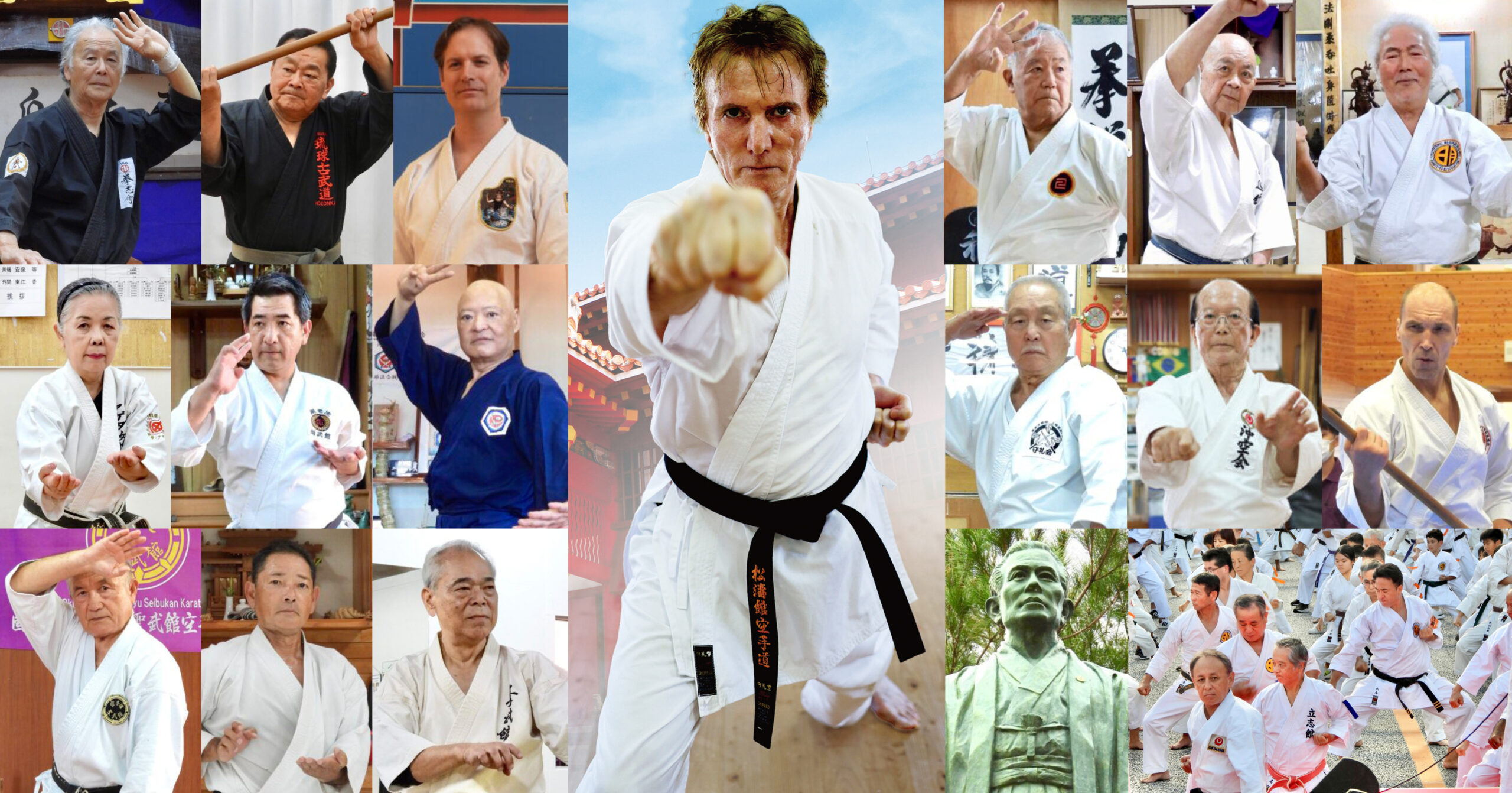
Interview/Writer: Daniel Mardon
Photographer/Translator: Yuko Takahashi
Daniel Mardon, “The Karateka-Therapist
Physiotherapist and longtime martial-arts practitioner, Daniel Sensei lives in Okinawa. One of his passions is to find unique Dojo with strong personalities that will leave an imprint forever. With his wife Yuko Takahashi, who is a great Karate historian, they let us discover many hidden aspects of Okinawa Karate…
This special series of articles proposes to explore the original spirit of Karate.
Rigour and the New Generation
These championships took place on Sunday, January 11, 2026, at the Karate Kaikan in Tomigusuku, Okinawa. The organizer was the Okinawa Karate Kobudo Renmei federation, which was founded in 1982.
The event drew a primarily local crowd, including a majority of very young participants and their families. A few adults, including a small Chinese delegation from Shanghai*, delivered a strong performance, particularly in Kobudō.
There were over 600 participants, including some twenty official figures (with guests) from the world of Karate, plus a team of federal referees/judges and their assistants.
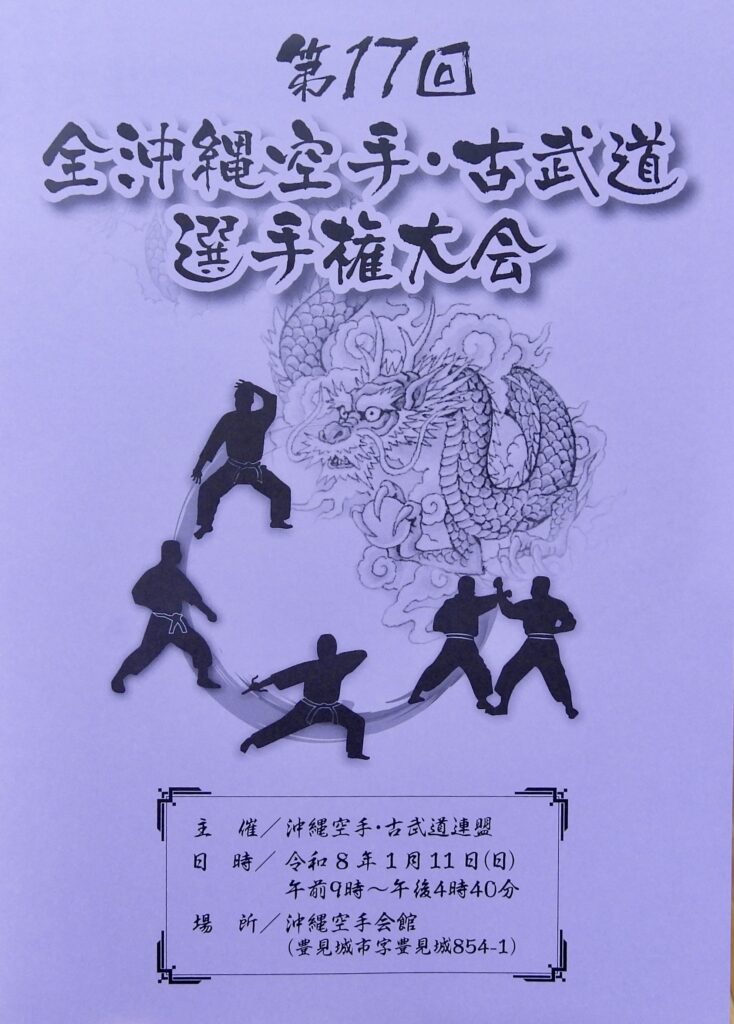
Competition program
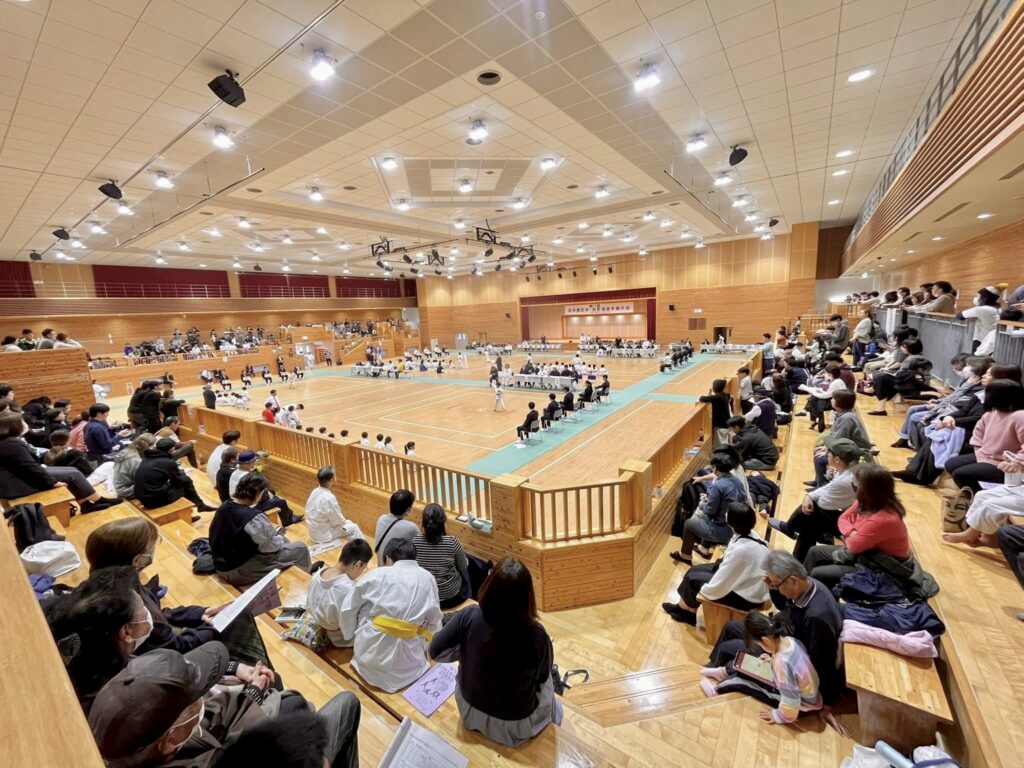
Overview of the 1,278 m² main dojo
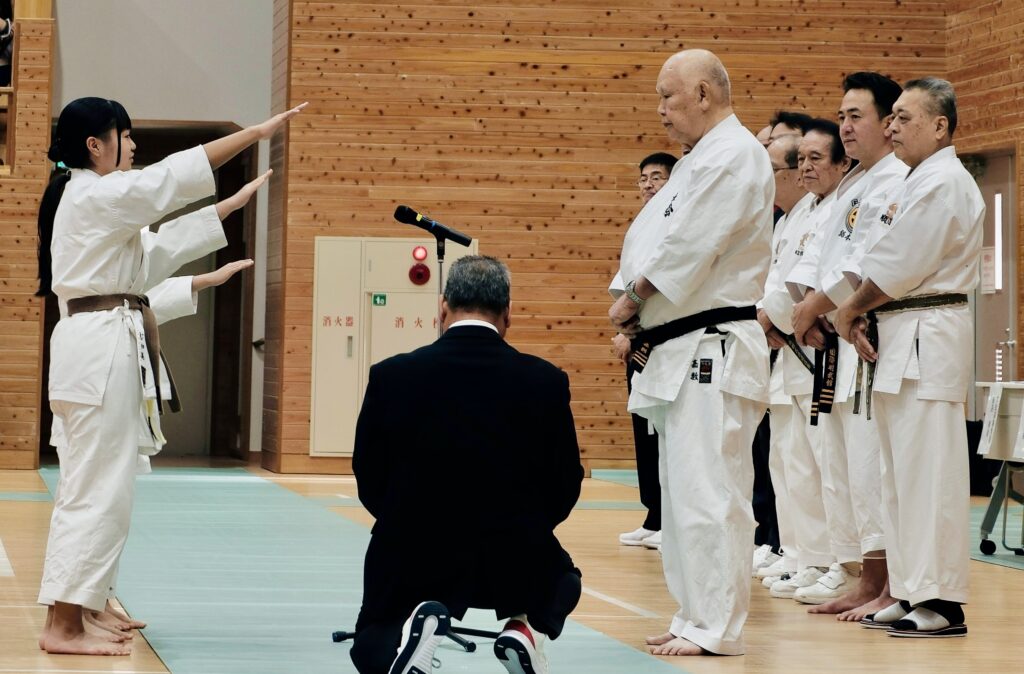
Start of the competition: 3 elementary school students take the oath
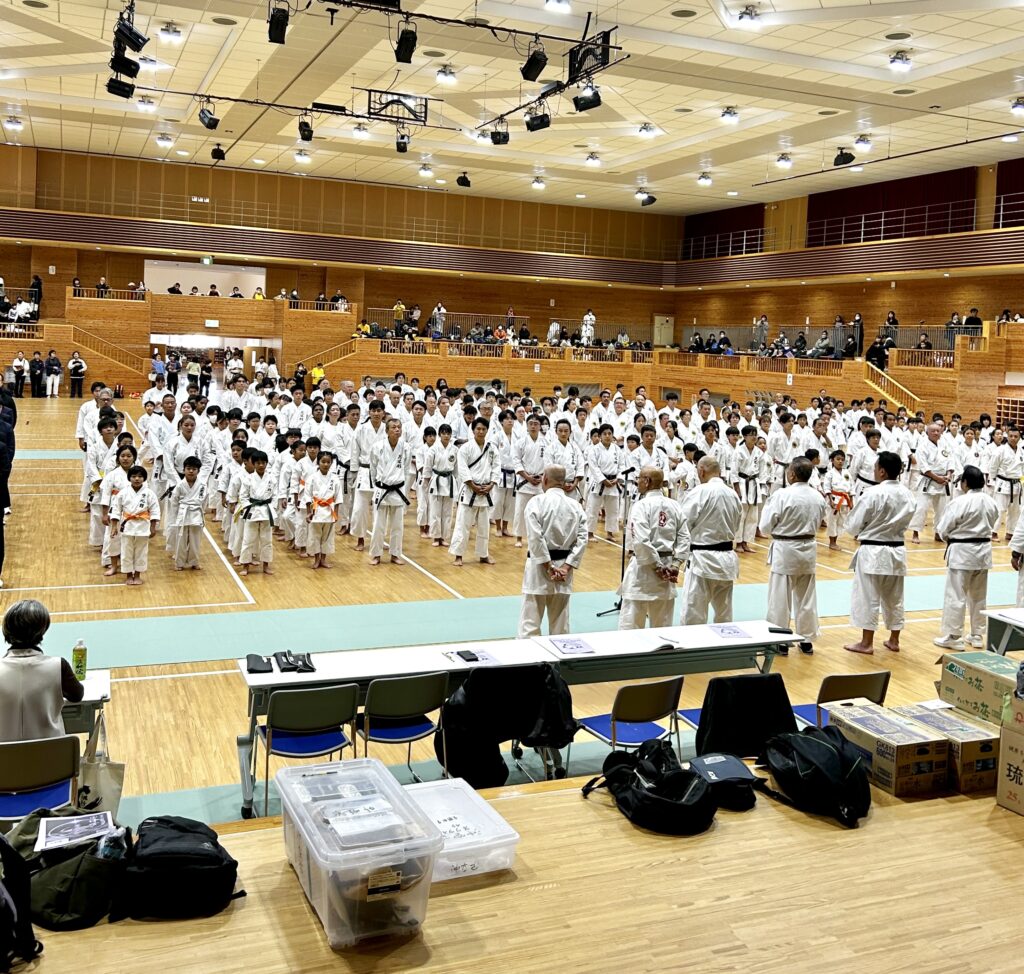
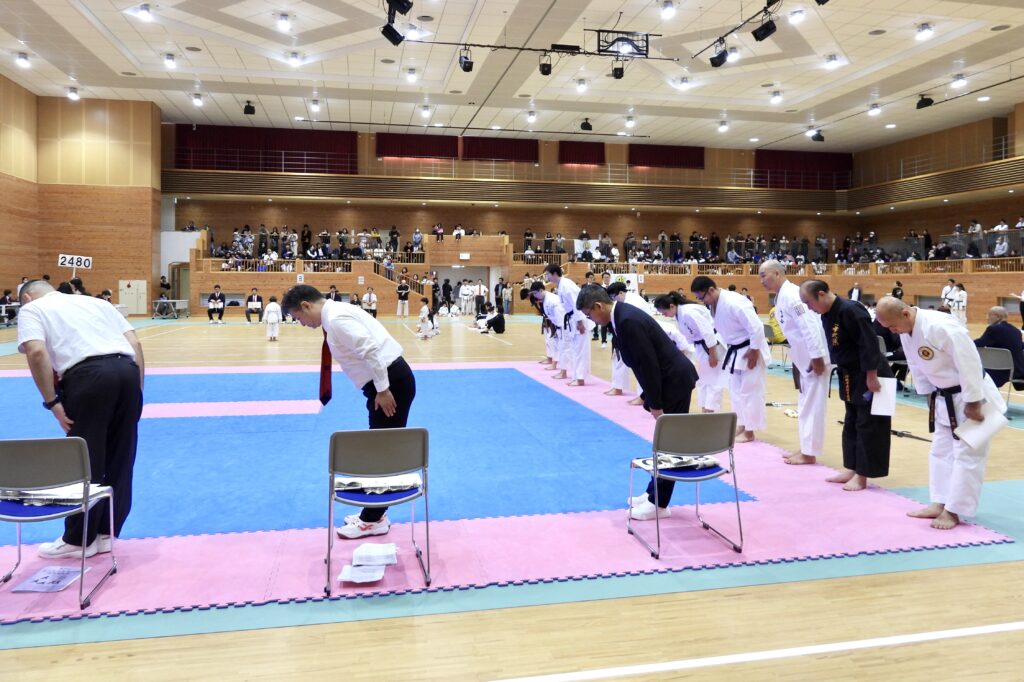
Opening ceremony
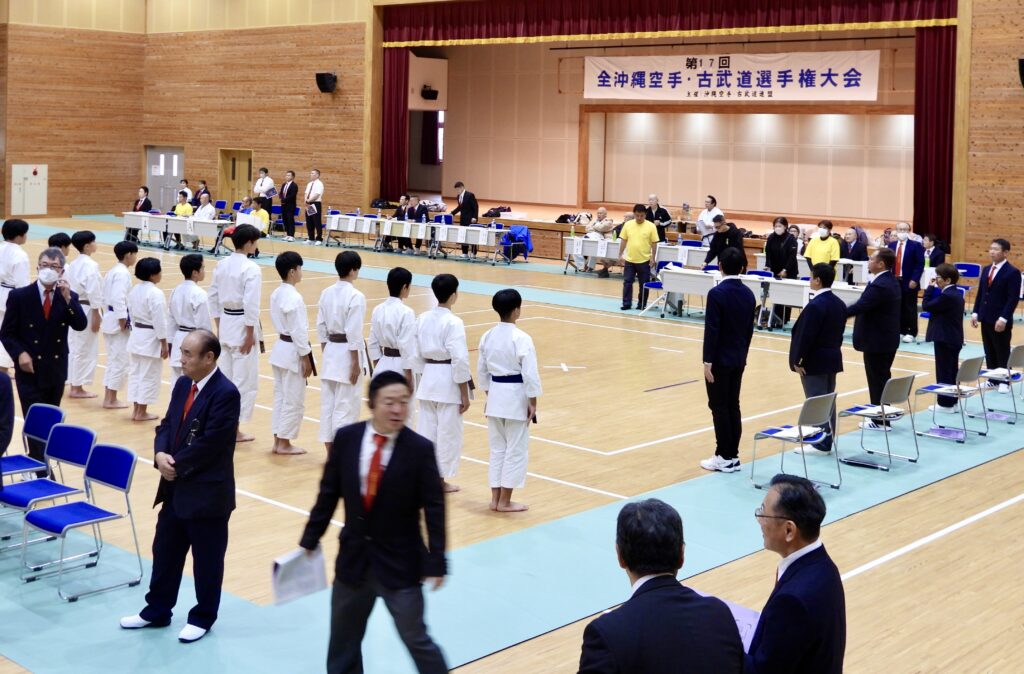
Team lineup
Competitors waiting in the “Tanren-shitsu” (training dojo)
Competition, but tradition
This tournament, now in its 17th edition, has a special character due to its very specific theme. While it is a competition with points and medals, it remains very much rooted in tradition.
The presence of such legendary figures as Shimabukuro Zenpo and Kakazu Yoshimasa (Shorin-ryū), alongside Yagi Meitatsu and Kinjo Tsuneo (Gojū-ryū), etc…
is far from merely ceremonial. They serve as the living seal of this pedagogical rigor. When these ‘guardians of the temple’ take their seats at the edge of the tatami, the message is unmistakable: this is not a place to ‘consume’ rank or dazzle with premature martial gymnastics. Their presence confirms that competition must remain a tool in service of the style and never the other way around.
The program sets the tone with a surprising list of prohibited katas (for children) and a warning that no “creative” kata are allowed.
So, no Occidental reinterpretation of “Shu-Ha-Ri” here, because tradition and the legacy of the ancient Masters are not treated lightly in “Dentō Karate”.
I was surprised to find banned 7 katas that I knew to be authentic, such as Kūsankū, Sanseiryu or Sūpārinpei.
In fact, I have always struggled to grasp the fine nuances between these three terms: original (the raw source), authentic (faithful transmission), and traditional (the practice established by a school).
In Okinawa, karateka’s value is not measured by the presentation of advanced katas, but by the strength of their foundations. Tradition prioritizes the discipline of “Shu-Ha-Ri” (the “Shu” part, not the “Ri”) over the aesthetics of competition.
[As a reminder, the Shorin-Ryū Kūsankū kata (of Chinese origin, imported in the 18th century) is the ancestor of Kanku-Dai/-Sho from Shōtōkan. Gojūshiho (54 steps) originates from the Useishi kata (which also means 54 steps in Okinawan) and comes from Shuri-Te.] The Gojū-Ryū Sūpārinpei (108 hands) kata, even in its ancestral “Petchūrin” version, is also banned. Sanseiryū (36), which is very dear to Uechi-Ryū, is also on the list, along with three others.
Surprised by my astonishment, it was explained to me that this strict rule only applies to Juniors and that the goal is to avoid rushing their progression. The listed katas are too advanced and require years of practice, which by definition is impossible with such young karate practitioners. Rather than simply memorizing the order and performing the kata, the true essence lies in carefully mastering each kata.
The respect of the tradition here therefore concerns the progression along the path and not the origin of the katas, as I had misinterpreted, having not read everything…
At this event, we will therefore not see, as on YouTube and in some competitions, very young children performing athletic feats and showcasing amazing prowesses…
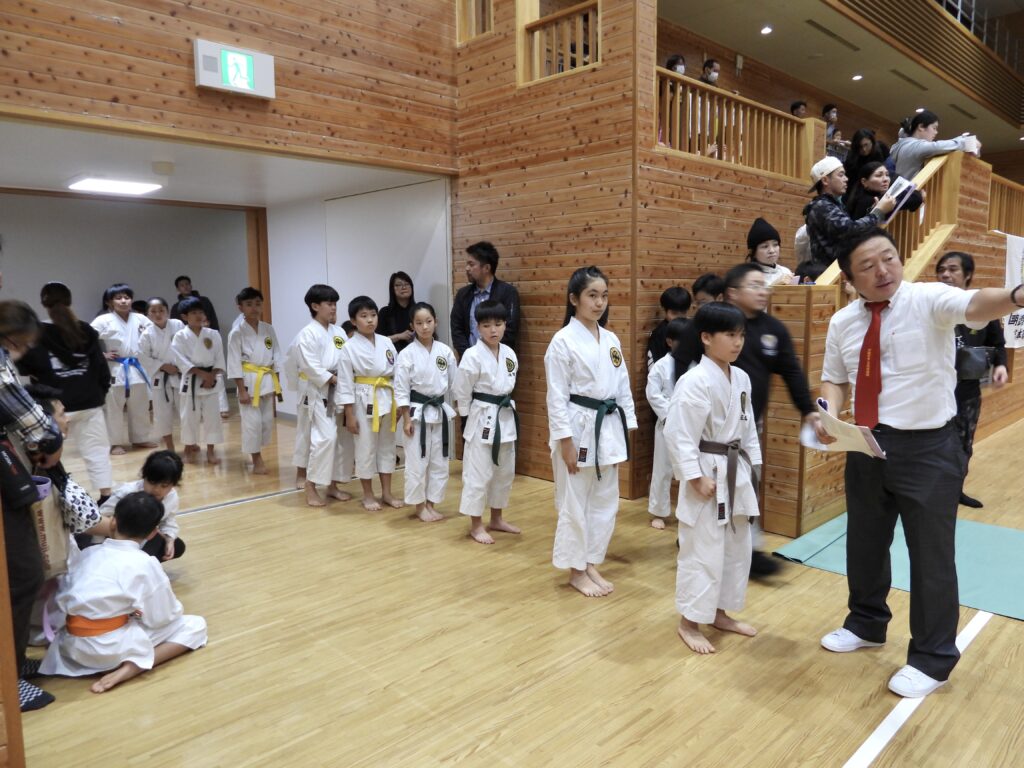
he cubs enter the arena…
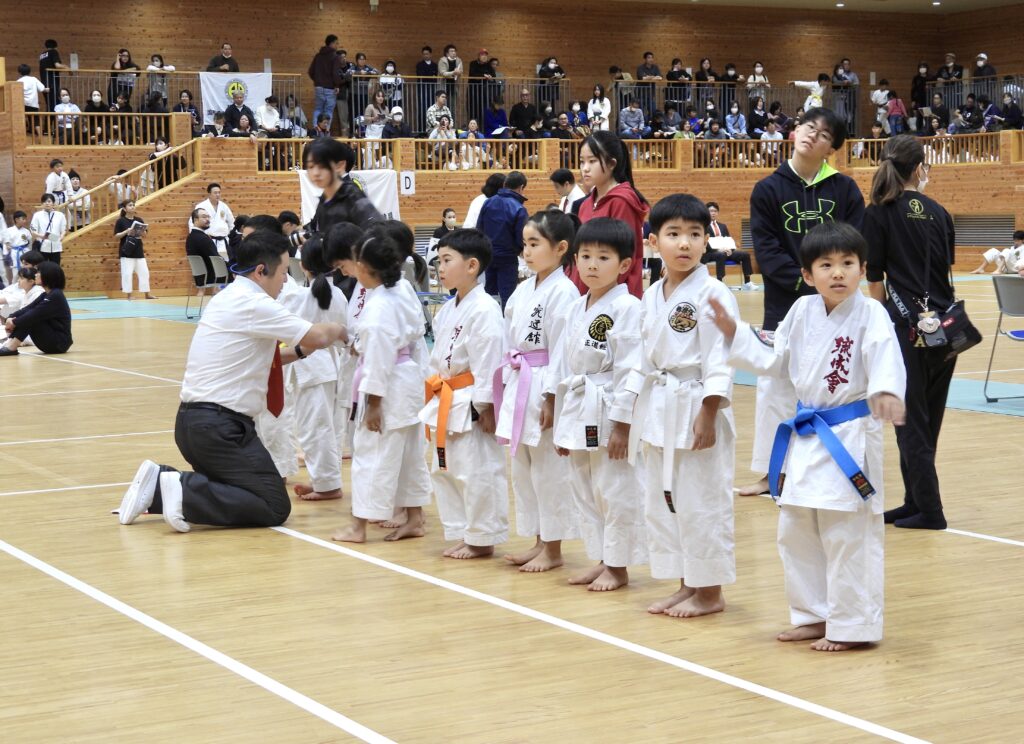
Final adjustments with help from the judges
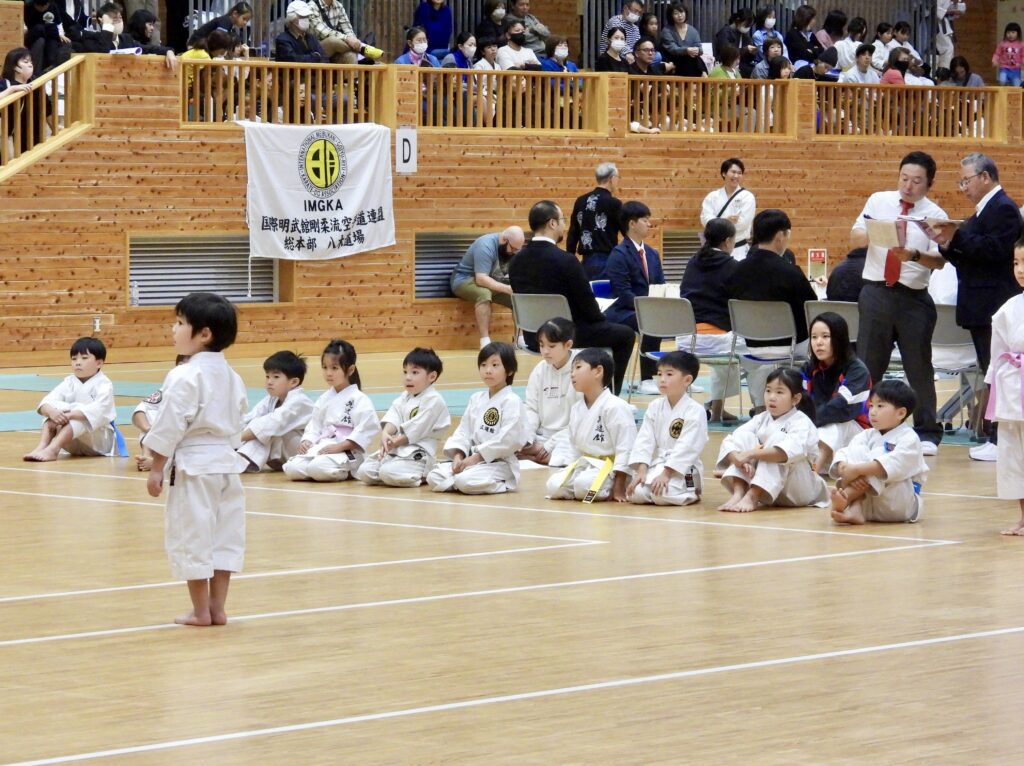
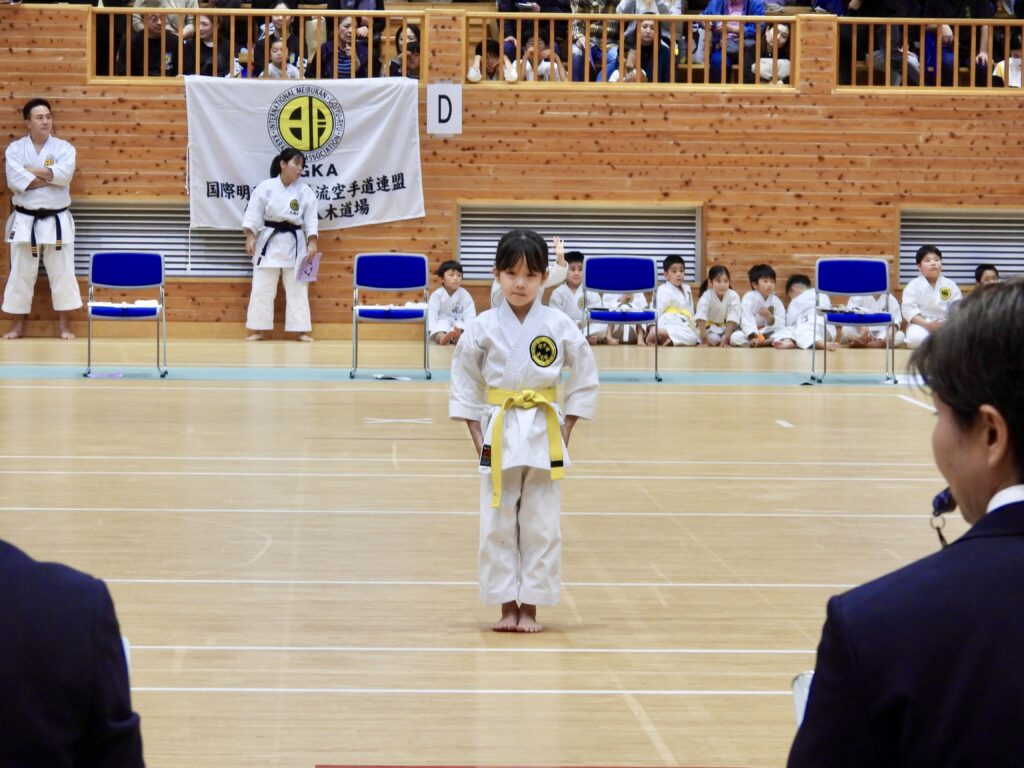
In starting position
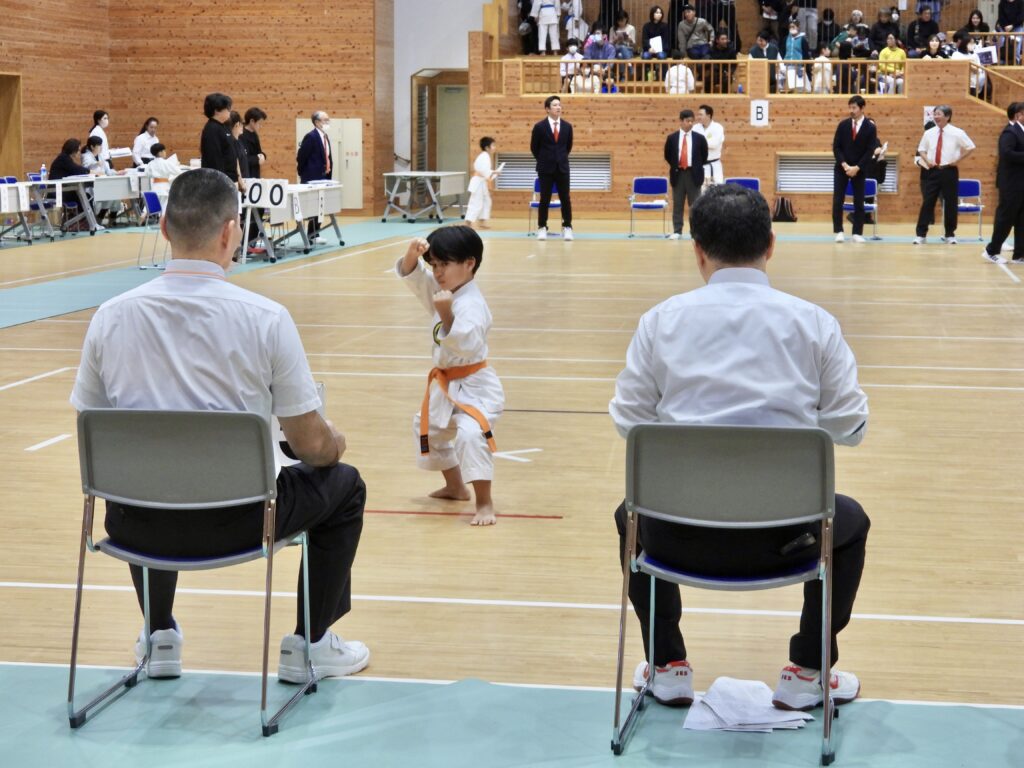
Hajime !
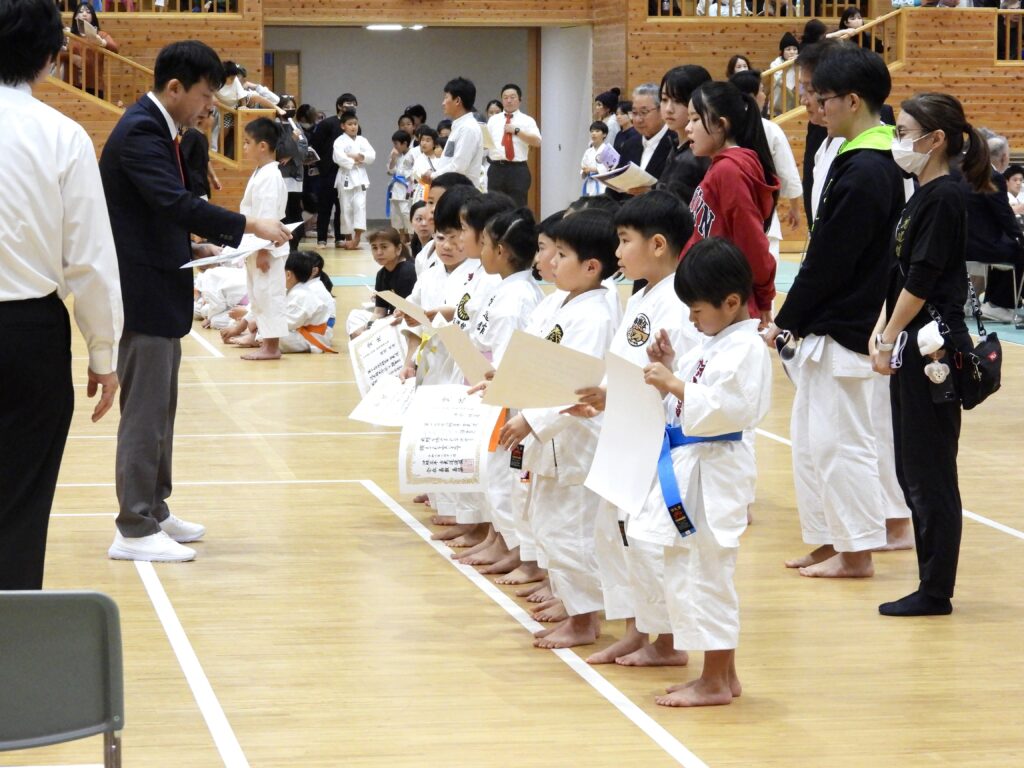
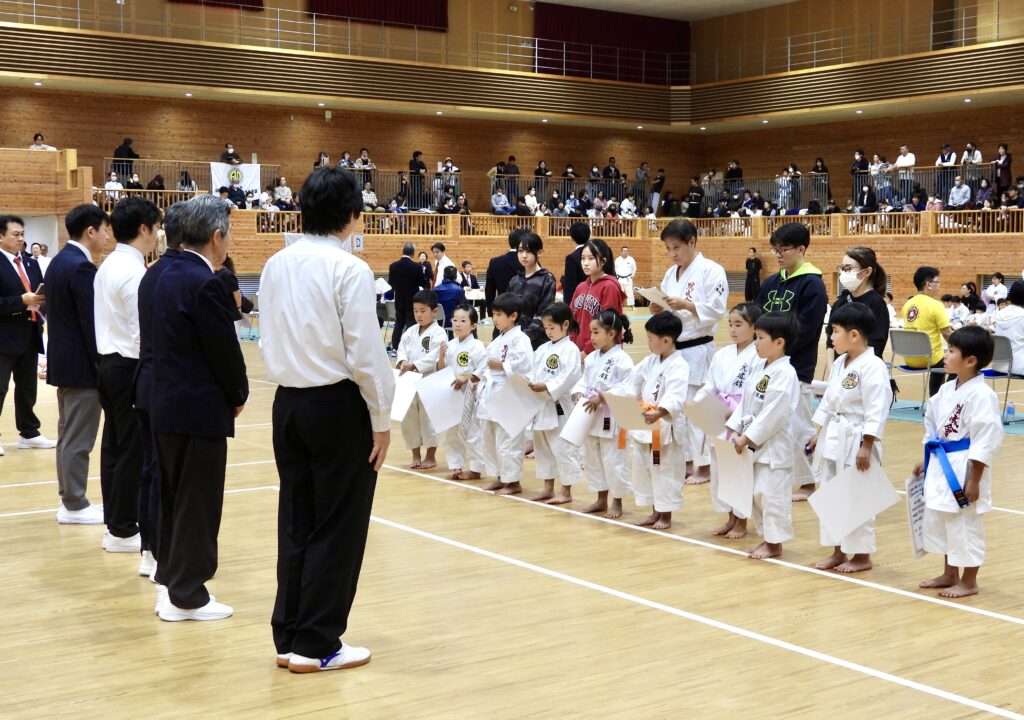
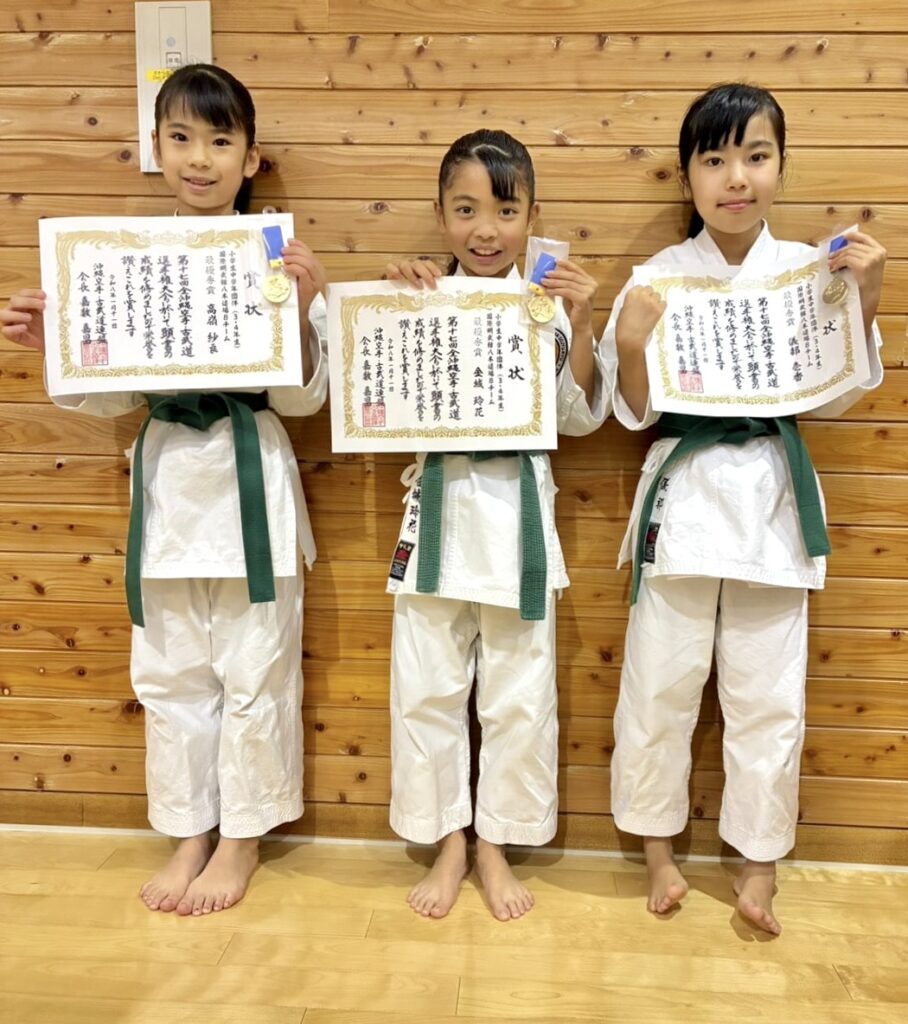
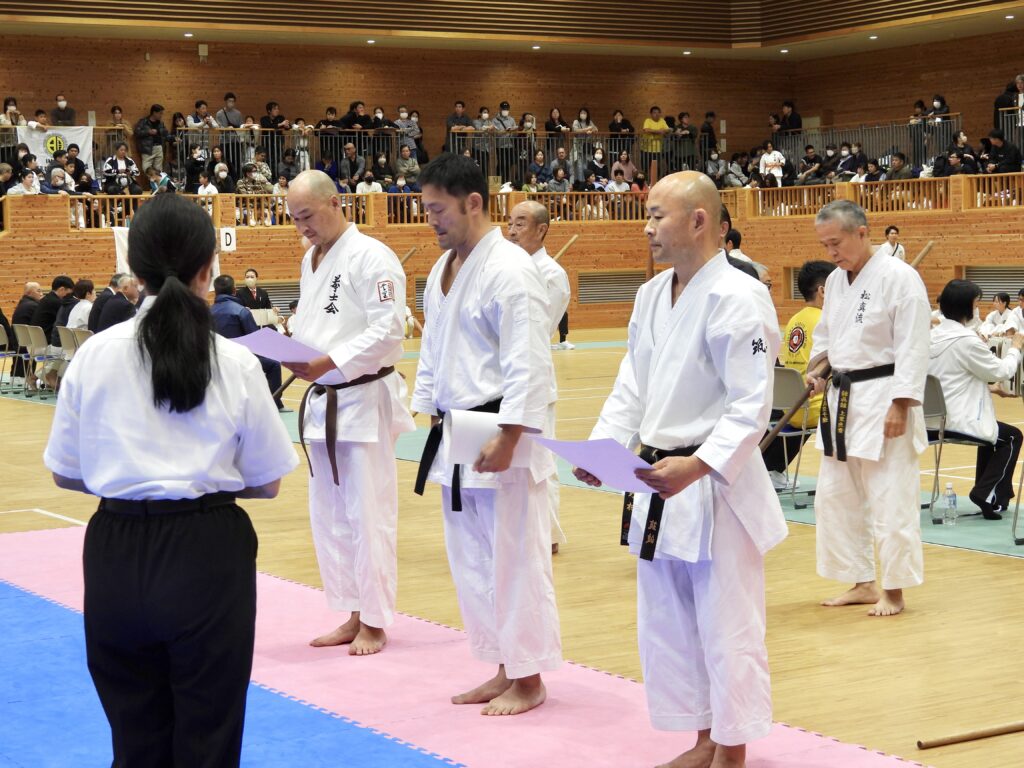
Presentation of diplomas and medals
Tournament Overview & Operations
*****大会役員 Tournament officials*****
大会顧問Taikai komon (Tournament Advisors), 6 leader figures : Shimabukuro Zenpo, Higaonna Morio, Higa Minoru, etc…
大会名誉顧問Taikai meiyo komon (Tournament Honorary Advisor):Yagi Meitatsu
大会長Taikaichō (Tournament Chairman) : Kakazu Yoshimasa
大会副会長Taikai fukukaicho (Tournament Vice Chairman) : 4 persons
大会総括本部長Taikai sokatsu honbuchō (Tournament General Manager) : Kinjyo Tsuneo
Total number of tournament applicants: over 600
Number of medals awarded: 306
At 9:00 am precisely, the tournament’s Taikaicho (Grand Chairman), Kakazu Yoshimasa, delivered a speech. Three elementary school students then took the athlete’s oath, marking the start of the competition.
The Enbu(demonstrations) were held at a brisk pace across four courts, A, B, C, and D, in the main dojo. Pre-event competitors gathered in the Tanren shitsu (training room) and other areas of the dojo, diligently reviewing and finalizing kata.
A New Era ?
The old rivalry between Dentō-Karate (traditional karate) and Kyōgi-Karate (sport karate) has largely faded. Modern karate is now widely accepted as a sporting art that develops both mental and physical qualities.
N.B. [The word “sport” traces back to 12th-century Old French se desporter—”to divert oneself from work,” “to amuse oneself,” or “to take pleasure.” It originally meant diversion and enjoyment for mind and body alike. When the term reached English shores, its meaning narrowed: from casual pastime to structured, competitive physical activity.]
Competition itself isn’t inherently harmful—even if it risks undervaluing some or overvaluing others, especially vulnerable children. The real responsibility falls to instructors: to temper emotional highs and lows by teaching rules alongside deeper values. Japanese culture already offers a powerful framework for this in reisetsu (礼節)—the strict norms of respect, courtesy, and kindness that guide social interactions.
What stands out most today is how young karate has become. Competitors as young as 5 are now common!
When I started training in Karate more than 50 years ago, I was only 14 or 15; one of the youngest people in the Dojo. Even the most experienced students were usually under 40.
Okinawa masters say the same thing was true in the traditional days back in Okinawa. Indeed, karate students were mostly teenagers and adults.
Today things are very different, Karate has become so popular that many young children now train too. This shows how much the art has spread and changed over time, becoming gentle enough that it feels completely safe for children today.
Who could have predicted, just 15 years ago, that “Soccer Moms” would evolve into “Karate Moms”?
The big question now is this:
Will these young karate students keep training and carry the deep values of karate with them into adult life?
Or will the busy demands of growing up (school pressure, jobs, family, and very little free time) cause most of them to stop?
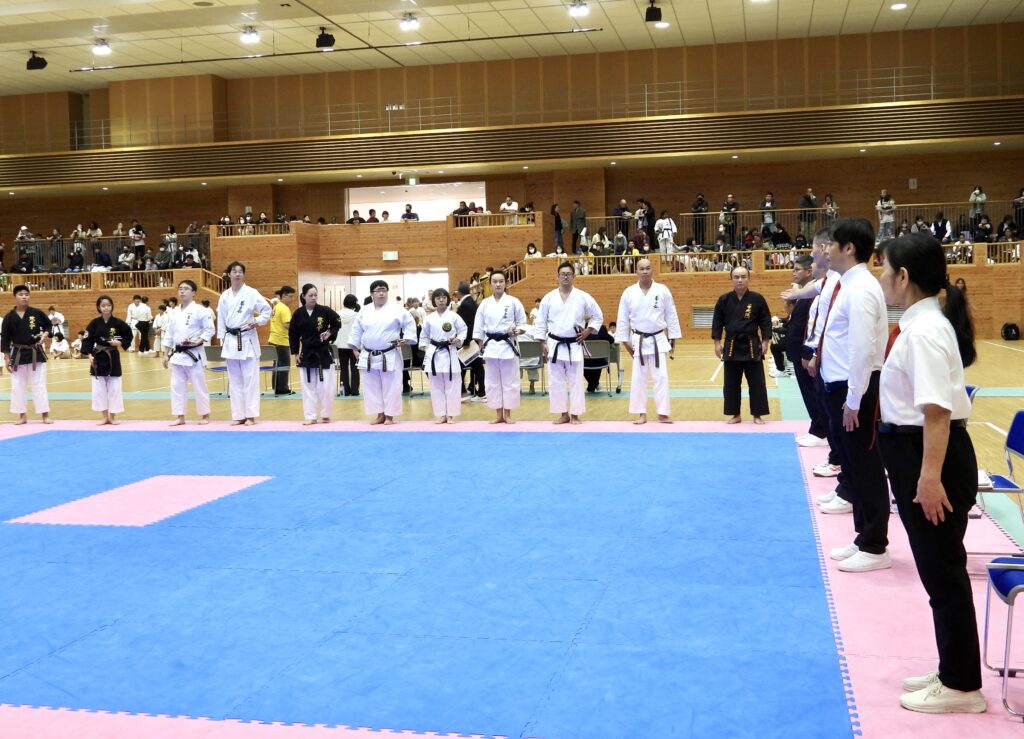
Lineup of an international adult team
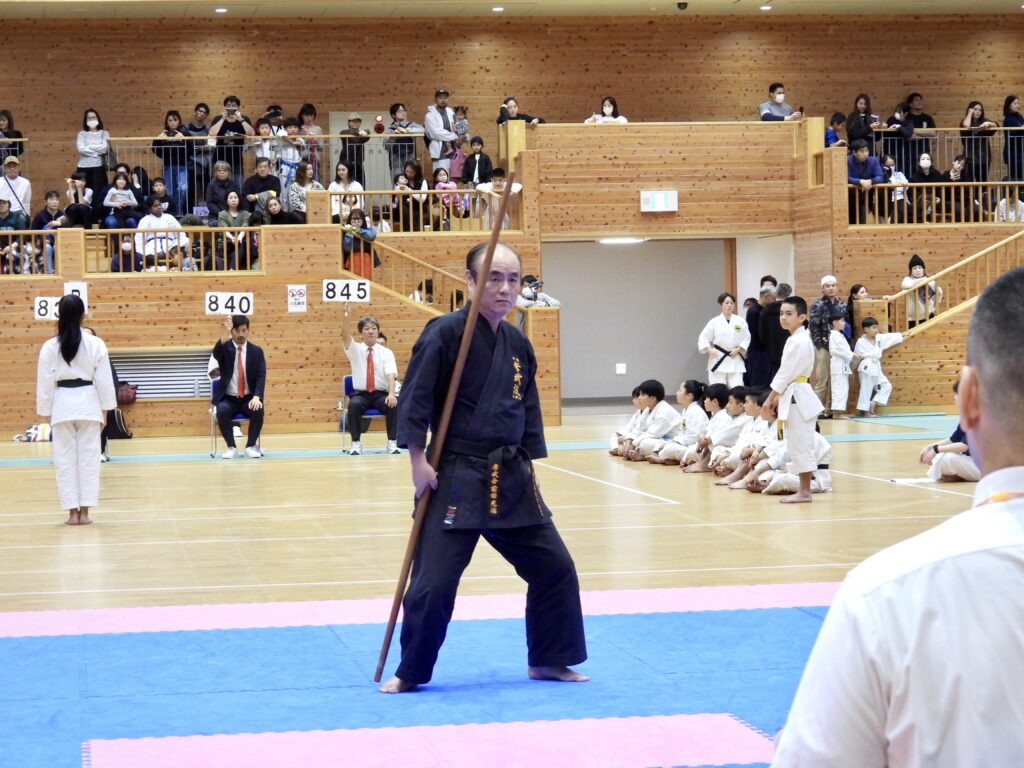
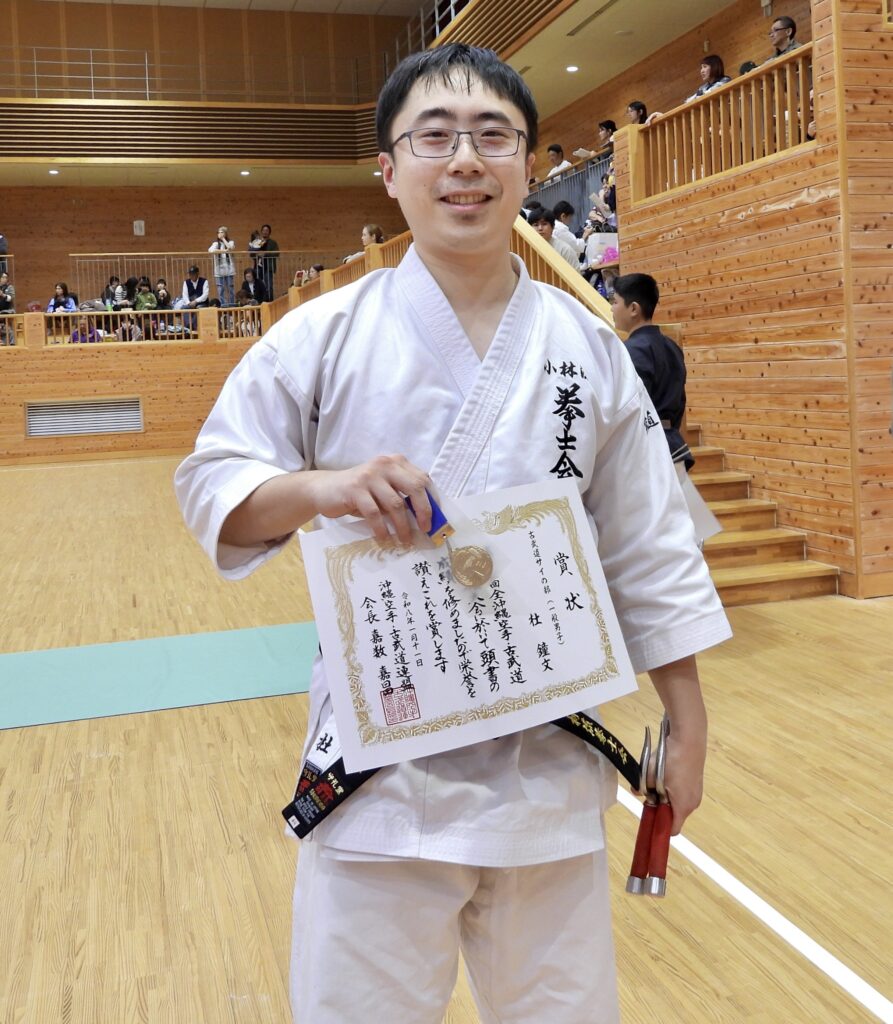
Maeda Mitsuharu (Bō kata) gold Saï Seniors
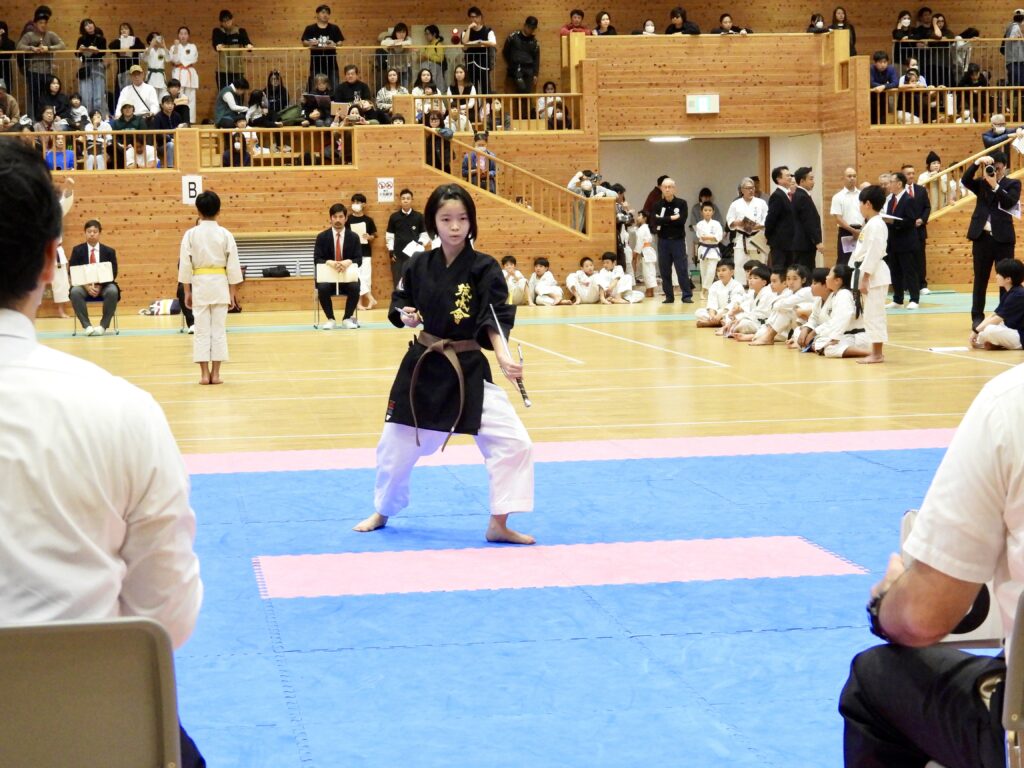
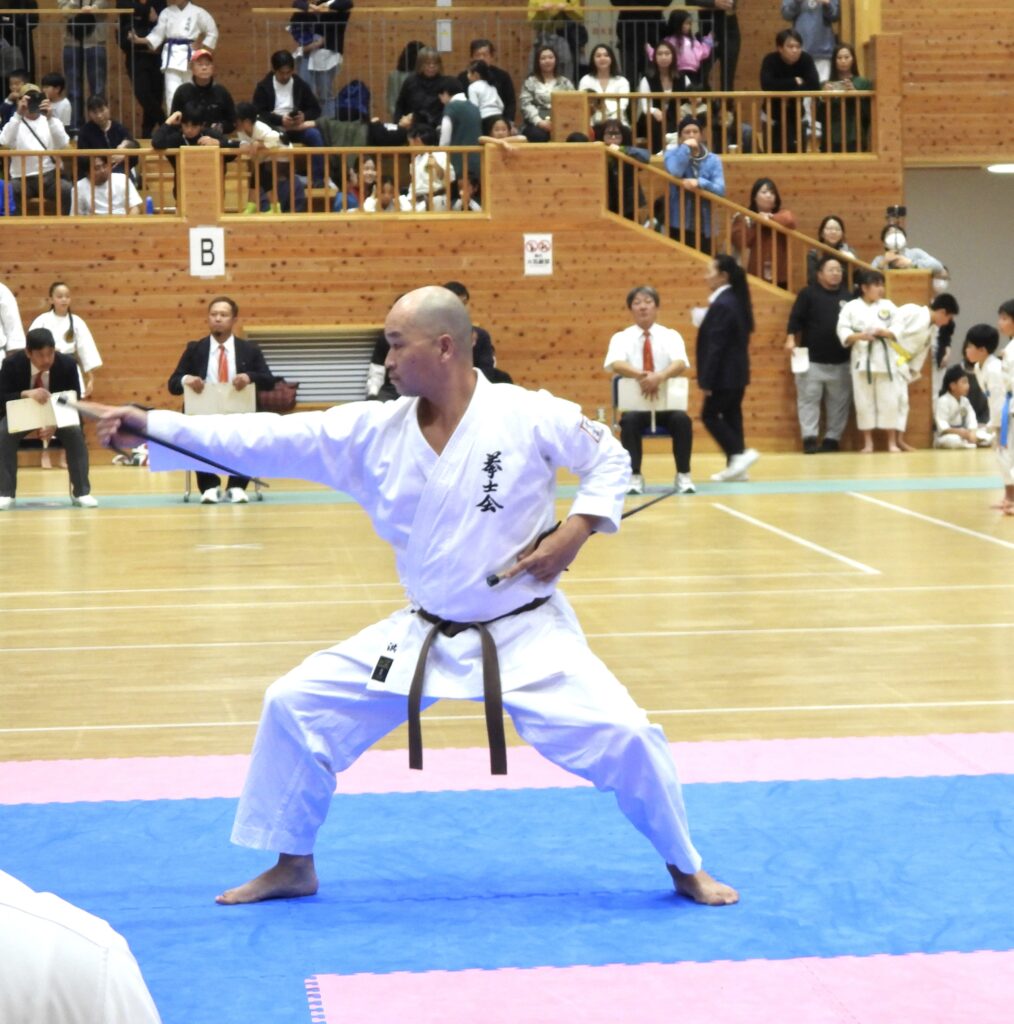
Kata with Saï
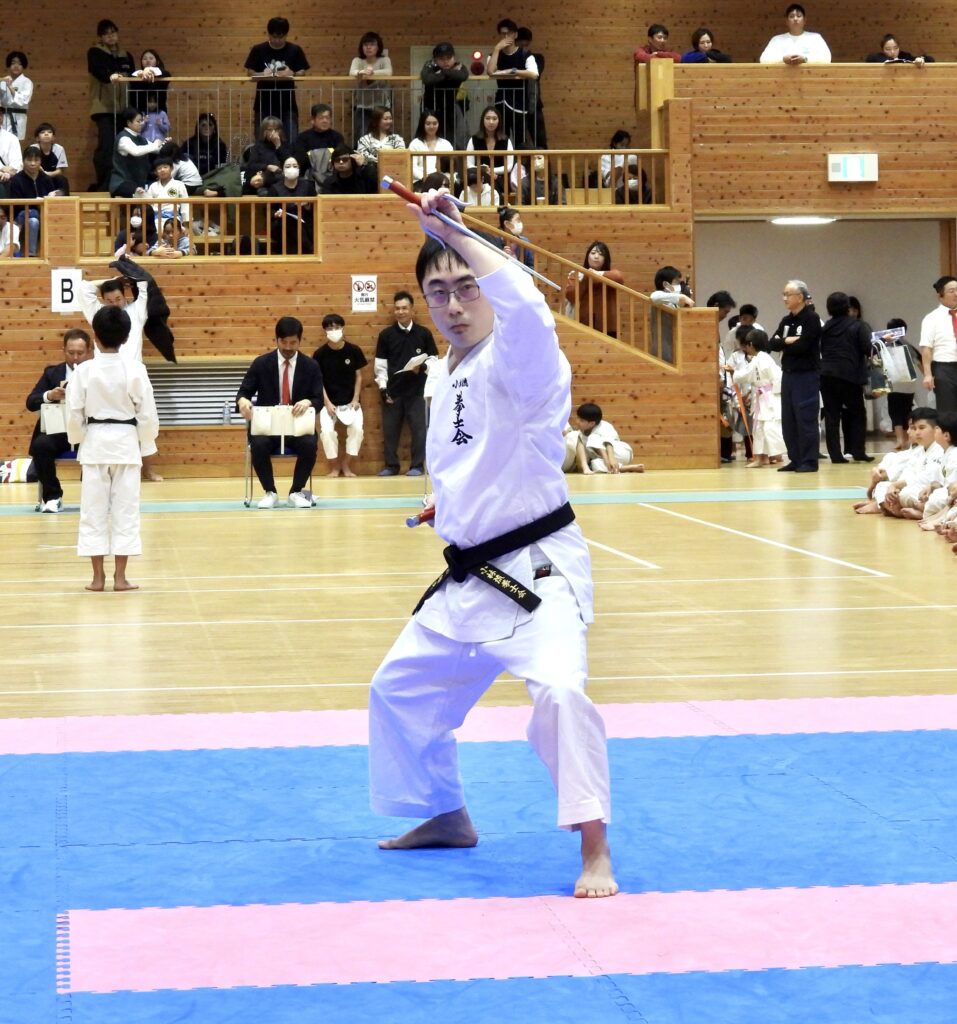
Du Zhongwen gold medal Saï + bronze Bō
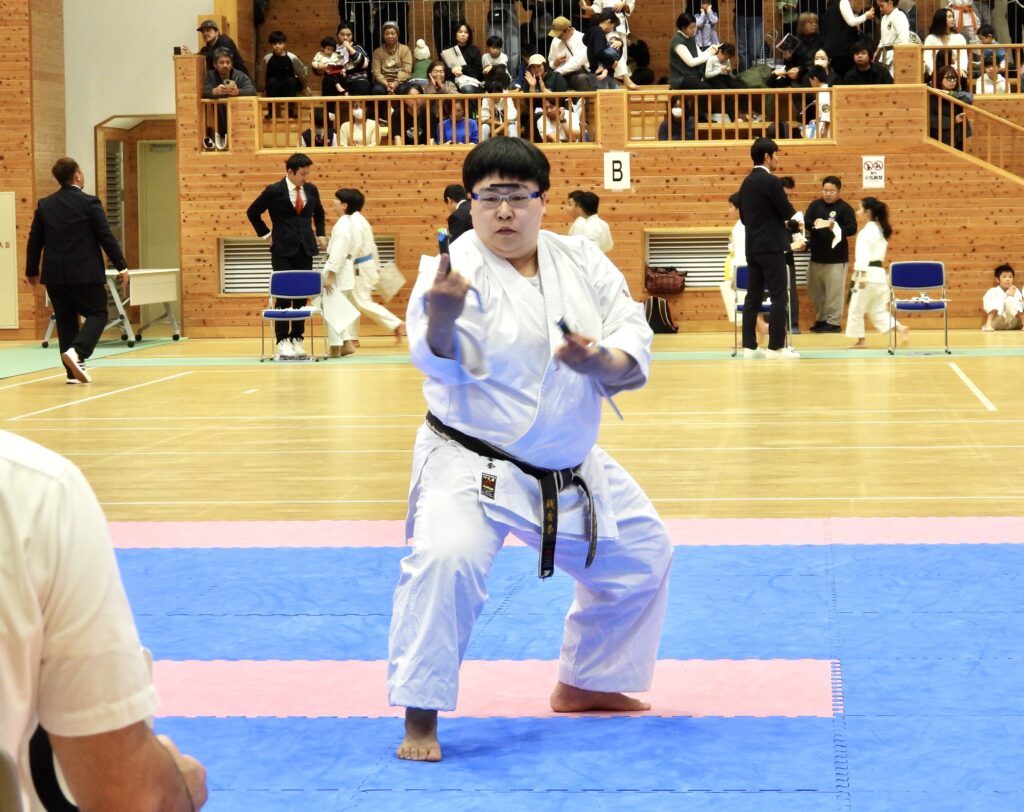
Li Ying gold medal Bō + bronze Karate
Qian Jin Li : Women’s gold medalist
Hong Chun Gia gold medal Saï Seniors
Presentation of certificates and medals
From the West
Kids’ karate classes are growing a lot these days. This shows the same trend we see elsewhere. There’s a big gap between young students and older adults.
The young adults from years ago were the ones who used to keep karate strong and alive. They have mostly stepped away from it now. Why?
Karate remains a difficult profession to monetize; it demands decades of physical investment for returns that are spiritual rather than financial and it takes years of hard work and a lot of time to get really good at it.
But for the seniors who’ve trained for 50+ years, we can clearly see what karate has given them. Even with their sore knees and hips, they helped shape karate’s future (often without meaning to) just by sticking with it.
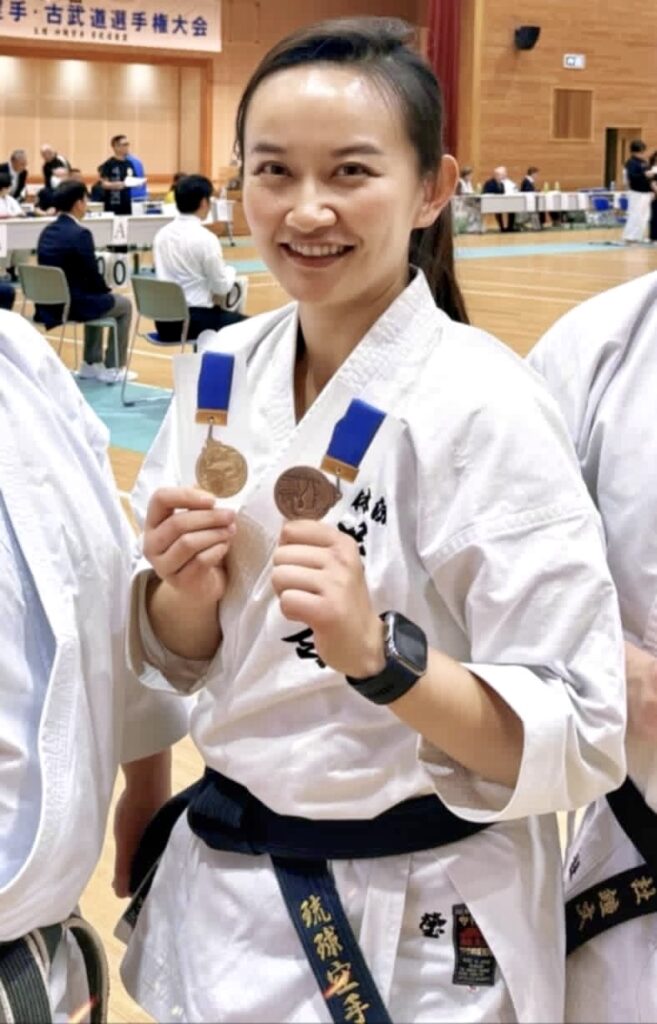
Gold medal and bronze for Du Zhongwen
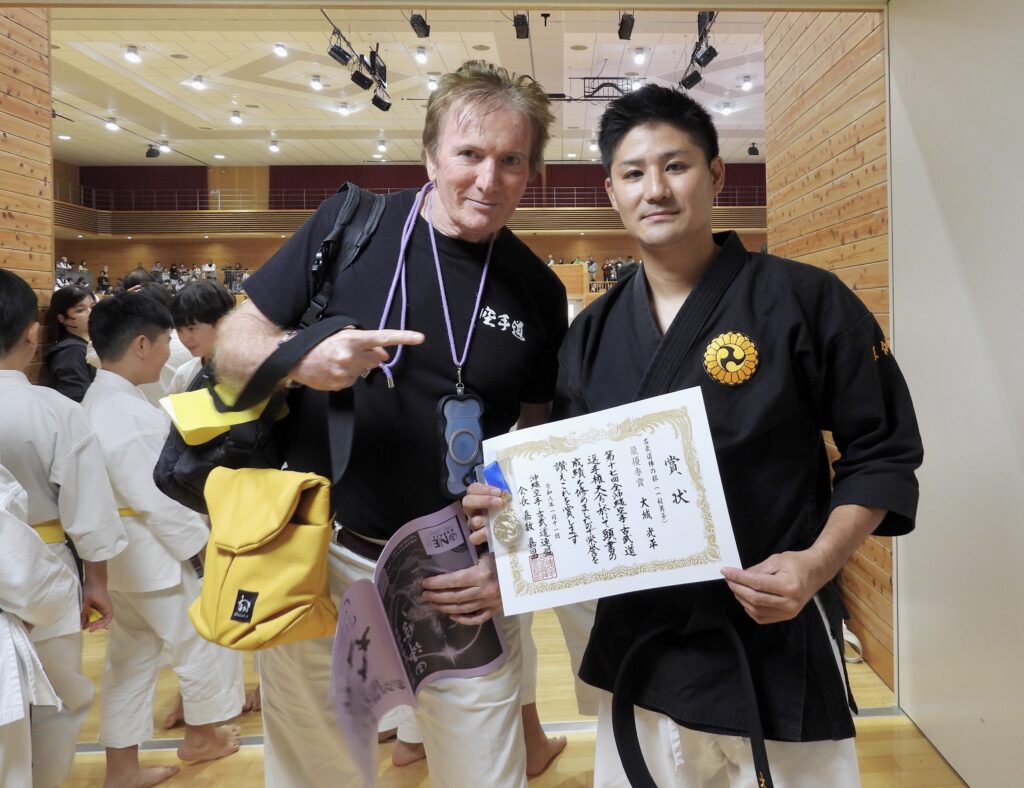
Gold for Ōshiro Kōhei, referee and competitor
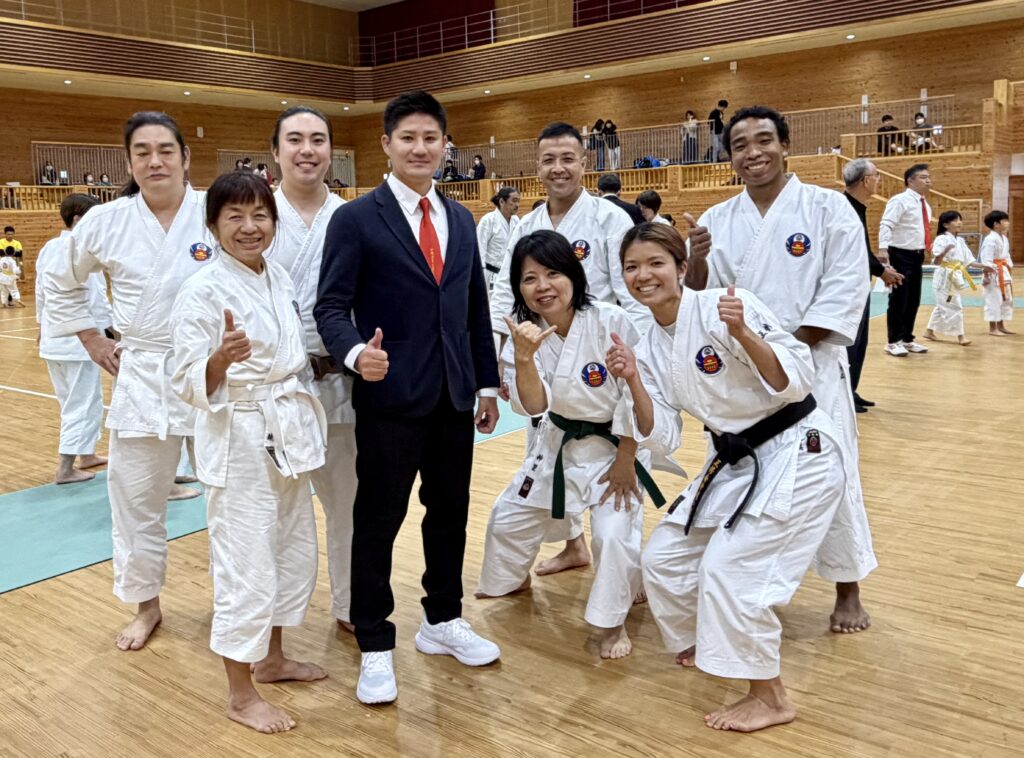
The friendly Oshukai Okinawa team
The end of myths
It’s time to face the facts. The early pioneers of karate in Europe are now searching for the real truth. They are letting go of romantic ideas about martial arts and looking straight at karate’s origins in Okinawa.
There, they find out that karate is not some spiritual New Age philosophy or just a nice set of rules for behavior. It is a tough, practical system built for real survival and fighting.
Seeing this hard reality makes them realize that a “Budo-fication” of karate had turned it into a sacred ritual exercise that cares more about form and ceremony than actual combat. In every way, they feel truly “dis-oriented.”
For many French practitioners, and particularly the veterans, the governance crisis within their national federation has deepened a profound disconnect. Where they once saw the guardian of the ‘Way,’ they now see a bureaucratic machine that has lost touch with the expectations and values of its members.
The biggest disappointment, though, is physical. Modern Japanese-style karate demands a kind of body use and training that wears people down over time and becomes impossible to keep up as you age.
Going back to the old Okinawan roots is not a letdown; it’s a way to survive and keep practicing for life. With guidance from elderly masters, many are moving away from pure brute strength toward smarter body mechanics and internal structure. This change protects the body as it gets older and makes the practice more mature, balanced, and lasting.
It means dropping the dream of “pure, hard karate” and choosing something wiser and more sustainable instead.
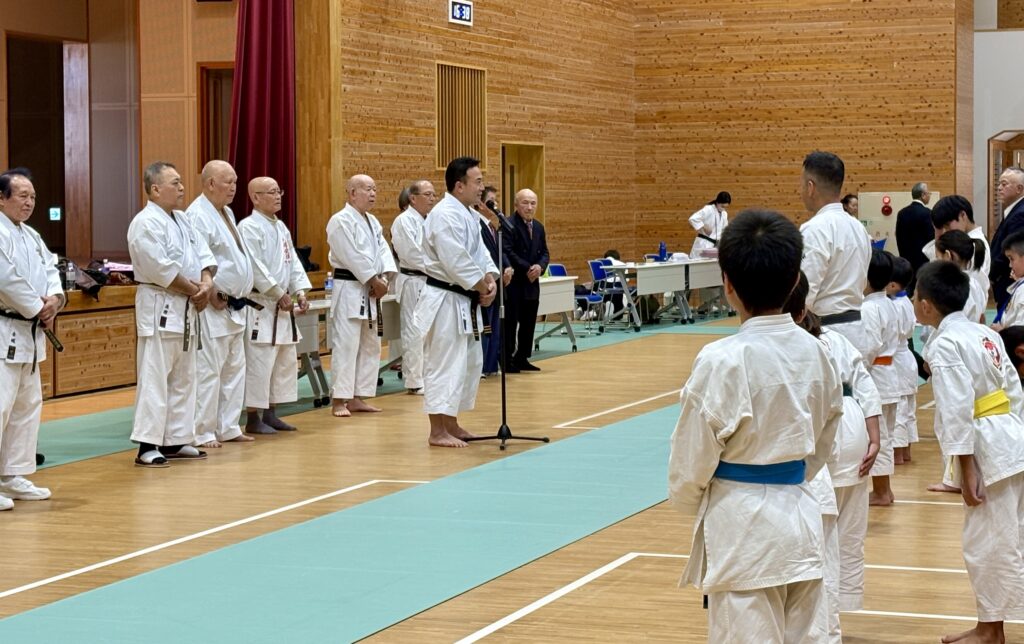
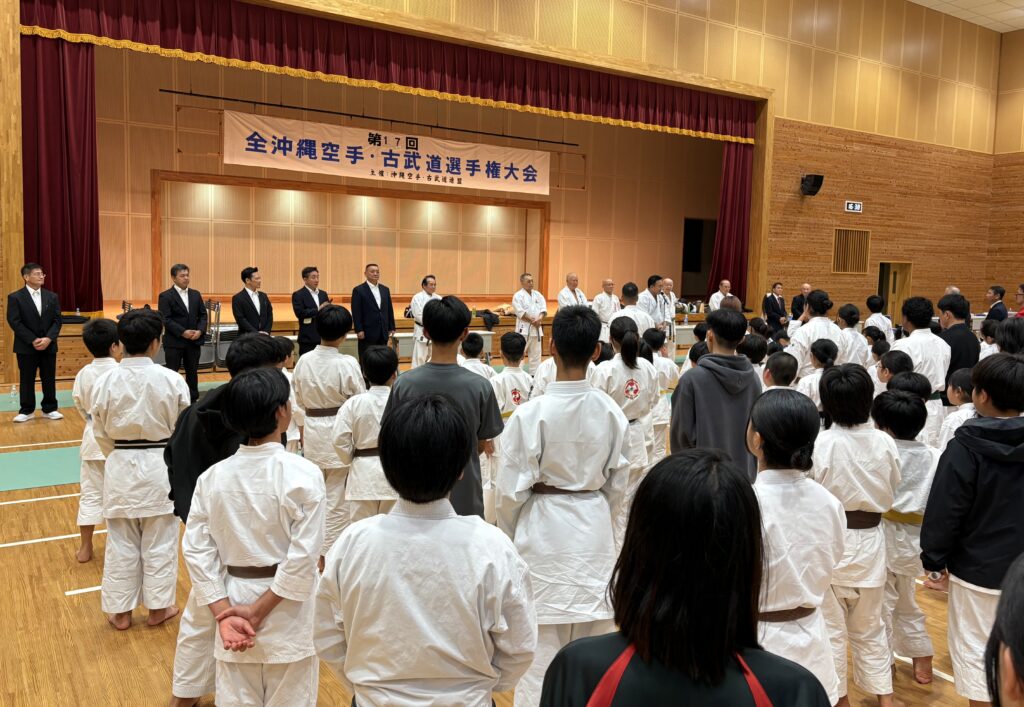
Closing speech by Yagi Akihito Sensei
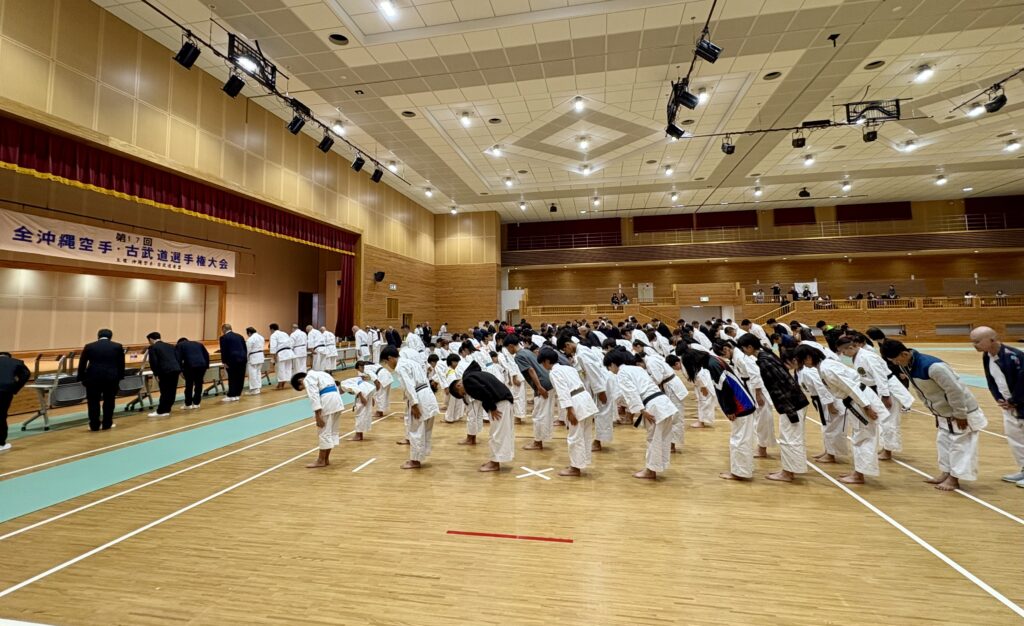
Impressive final shōmen bow
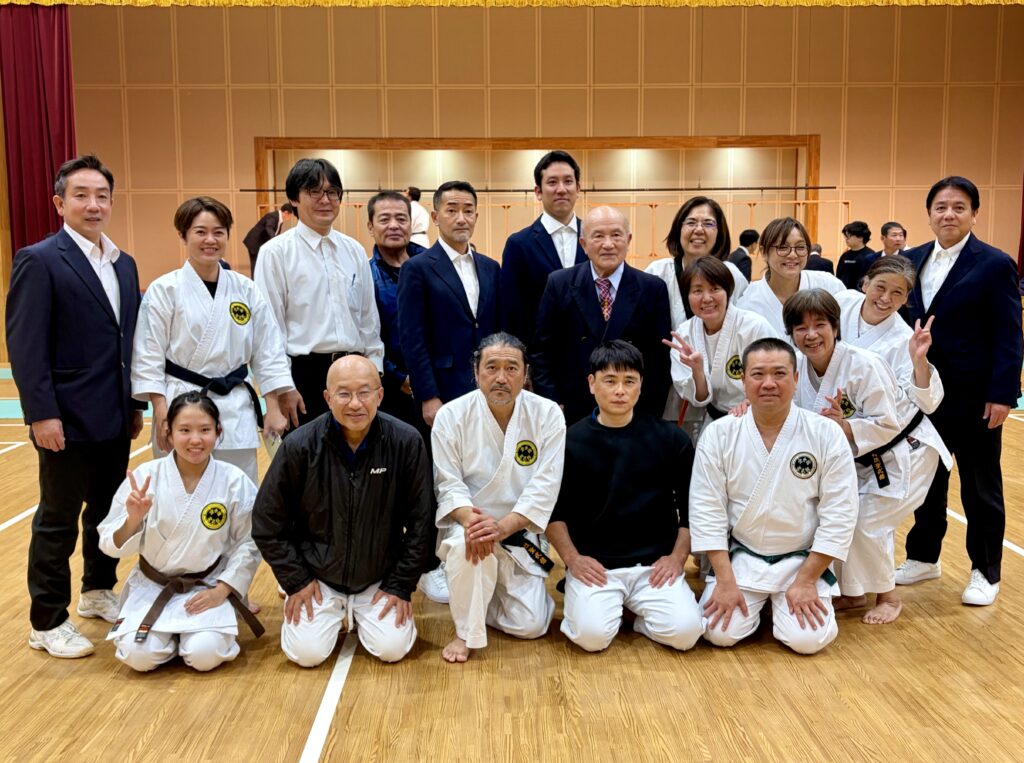
Shimabukuro Zenpō Sensei with his group
Conclusion
I have interviewed many of Okinawa’s most influential Senseis, and they all share a common concern: the ongoing transformation of “traditional kata” as karate becomes more widespread globally. They point out that the essence of tradition is being lost, with overly long kime (powerful pose/pause) and maai, movements that have lost their original meaning, and dynamic modifications that prioritize visual impact. Preserving tradition is no easy task, especially in a world where karate has already spread and popularized globally.
N.B. The concept of Maai (間合い)
[In Kata competition, Maai, which normally defines the space/gap (“Ma”) and harmonious timing (“ai”) between two fighters, takes on a different nature. Since one is alone with oneself, it is no longer about managing physical distance, but about demonstrating a credible rhythm and timing according to the judges’ rules. The athlete must prove mastery of their fight by varying their speed and making precise pauses. Maai then becomes a kind of performance. Indeed, the space between each movement must demonstrate an understanding of the actual application of karate. It is a mastery of tempo imposed by the sport’s regulations to validate strength, breathing, and posture in the face of an imaginary opponent.]
Tomorrow’s practitioner must make a clear choice between gentle health cultivation, competitive athletic performance, or raw survival competence. The comforting illusion of one universal path has dissolved. This is the death of a convenient myth and the birth of a more mature, self-aware practice, precisely as children flood back into dojos in record numbers. Paradox defines the moment! The old dream fades just as a new, more grounded generation begins to train.
* Kenshikai Shangai had 5 participants & obtained 7 medals (3 Gold, 2 Silver, 2 Bronze)
-Du Zhongwen, 2 medals. Gold in Sai and Bronze in Bō
-Lee Ying, 2 medals. Gold in Bō and Bronze in Karate
-Qian Jin Li, 1 medal. Gold in Sai
-Xia Fei, 1 medal. Silver in Karate
-Qiang Zhiyu, 1 medal. Silver in Sai
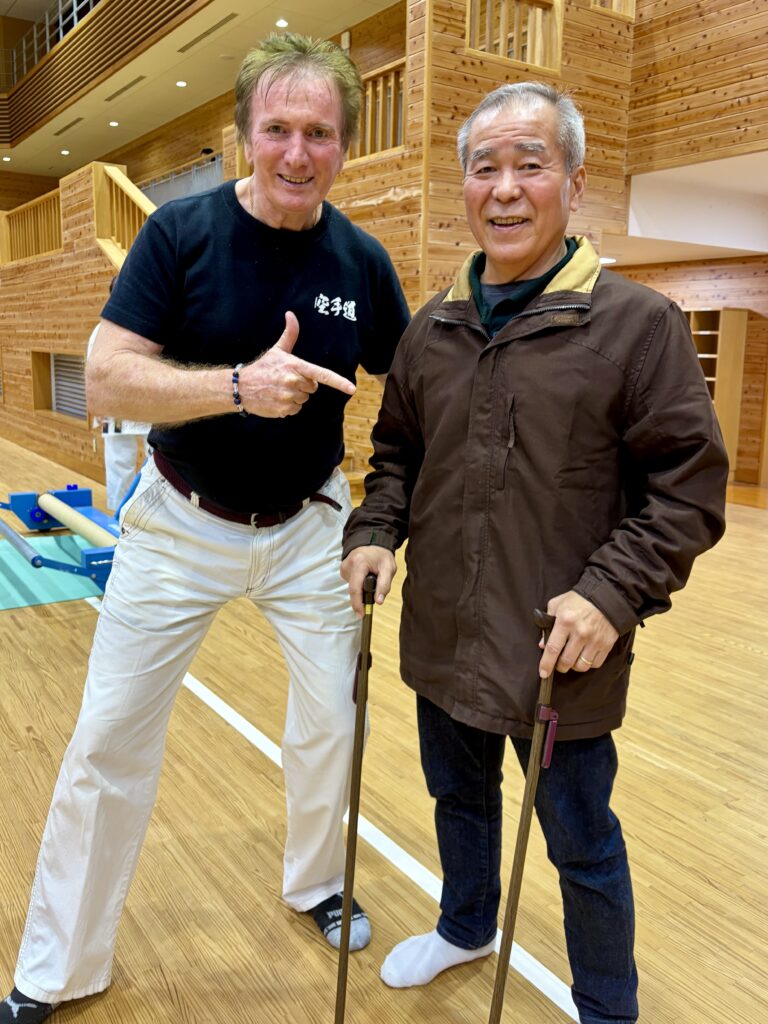
With Ōshiro Zenei Sensei, who lived in France longer than I did!
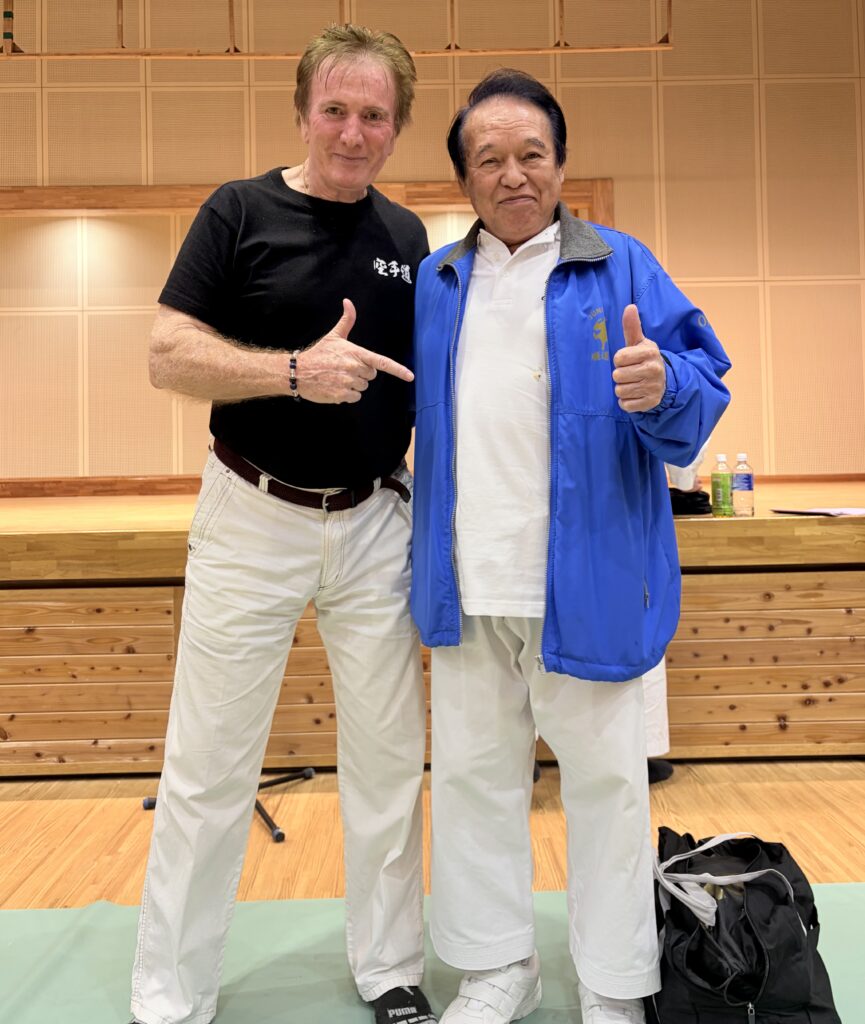
Two Hawaii veterans… Kinjō Tsuneo Sensei and Daniel
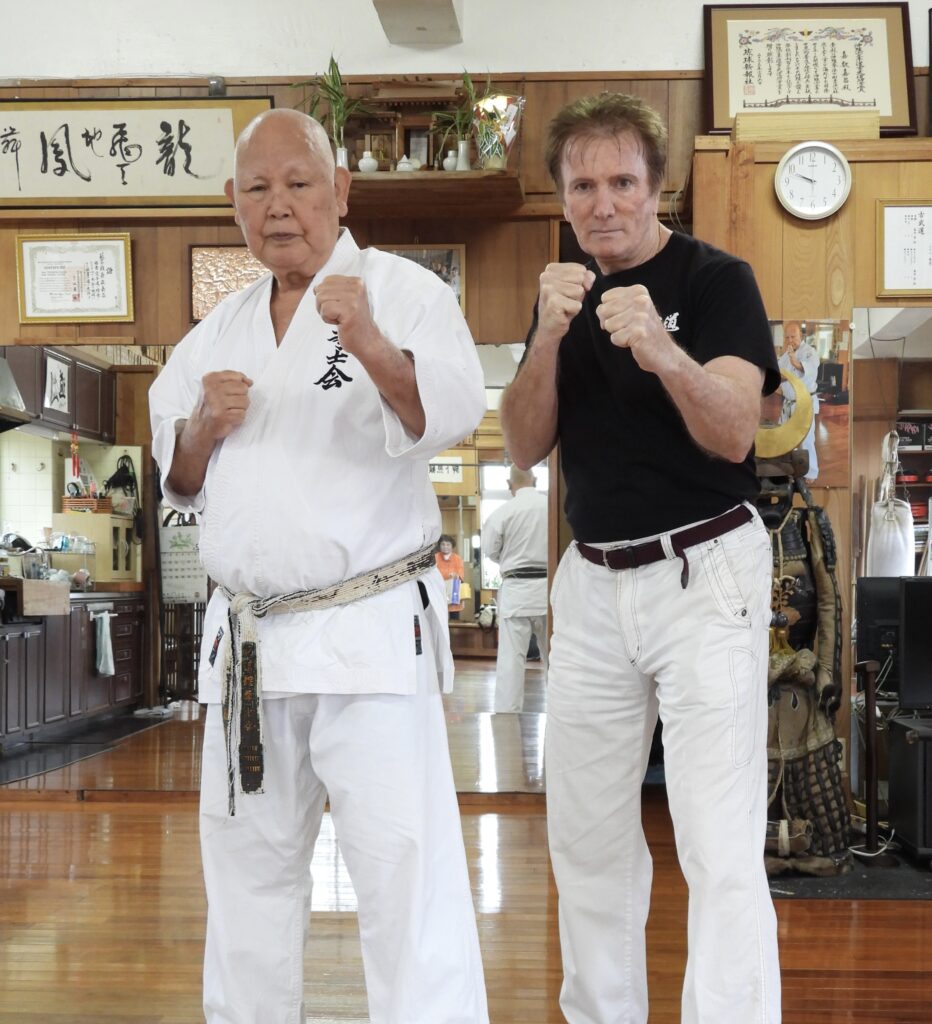
With the impressive Kakazu Yoshimasa, President of this championship
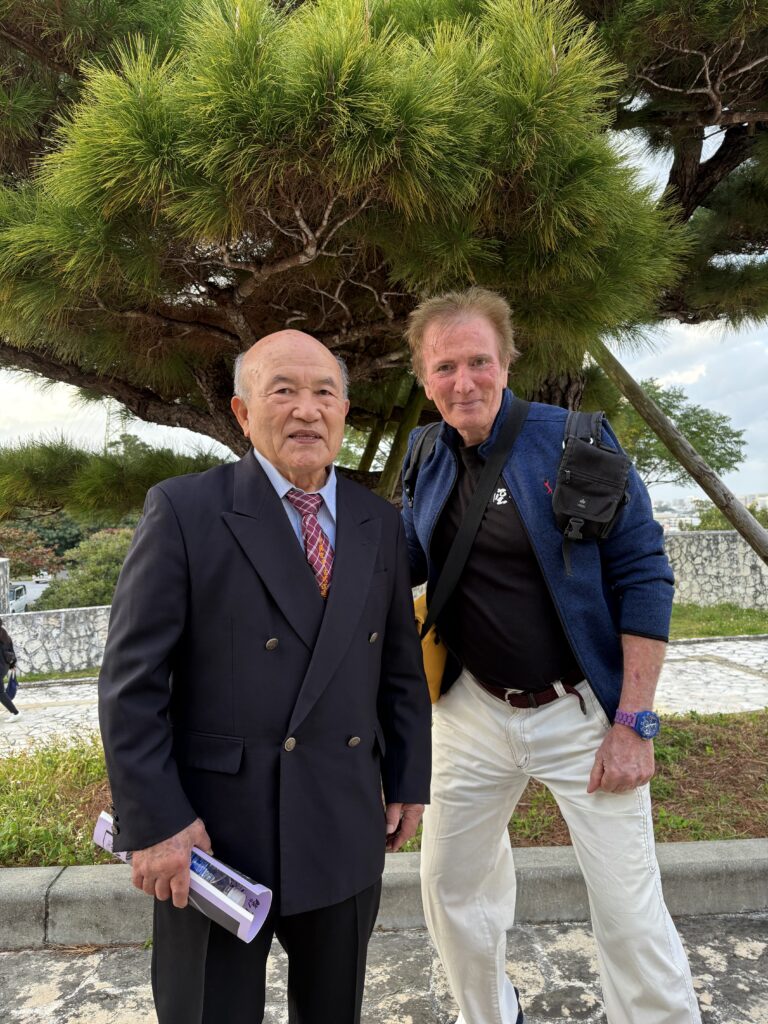
A big thanks again to Zenpō Sensei, who is a living legend
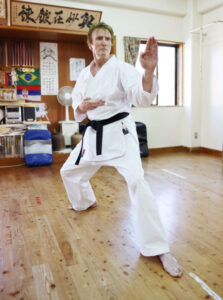
Daniel Mardon; the Karateka-Therapist
Creator of Aromapressure® method and physiotherapist with a valid US license, Daniel Mardon was born in Paris. One of his specialties is to teach and to perform lymphedema and subcutaneous tissue-damage care, after radiotherapy for cancer patients at medical institutions and subcutaneous tissue-circulation stimulation before and after surgery.
He was also a therapist for two famous soccer teams in Paris. Since 2005, he has focused on producing top-class hotel spas in Japan, as well as physiotherapy education and awareness-raising activities for health care professionals. Author of several books, among his major publications includes “The Physiology and Bodywork of Physical Therapy ” (Published by BAB Japan) and DVD “Daniel Mardon Aromapressure® Method ” (Pony Canyon). He regularly appears on television and radio shows, and has featured in numerous media publications.
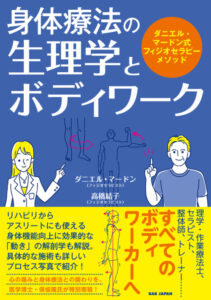
『身体療法の生理学とボディワーク』(The Physiology of Somatic Therapy and Bodywork)
Co-written by Daniel Mardon and Yuko Takahashi
On sale now on the BAB Japan website!