

【Exploring the spirit of the Ryukyu】Special edition (HIDEN January 2026)「Okinawa, the gathering place of Karate」
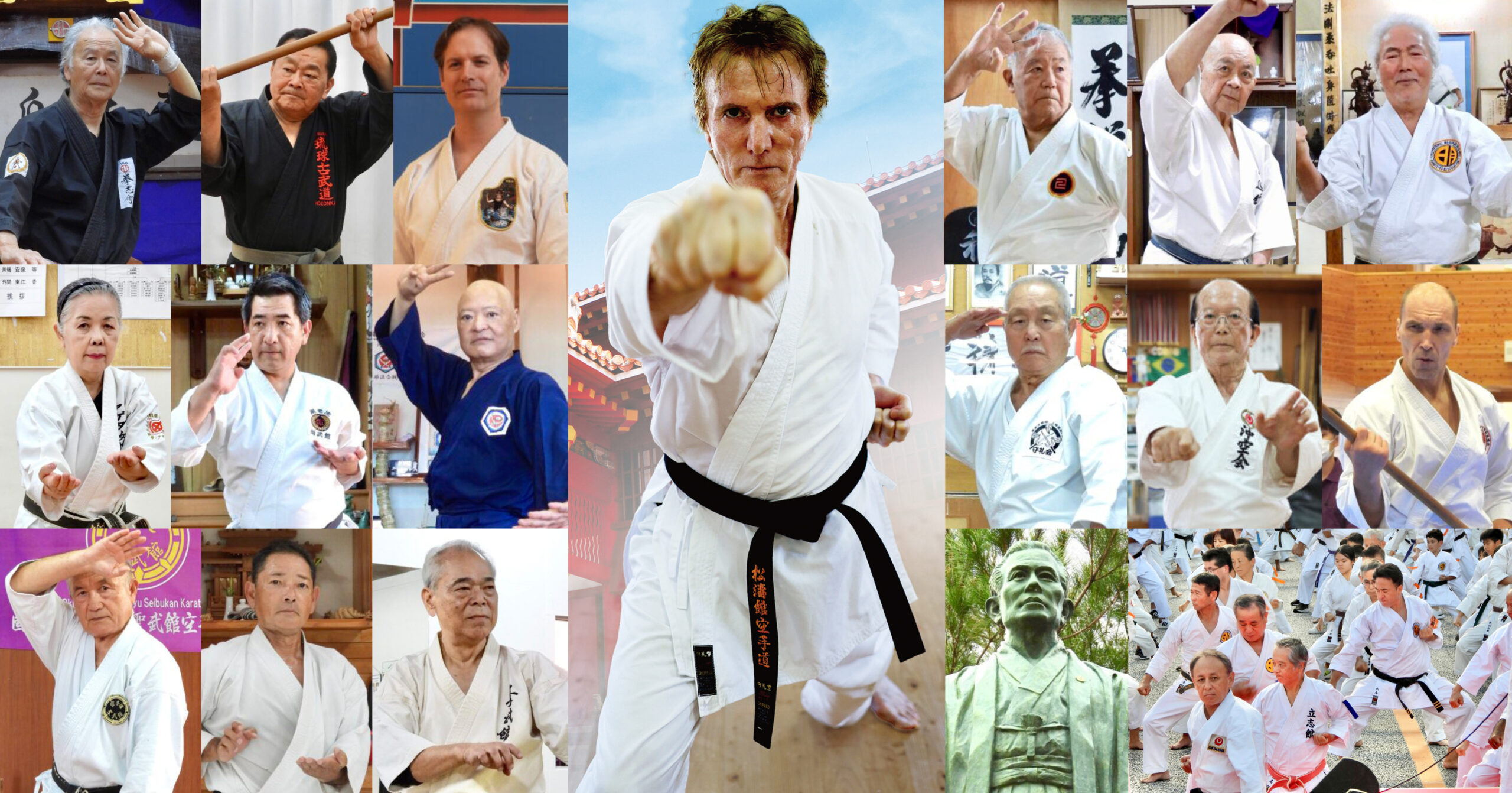
Interview/Writer: Daniel Mardon
Photographer/Translator: Yuko Takahashi
Daniel Mardon, “The Karateka-Therapist
Physiotherapist and longtime martial-arts practitioner, Daniel Sensei lives in Okinawa. One of his passions is to find unique Dojo with strong personalities that will leave an imprint forever. With his wife Yuko Takahashi, who is a great Karate historian, they let us discover many hidden aspects of Okinawa Karate…
This special series of articles proposes to explore the original spirit of Karate. Today, the subject is:
Okinawa, the gathering place of Karate
Back to the roots
Okinawa is widely recognized as the birthplace of Karate, a martial art that developed centuries ago on the Ryūkyū islands through indigenous fighting methods blended with influences from China and Southeast Asia. It evolved in places like Shuri, Naha, and Tomari, giving rise to major styles such as Shorin-ryu (Shuri-Te), Goju-ryu (Naha-Te), Uechi-ryu, and others.
Despite sharing a method based on punching and kicking techniques, named Tsuki (突き) and Keri (蹴り), each school emphasizes on particular qualities.
Shuri-Te & Tomari-Te tend to focus on speed and flexibility, while Naha-Te is about physical strength.
Uechi-Ryu, which came later and has a clear Chinese origin, is now part of the main Okinawa Karate styles. Until recently, it was not popular globally, except in the USA where it was brought by the GI that learned it in Okinawa. This Ryu carries the name of its founder, Uechi Kanbun, who elaborated it from Pangai-noon that he studied while living in Fujian-China. Uechi-Ryu shares with Gōjū-Ryū the similar concept of “Hard and soft”. Uechi-Ryu is promoting body toughening to its utmost limits in order to be able to endure a lot. It also uses a large variety of hands and body-parts to compose tools and weapons. A lot of open-handed techniques are used for piercing rather than punching which makes kumite and sparring difficult. Originally, this form used the name “Nuki” and not “Tsuki” for its hand-strikes… (See previous article with Shimabukuro Tsuneo Sensei)
https://budojapan.com/karate/dm13e/

Kadena Chōtoku Kyan’s memorial above the Hijya river separating Kadena and Yomitan.

Memorial “Birthplace of Karate and Kobujutsu” at Sakiyama Park Shuri ancient open-air Dojo.
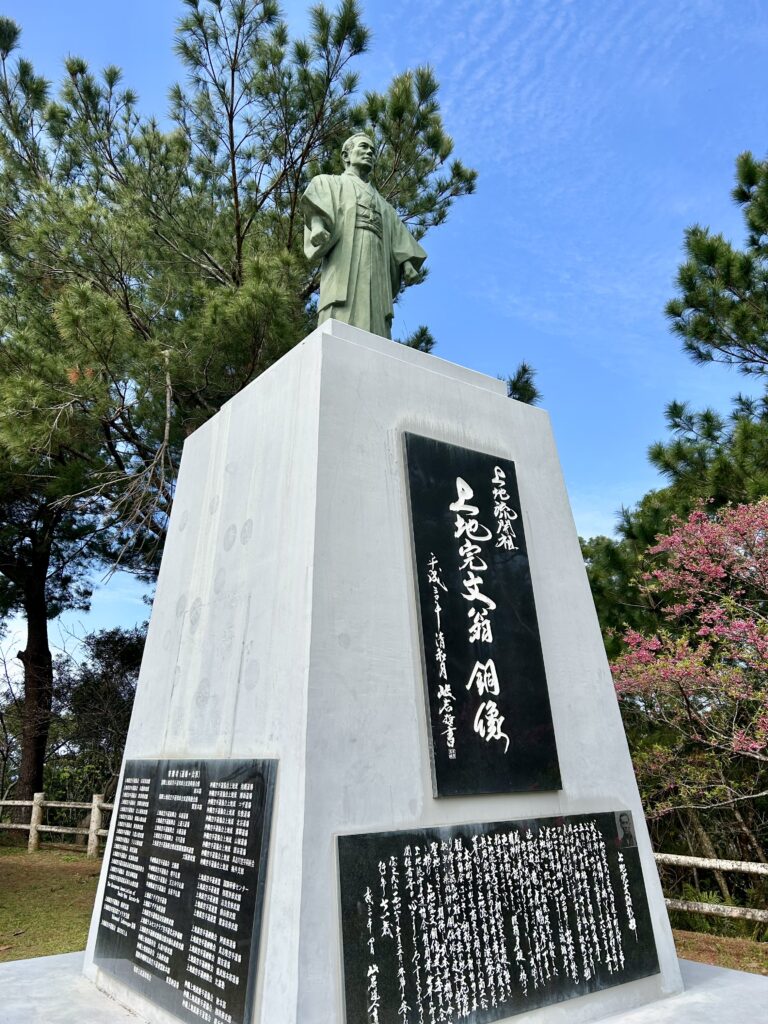
Uechi Kanbun bronze statue at Yae mountain sakura forest park near Izumi, his birthplace.
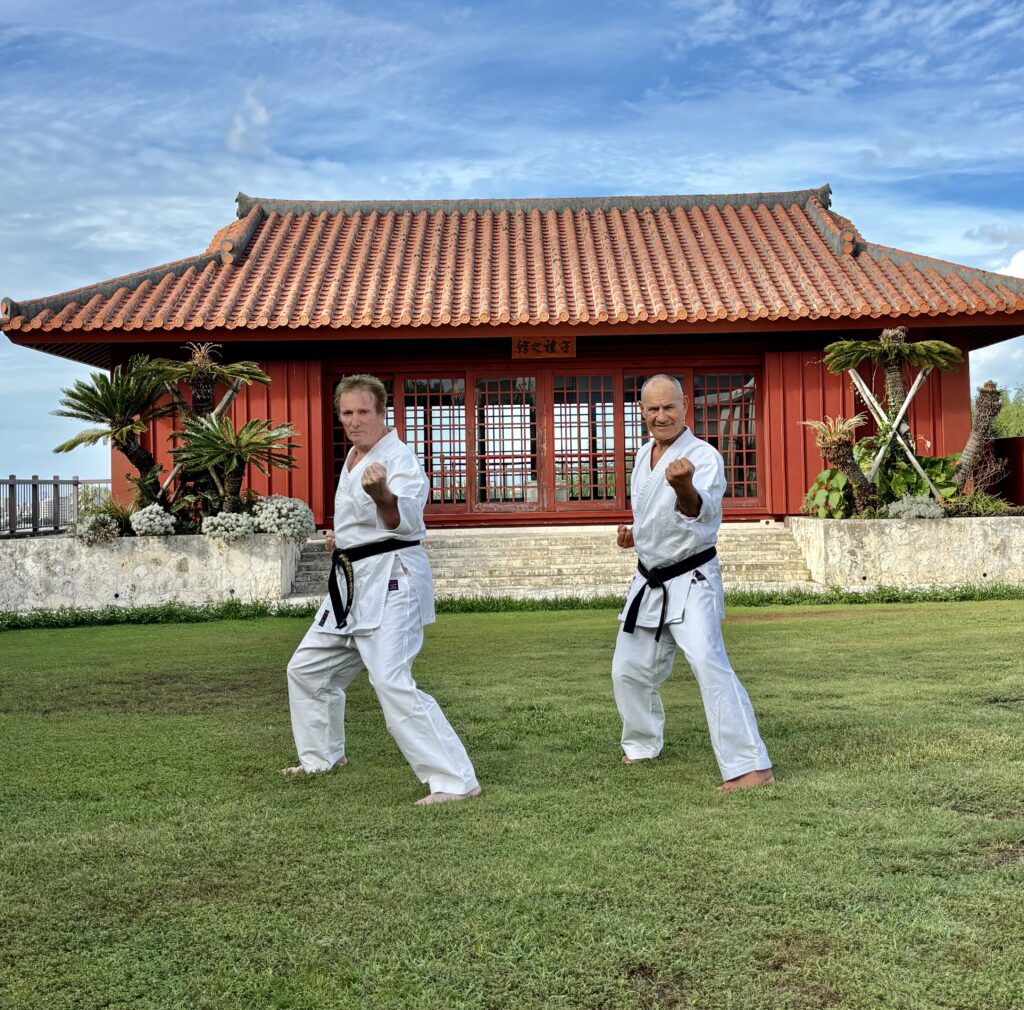
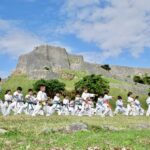
Tomigusuku “Karate Kaikan” outside Dojo (565m2) under Okinawa’s blue sky and ocean breeze.
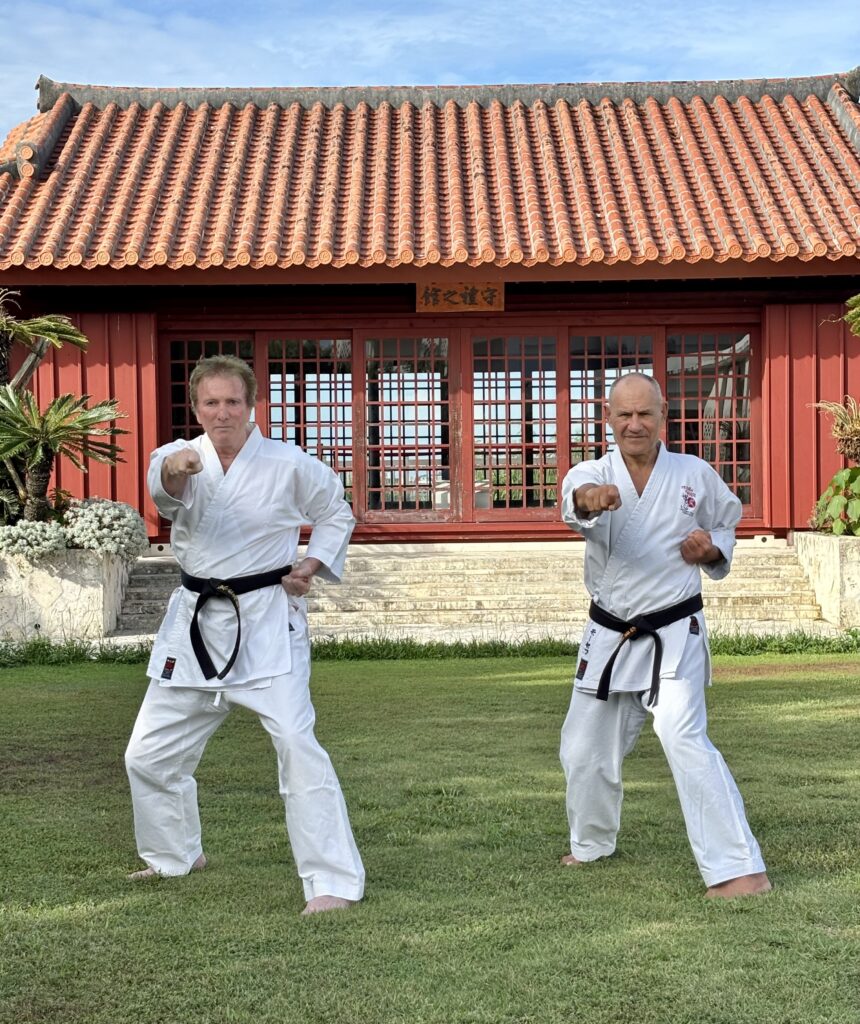
With Moncef Sensei, Kobudo 2024 World champion, in front of “Shurei no yakata” (special Dojo) where upper dan exams and demonstrations take place.
Karate no hi (Karate Day) Season
This period, that follows the long summer traditional and religious festivals, is the high season for Karate tourism. Each year, Okinawa Prefecture pays tribute to its ancestral Karate with two official annual celebrations. The first is imperatively held on October 25 and is called Hōnō enbu, which is translated by “Inaugural dedication”.
The access is restricted due to the solemnity of this commemoration. The memory of the ancestors who created Karate is honored by their lineal descendants that are at the head of each Karate-Ryu.
This year, this sacred event took place at the “Peace Park”, situated in Itoman, the Southernmost part of the island. The choice for this site, heavy in emotion, was made to celebrate the 80th anniversary of the Postwar-peace.
Sadly, the aging of the leaders made that some Masters could not attend or directly participate this year.
The beginning of the ceremony started with a floral tribute and a moment of silence. Eight Masters attended and each presented a Kata. Two groups were made and the first group involved four Presidents of four Karate organizations in this order:
-Nakazato Minoru (Okinawa Prefecture Karate-do Federation) Shorin-ryu with Kata “Kū Sankū Shō”.
-Ikemiyagi Masaaki (All Okinawa Karate-do Federation) Gōjū-ryu with Kata “Sepai”.
-Taira Yoshitaka (Okinawa Prefecture Karate-do Federation) Matsubayashi-ryu Tomari with Kata “Passai”.
-Kakazu Yoshimasa (Okinawa Karate and Kobudō Federation) Shorin-ryu with Kata “Unshū”.
Then, 4 Prefectural Designated Intangible Cultural Asset Holders:
-Kikukawa Masanari (Gōjū-ryu) with Kata “Kururunfa”.
-Maeshiro Morinobu (Shorin-ryu) with Kata “Matsumura no Passai”.
-Nakamoto Masahiro (Kobudo) with Kata “Nicho Nunchaku”.
-Takara Shintoku (Uechi-ryu) with Kata “Sansei-ryū”.
The second event, called “Kinen Enbu sai” (Commemorative Demonstration Festival), is much more popular and festive and is open to all, but given its international success, is now subject to fairly strict regulations.
It is held on the last Sunday of October and on this Sunday the 26th, it occupies entirely the “Miracle mile” Kokusai Dori (the one mile long International Street). The opening ceremony started with a speech from Governor Tamaki who is always participating in the entire event, wearing his Karate-Gi and black belt.
Fukyu Kata I, II, and III, were performed simultaneously by approximately 3,100 participants and group demonstrations followed; each one presenting a Kata. The closing ceremony was made with a prayer for world peace that everybody celebrated with 50 tsuki.
For this 2025 Karate Day, the weather was not too good and that may be why some people are still talking about last-year’s success…
(See article below)
https://budojapan.com/karate/dmspe02/

Hōnō enbu (inaugural dedication) took place this year at the Peace Park in Itoman. (Photo by Maestro Filippo Okinawa Jones)
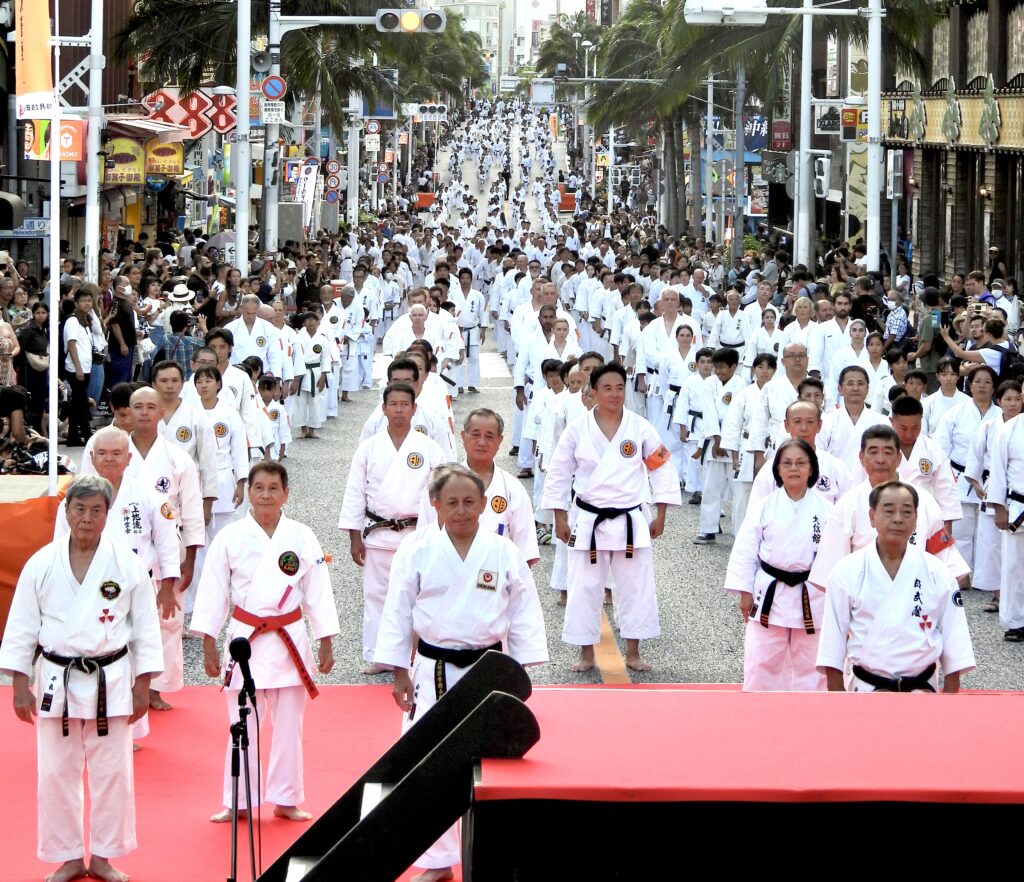
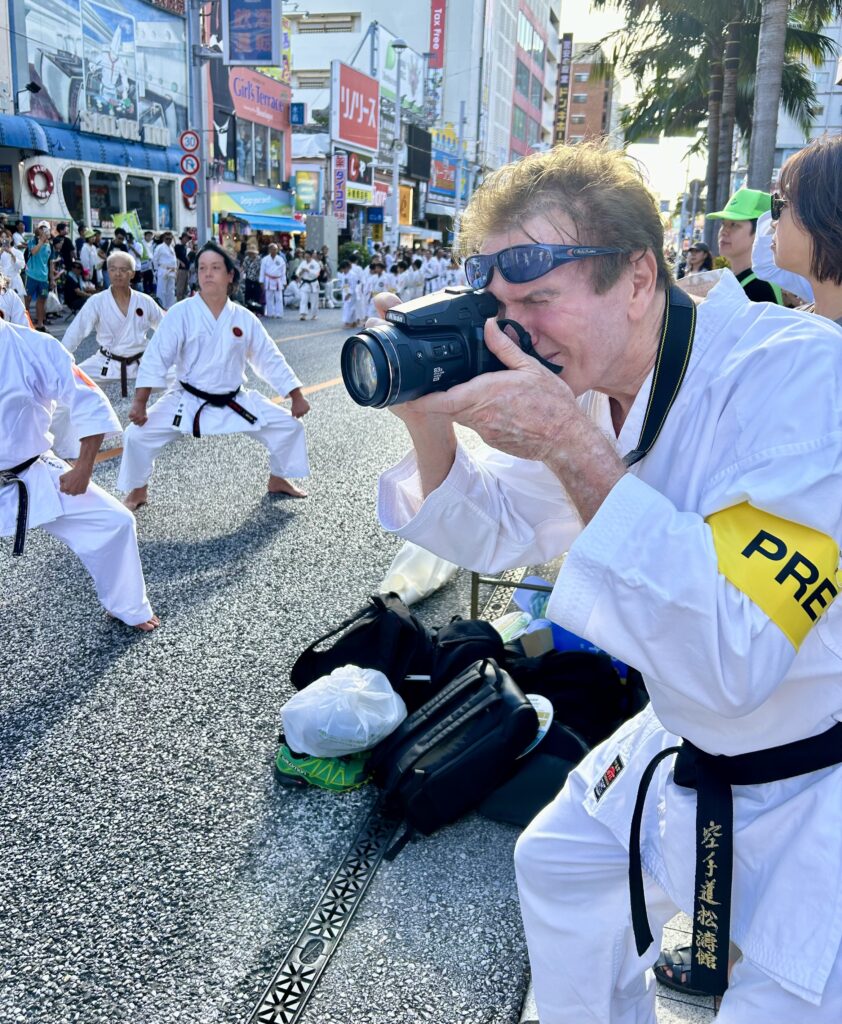
Kinen enbusai (commemorative performance) on Kokusai Dori (2024)
The spiritual home of Karate
Practitioners from around the world travel to Okinawa year-round to train in authentic Dojos, visit historical sites (like masters’ tombs or the Okinawa Karate Kaikan), and connect with the art’s roots, seeing it as a pilgrimage.
Besides “Karate Day” in October, the biggest waves of visitors follow the school vacations since Karate has become a trendy sport for children. This year, the presence of numerous karatekas until the end of November is due to the preparation and registration for next Summer’s “3rd Okinawa Karate World Tournament”. Some other major events in different Ryu are also taking place and it creates a huge influx of karatekas, coaches, officials, and fans.
As a permanent Okinawa resident, I receive daily questions from mostly French karatekas, who are often mistaking me for a tour guide. Among them, I do have old friends that I have known as far back as the 70’s. It is hard to refuse them some help.
During 2025, Yuko Takahashi and I have participated in Karate events on Okinawa with several groups including the French military, the Oshukai organization and this time, we accompanied an association group led by Sensei Moncef (gold medalist in the “Sai” division in the Men’s Senior category at the 2024 Okinawa Traditional Kobudō World Championships), for about two weeks.
During the two seminars taught by Shimabukuro Tsuneo Sensei (President of the Okinawa Kobudō Federation and the Okinawa Uechi-ryu Karate Federation), participants learned very interesting techniques unique to Uechi-ryu, such as the flat-hand mawashi uke, attacking techniques from soette mawashi uke and how to use fingers, wrists, elbows and many body parts as a lethal weapon. They also learned the full version of “Kanshiwa,” the Kata that forms the basis of Fukyu Kata III.
At the seminar delivered by Uema Takeshi Sensei (Director of the Kobayashi-ryu Shubukan Uema Dojo), participants began with basic training, then moved on to a big group practice and demonstration of Fukyū Kata I, II, and III, serving as a rehearsal for the following “Karate Day.”
The 3rd seminar was conducted by Tamaki Tatsuya Sensei (President of the Maite Honbu-ryu Gassen Toride-kai), disciple of late Yagi Isao, who was the “Moidi Motobu-Ryu” expert on Okinawa (See article https://budojapan.com/karate/dm06e/) Participants repeatedly practiced basic walking techniques and very unique punching and kicking techniques. Everyone was captivated by Tamaki Sensei’s demonstration of weapon techniques including 2 swords.
The last day, at the end of Shimabukuro Sensei’s training, everyone participated in a hip adjustment and muscle balancing session that I gave with the hope to motivate Karate teachers to care more for their bodies. Like me, many Karate practitioners have suffered hip and knee injuries and undergone surgery. Our arthritis and problems were caused by dangerous biomechanics more than just aging. Learning about and properly maintaining our body is essential to enjoying Karate throughout our life.
I hope to contribute to the Karate I love from this perspective.
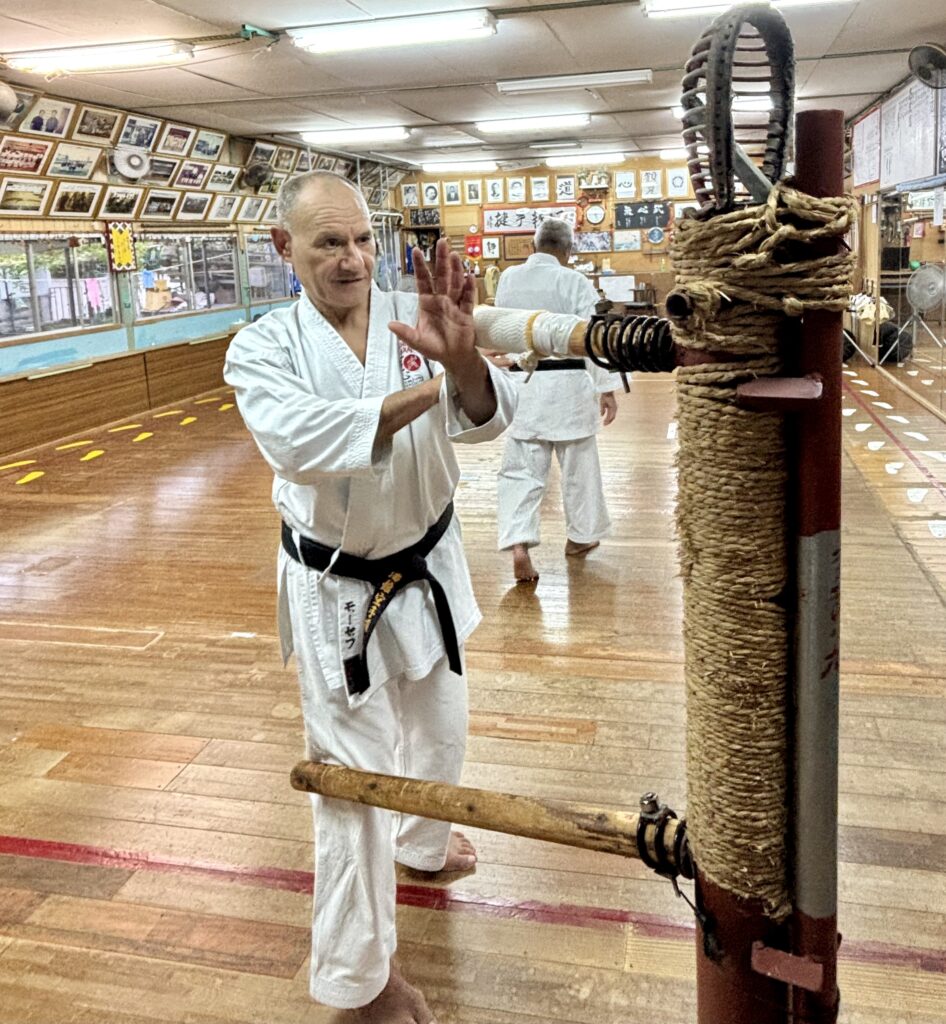
Moncef Sensei on “Bo-makiwara” during a private class at Shimabukuro Tsuneo Sensei’s honbu Dojo under Katsuren medieval castle.
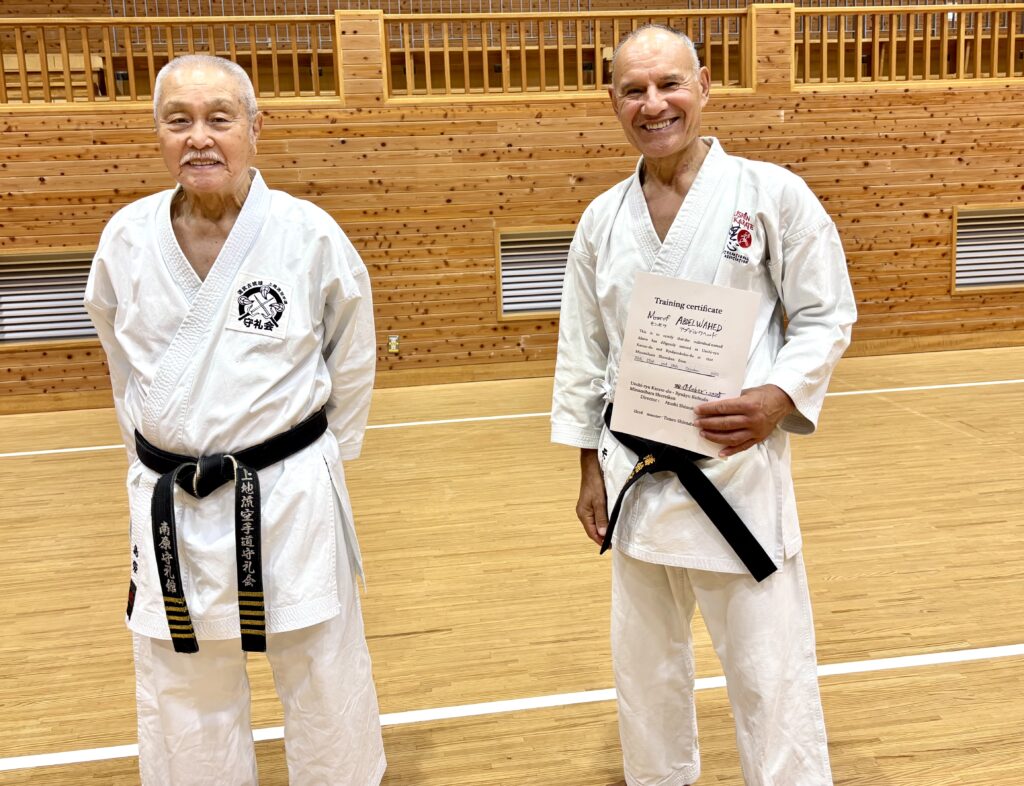
Moncef and Tsuneo Sensei.
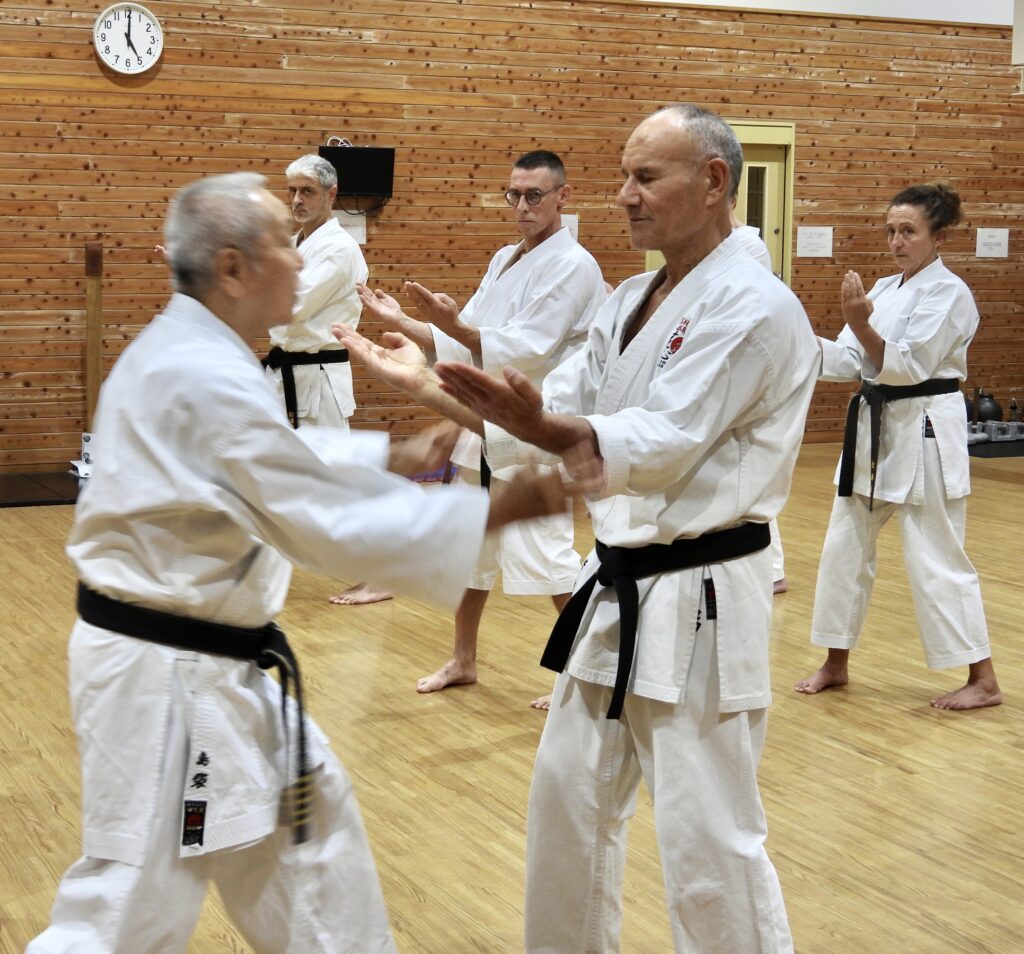
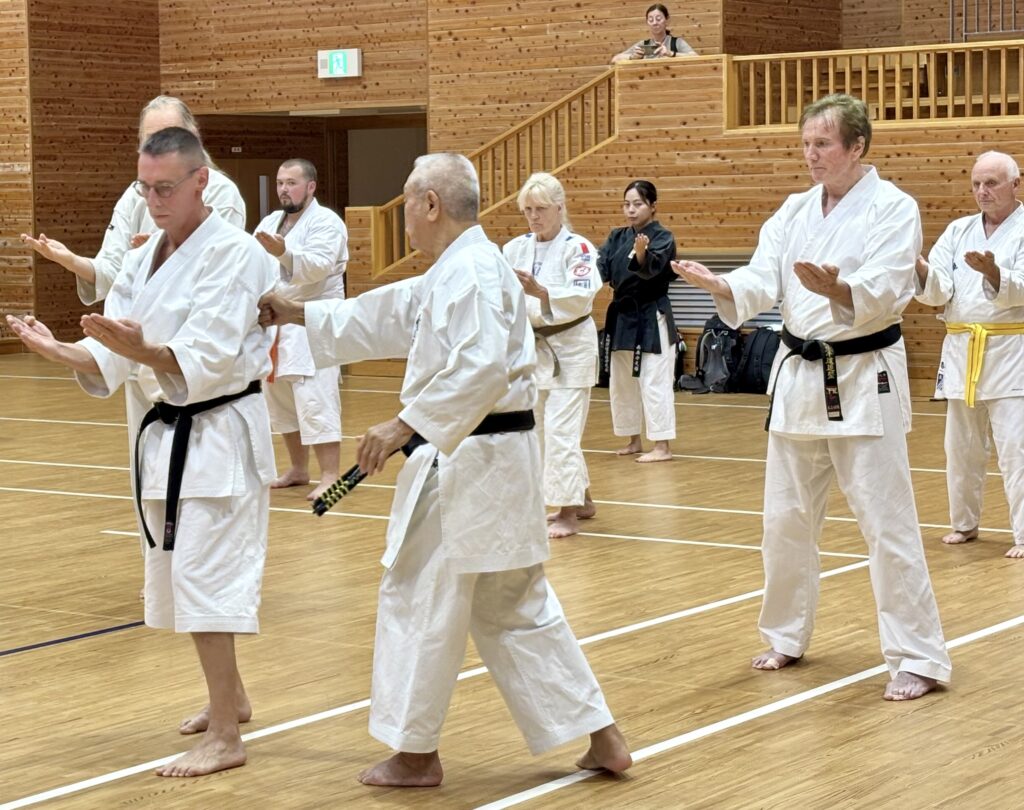
Strengthening the body while correcting techniques is part of Uechi-Ryu’s philosophy.
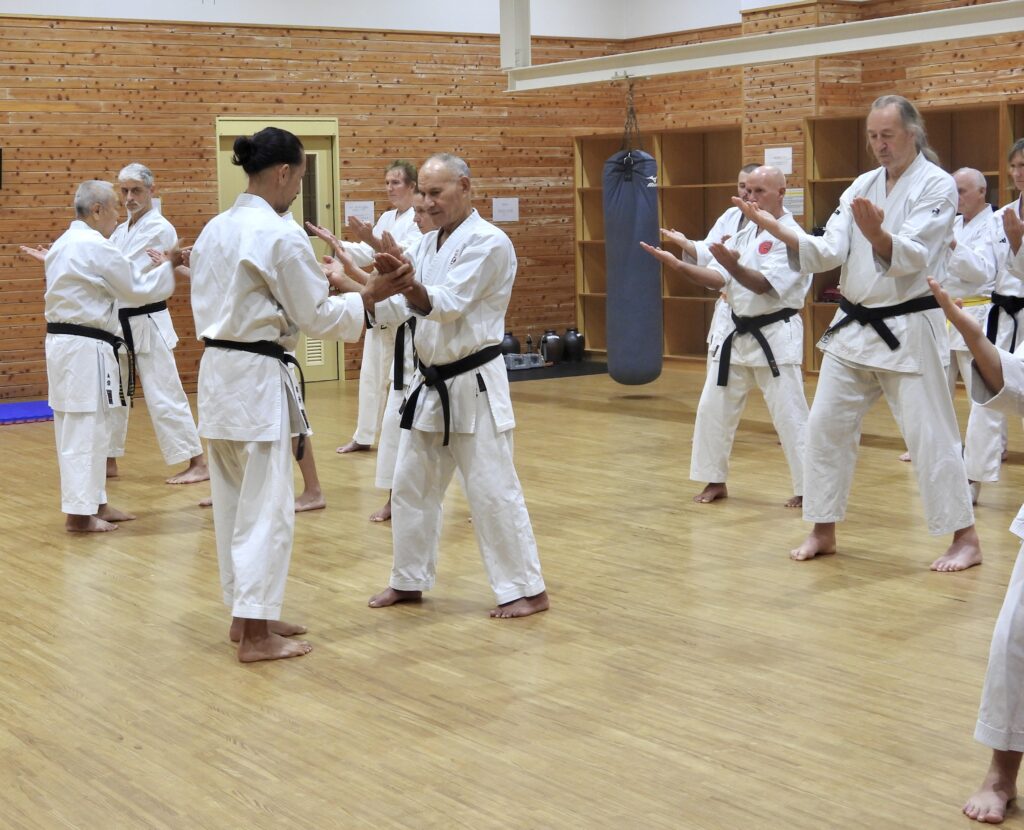
Zukeran Chōgō Sensei, main assistant of Shimabukuro, correcting details.
“History is telling us”
Indeed, I have a lot in common with the repeaters that come once or twice a year. Many are around my age and have started with the same JKA Karate reinterpretation. This long, linear and swinging hip style, exported to Europe and America in the 1950s–70s and that became the standard image of Shōtōkan.
France was particularly fond of this style that is still widely taught.
The Japanese teachers who acted as missionaries were for sure impressive young karatekas, but very few had knowledge about the body and experience for teaching to foreigners in those days. Okinawa Karate was passed on to Japan with many misunderstandings and then passed on to French teachers with more misunderstandings. In both cases, language barrier and cultural differences were the cause for poor communication.
Another historical theory is that, after the war, when Karate was systematized for Japanese universities and the JKA was created, many instructors (often with Jūdō or Kendō background) started interpreting anatomical parts the same way Jūdō uses it. They didn’t see that Karate is a “Gō”(hard) and explosive martial art that doesn’t need to swing the hips, contrary to “Jū”(soft) Dō(way), which uses fluid, circular techniques to induce an opponent’s loss of balance.
In Jūdō, the hips are the center of rotation and are used for throwing.
The typical “Koshi-waza” is a good example. However, here the word “Koshi” is confusing because in precise anatomy, “Koshi” describes the part of the torso between the ribs and the hips. The hips, that are fundamental in Judo, are a different anatomical part called “Kotsuban” in Japanese and represent the pelvic area where the upper legs connect.
In original Karate, the motion comes from the waistline (“Gamaku/Koshi”) that powerfully rotates the torso and not the hip. The hip only acts as a support with the back leg.
In the Shōtōkan that I have learned, it is the foot and the back leg that violently push the hip forward while the torso remains fixed…
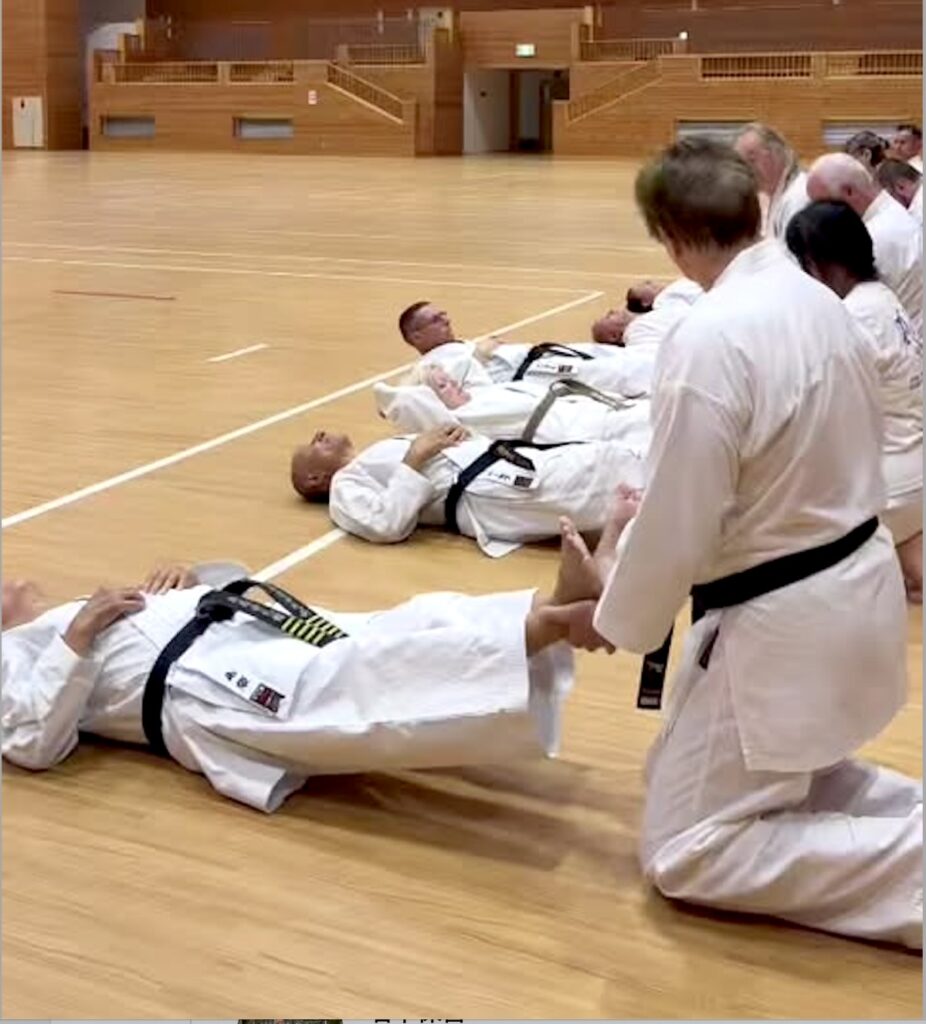
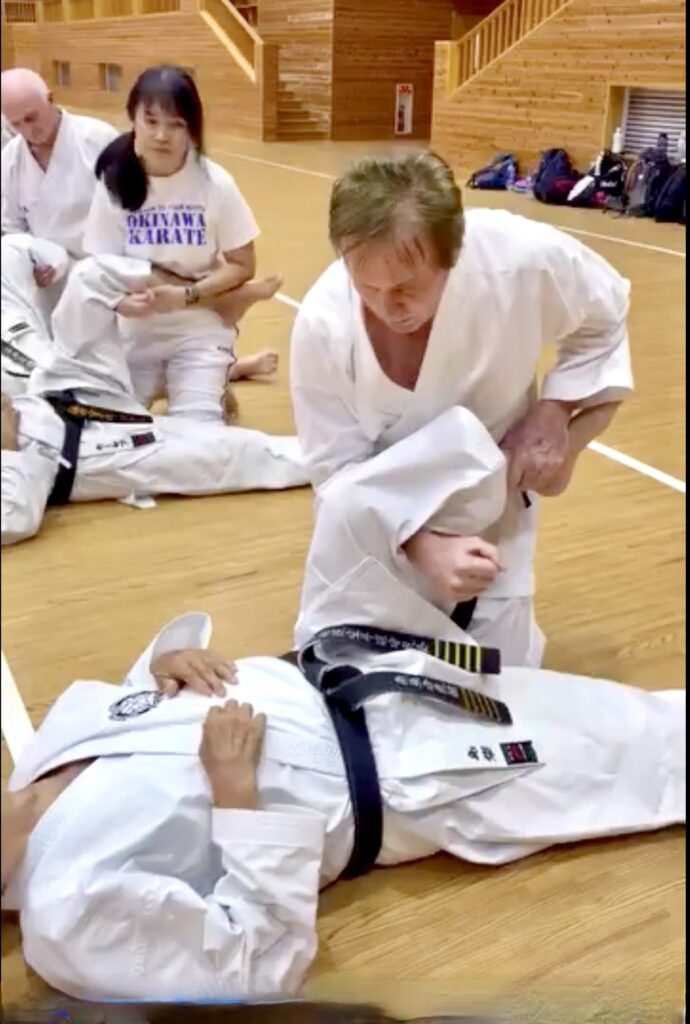
Therapy session after training. Adjustment of the hip-joint and muscle-balance.
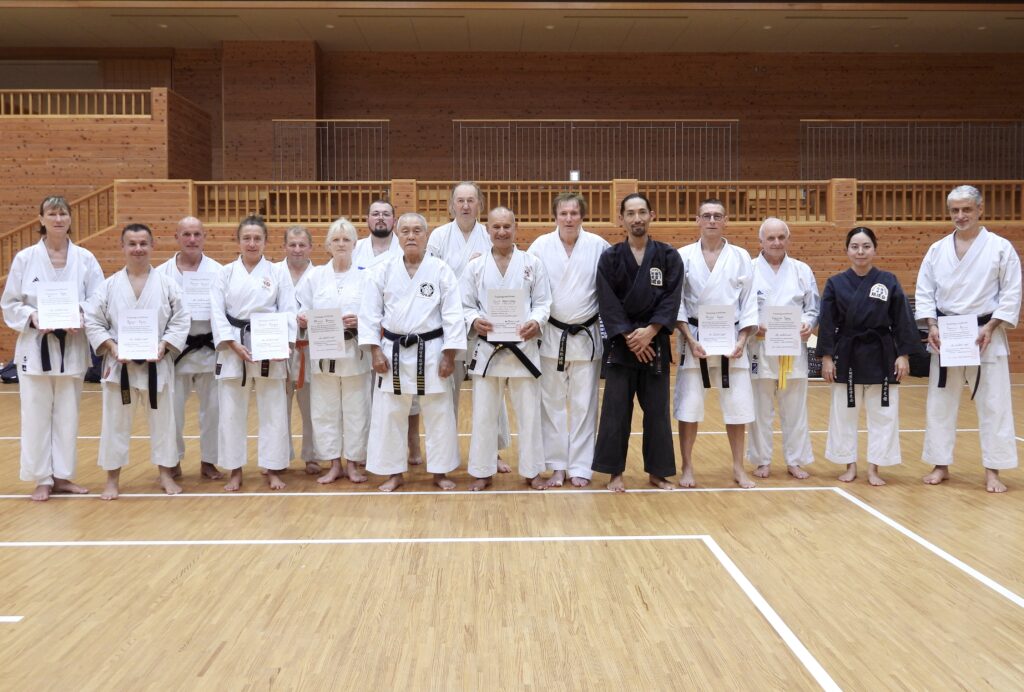
Line-up with Shimabukuro Sensei, Zukeran & grand-daughter Saki, his assistants.
Explaining the “Gamaku”
In traditional Okinawa Karate, we are asked to engage the “Gamaku” to advance or to throw a technique.
It alternates between being tensed or relaxed independently of the hip joints. The power comes from inside (tanden area) and not from outside (hips & legs).
Higa Yuchoku Sensei (https://budojapan.com/karate/dm11e/) said to imagine punching with fists on each side of the belly-button…
Using “Gamaku” is much harder from a low position and the heavy pressure exerted on the hips would make it less effective for spinning and for dragging the back leg. This would have the consequence of generating less rotational force. That is why Okinawa Karate adopts higher stances. Exaggerated pelvic tilt seen in French/European Shōtōkan, JKA-style are different from the “Koshi/Gamaku” power that Masters Itosu, Funakoshi (early period), Motobu, Mabuni and most Okinawan lines meant. Modern misinterpretation makes people violently thrust the pelvis forward or swing the hips sideways, thinking they are using “Koshi/Gamaku”.
In traditional Karate, the pelvis itself moves very little; instead, the whole lumbar–core region twists as a block, while the hip joints stay relatively closed and slightly flexed. This is why old masters could deliver devastating power while appearing almost still from the waist down.
Despite traditional Okinawan texts and Funakoshi Sensei’s books described clearly that “Gamaku” (in Okinawa language) or “Koshi”腰 (in Japanese) represent the waist area, some karatekas spread the mistake, making the world believe, that “Gamaku/Koshi”腰 and “Kotsuban”骨盤 (the hip), are the same thing. The legend of the hip was born and visual demonstration had to be exaggerated to make the movement easier to see for large groups.
Anatomically, ”Gamaku” represents the waistline with its various muscle groups (including the abs, the obliques, lower back and inner pelvic muscles) that flex, extend and rotate the torso like a pivot at the waist. It also allows “pelvic tilt”. Nowadays, sport-trainers call it “the core”.
The best way to experience “Gamaku” is by throwing punches and blocking techniques while seated…
As we already said, the hips (“Kotsuban”) refer to the lower anatomical part that connect the legs to the pelvis. The hips are primarily the coxo-femoral joints, which connects the pelvic bone and the femurs. The hips, therefore, have a well-defined articular function in relation to the legs, assuring mobility, balance and stability. They enable a wide range of motion of the legs in flexion, extension, abduction, adduction and rotations.
Unfortunately, after all these years, it is very hard for our nervous system to forget everything we have learnt and to adopt the higher, easier and healthier postures from most Okinawa styles…. It is heartbreaking to discover that better Karate existed!
I feel that some older karatekas are coming to Okinawa in search of the truth and maybe of a miracle. I compare this to the people who go to the holy city Lourdes in France.
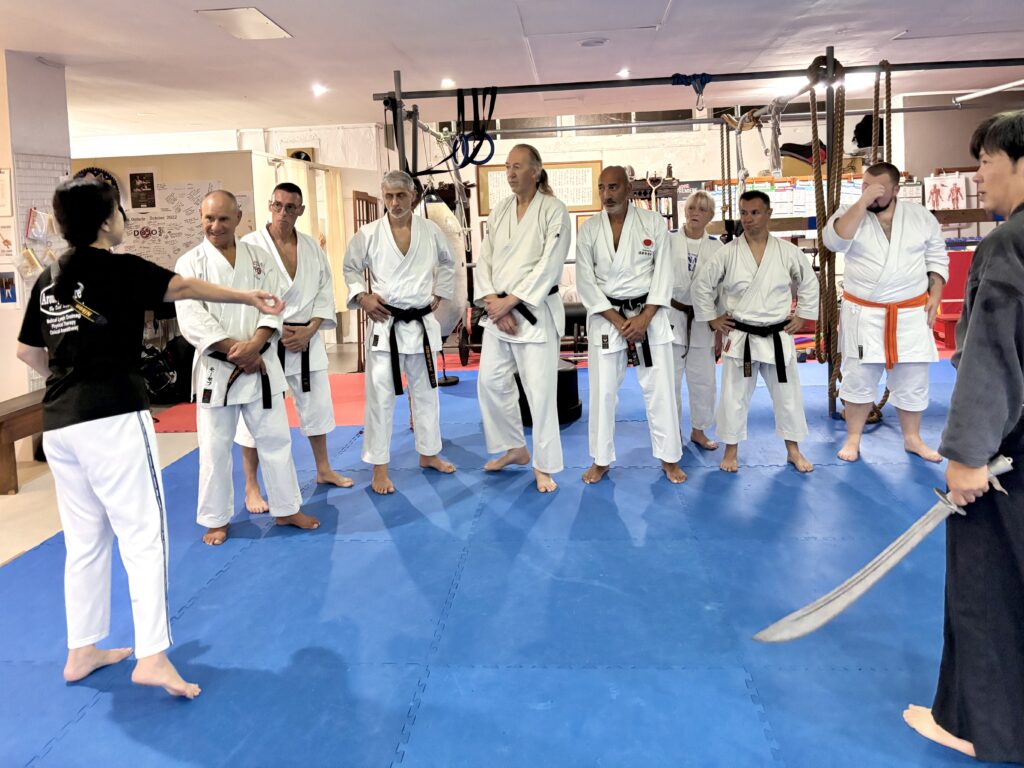
Yuko Takahashi introducing Moncef’s group to Tamaki Tatsuya “Kaicho” of the the ancient and secret Moidi Motobu-Ryu.
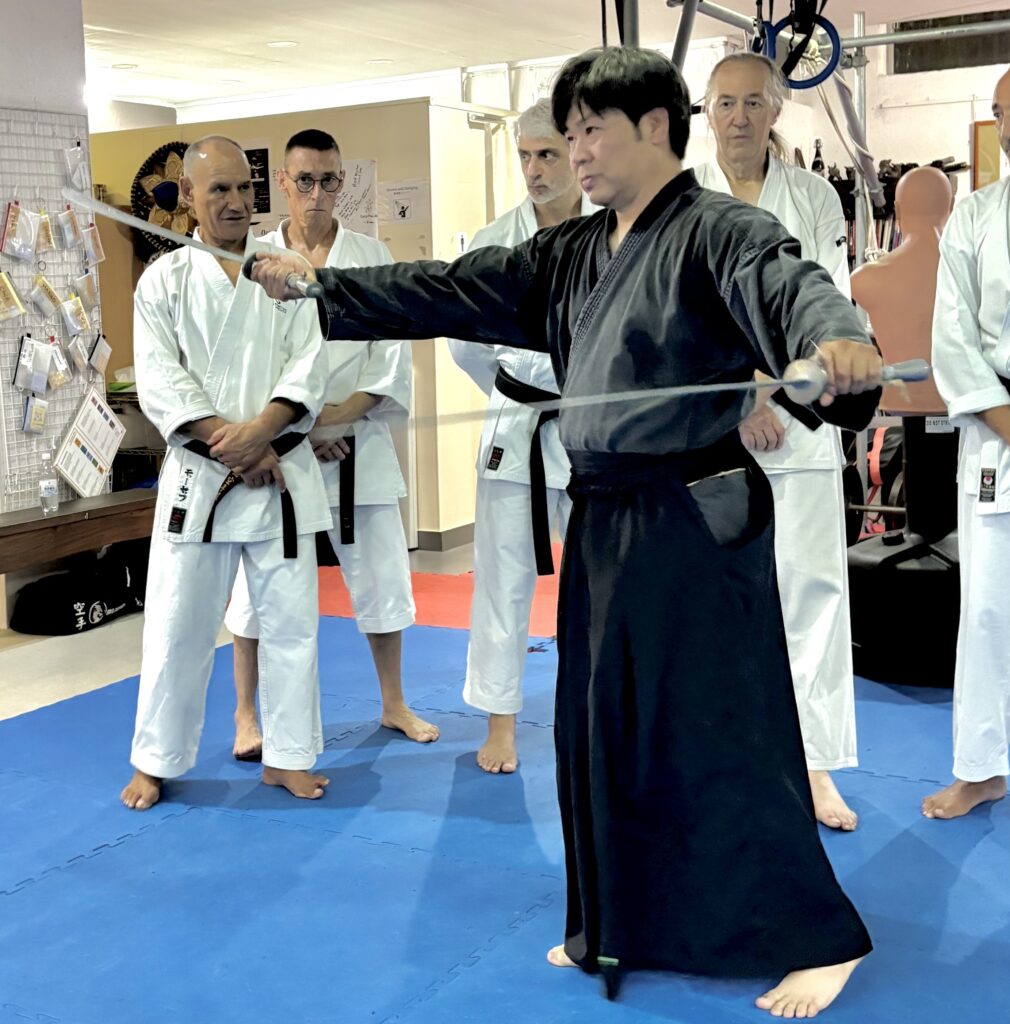
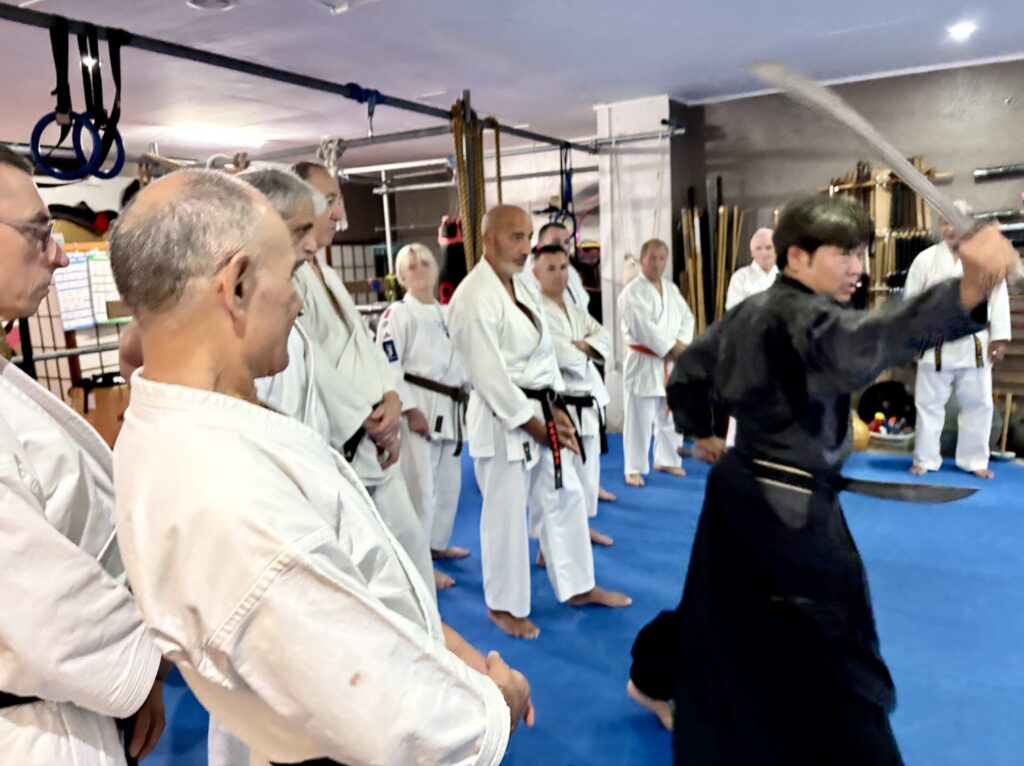
Moidi Motobu-Ryu has very special bare-hands techniques and a rich Kobudo that includes impressive double-swords techniques.
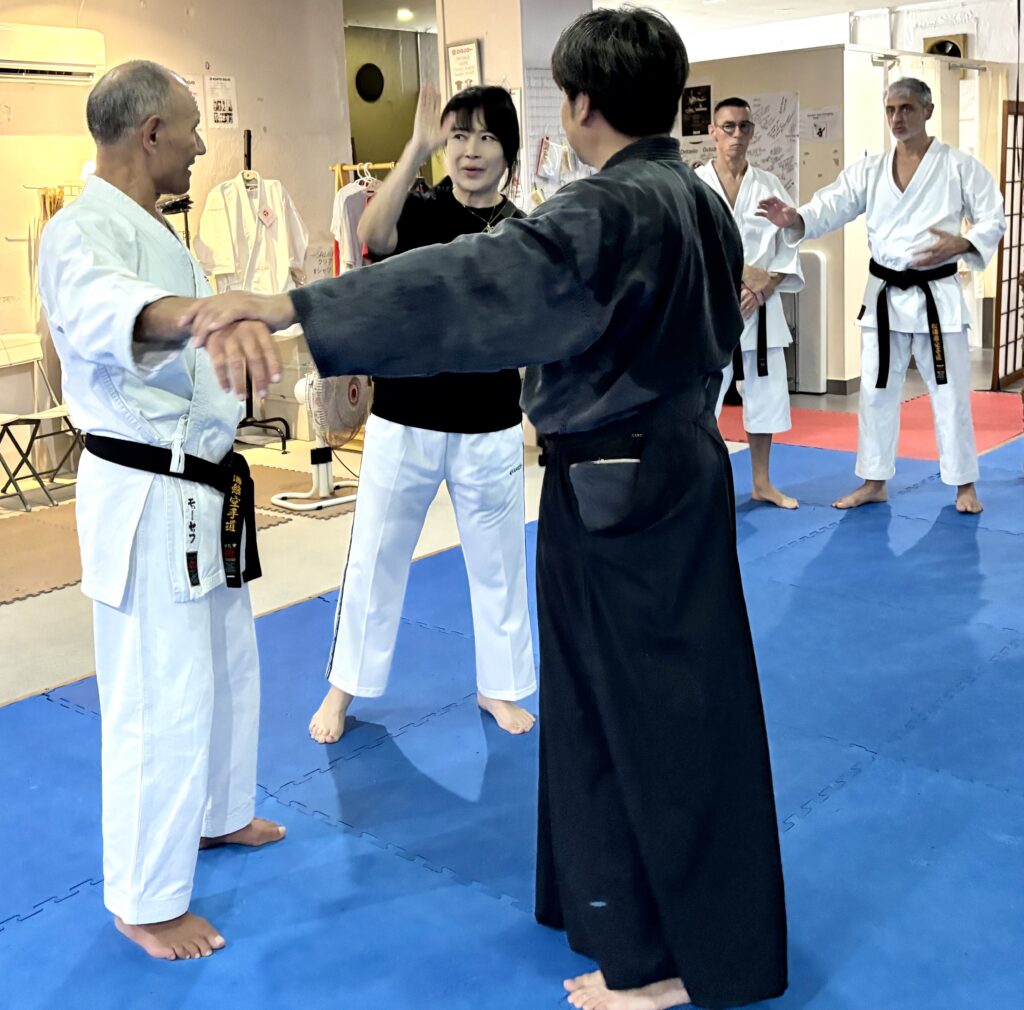
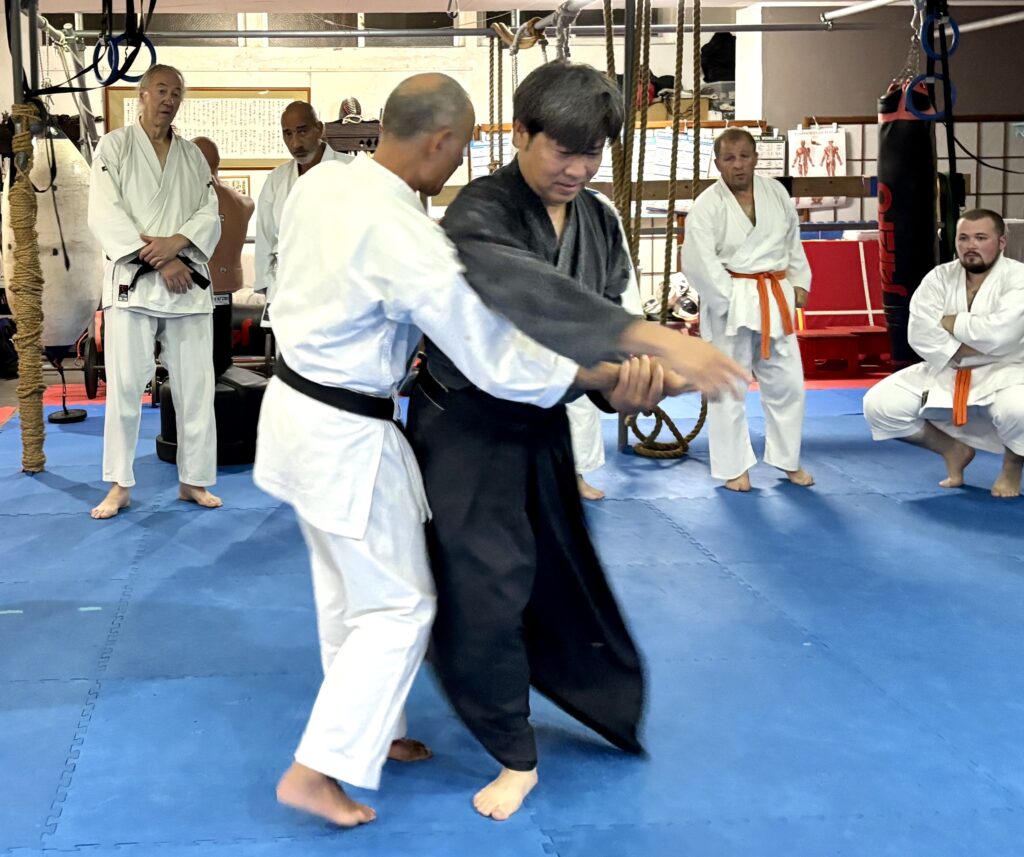
Yuko explains to Moncef that “Tuidi” (Torite) is aso a big part of this martial art.
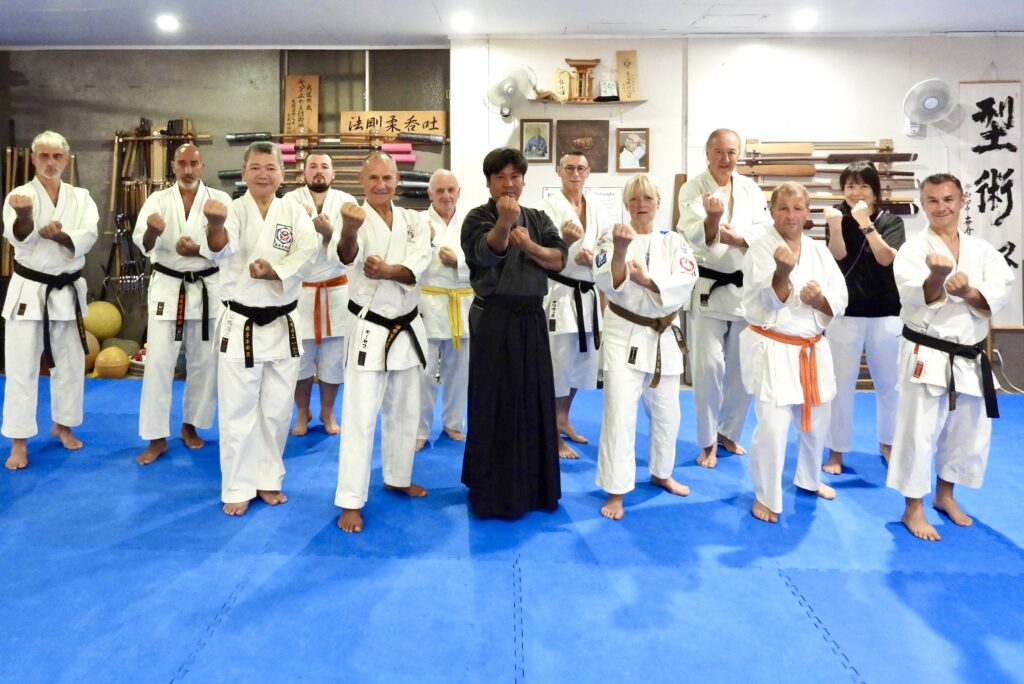
Line-up with Tamaki Sensei and his assistant Yamashiro Kōji.
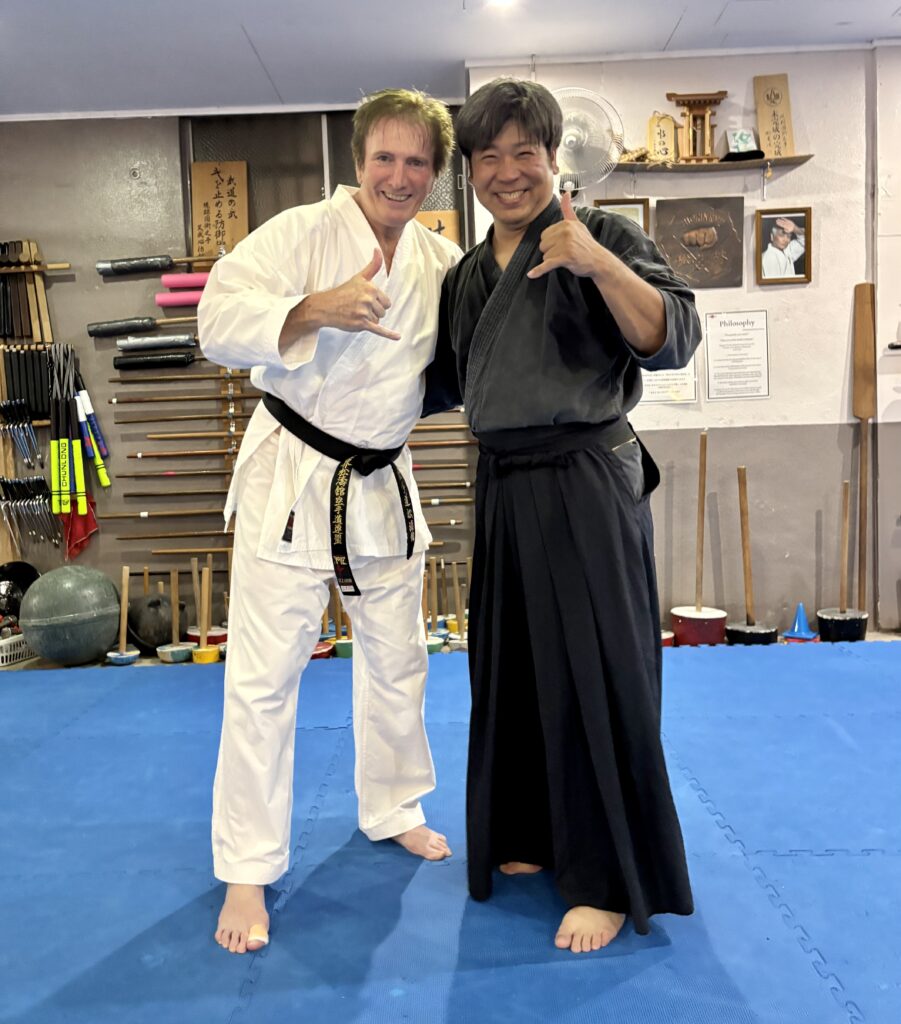
Daniel with his friend Tamaki Tatsuya Kaicho.
The reality of body-types and physics
It is common-sense to admit that body types significantly affect biomechanics because physical characteristics like height, weight, limb length, and body composition directly influence movement efficiency, balance, and the way forces are transmitted through the body.
As much as boxing and kick-boxing were fun, very effective and relatively easy for my body-type, Karate has always been strenuous for my legs.
Karate was not made by people with long limbs and it therefore requires you to adopt lower posture if you have long legs, in order to fit in the Karate image. The lower you need to go, the harder it is. When the limbs are longer, the body needs to generate more force to move or stabilize, because the torque required at the joints (especially the hips and core) is greater. This makes holding and moving from low positions more demanding on the core and surrounding muscles. Taller individuals with long legs have a greater distance to travel to reach a low position and it is harder for them to lower their center of gravity. This means a larger range of motion is required in the joints and especially the hips.
This is another reason to validate that my Karate was not good for me.
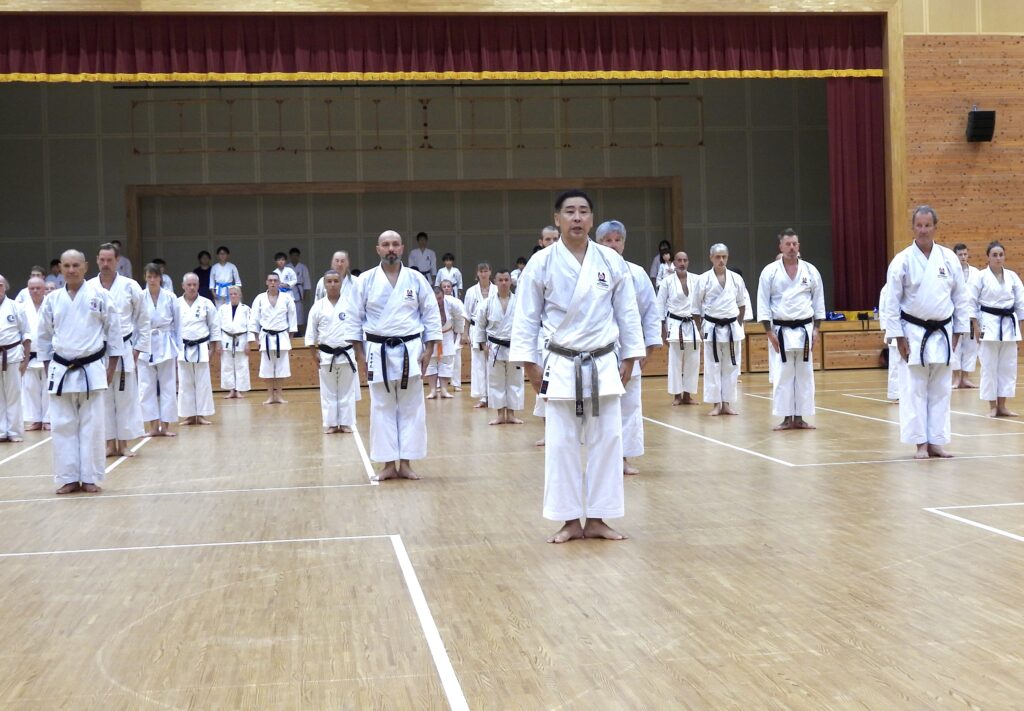
Starting to feel what Fukyu-gata is from a Shotokan’s perspective.
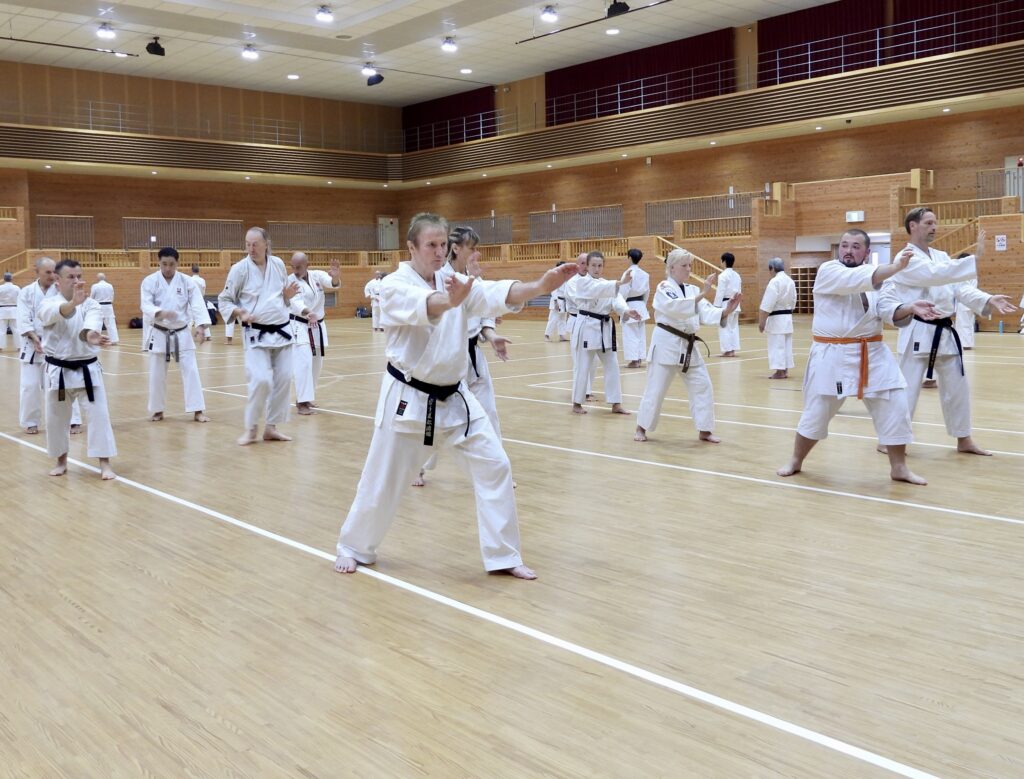
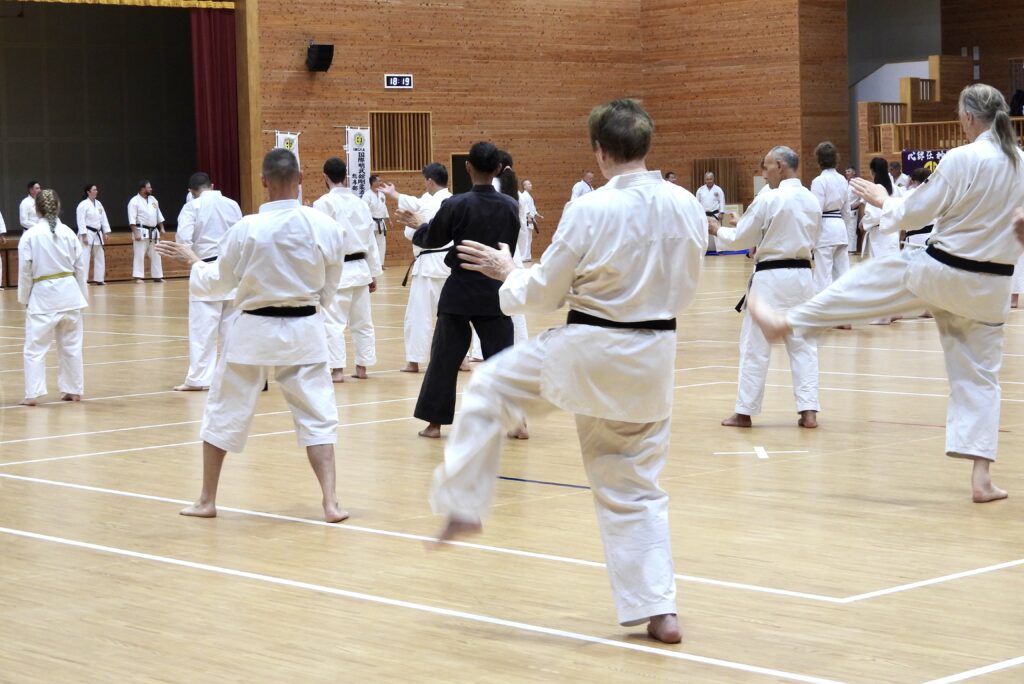
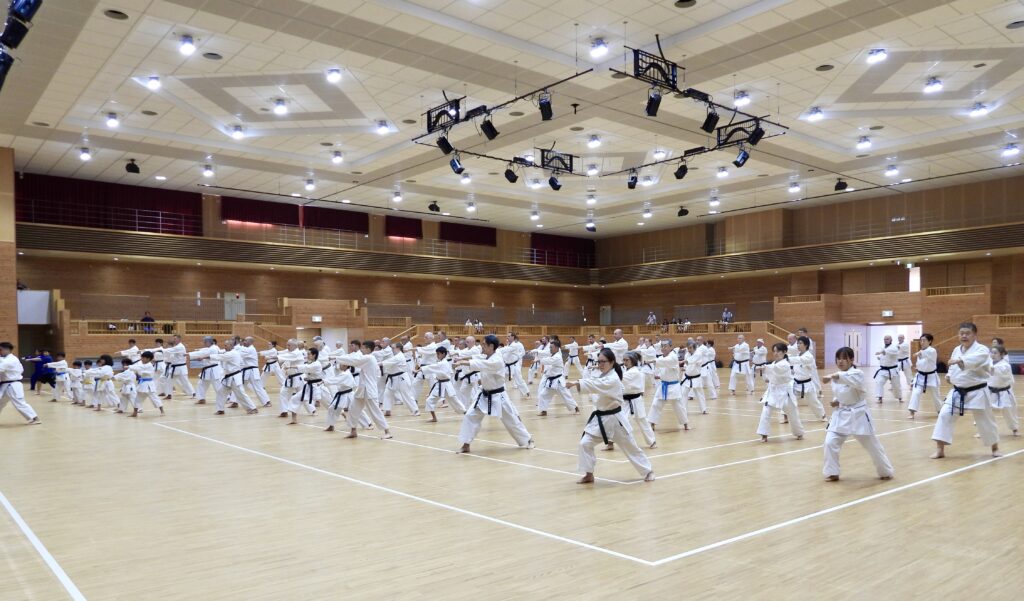
Training with Uema Takeshi Sensei, using the 4 courts (1278m2) main Dojo, made with a natural red-pine floor.
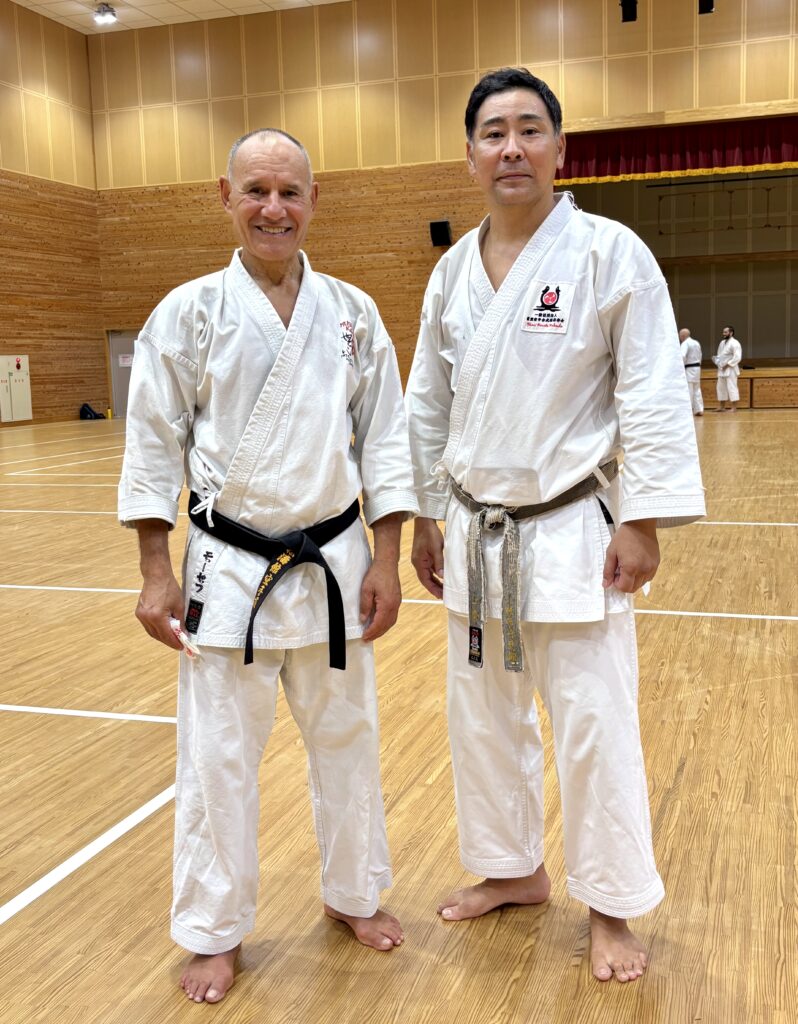
Moncef with Uema Takeshi Sensei.
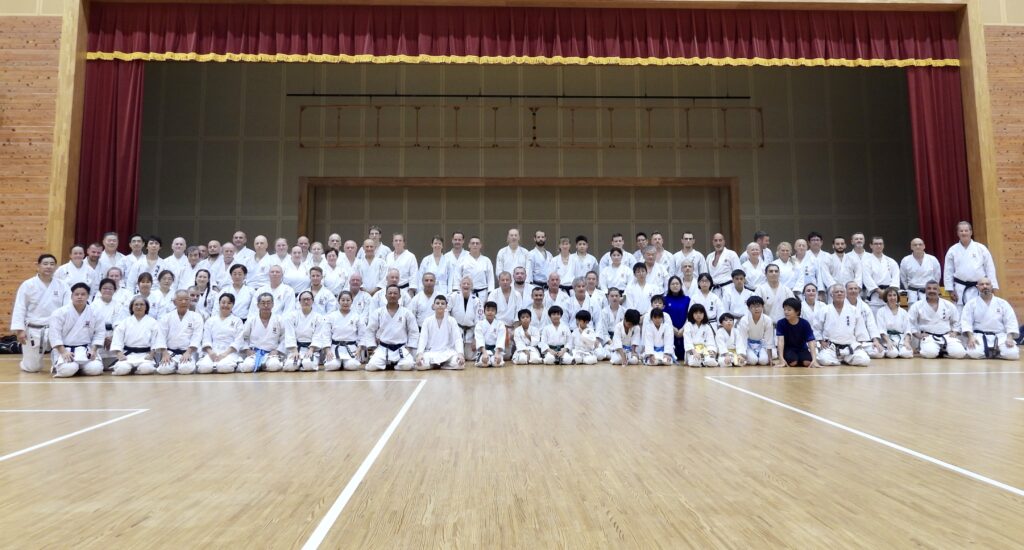
Line-up with the group.
Time for an alternative Karate
After the trend toward teaching Karate to very young children (“Kindergarten Karate”), there is now a strong ambition to open Karate for all, including the old, the sick and the handicapped.
Some teachers and therapists have already proposed for years a modified or adapted Karate for those affected by limitations caused by aging, sickness and disabilities. However, it is the very official and governmental French Federation of Karate that introduced “Para-Karaté” to the public in 2012, at the World Championships in Paris.
It is a wonderful decision that could be also extended to those who dislike traditional Karate, because they find it too difficult or complicated to learn.
Some people would love to learn Karate, but just want to do keri and tsuki.
They don’t have a burning ambition to become experts. They just wish to learn some Karate quickly as a sport and for protection. They also prefer to go to a Dojo and wear a Karate-Gi than joining a kickboxing-gym. Let’s greet them and not kick them out!
Karate leaders must therefore not only tolerate the coexistence of “Dento” (traditional) and “Kyogi” (Sport-Karate), but the creation of a simplified Karate.
Until now, we have forced people to fit the mould and to adapt to strict Karate forms, no matter their size and their body types. Even Kung-Fu possesses different forms tailored for taller sizes attributed to Northern China or for smaller sizes in the South.
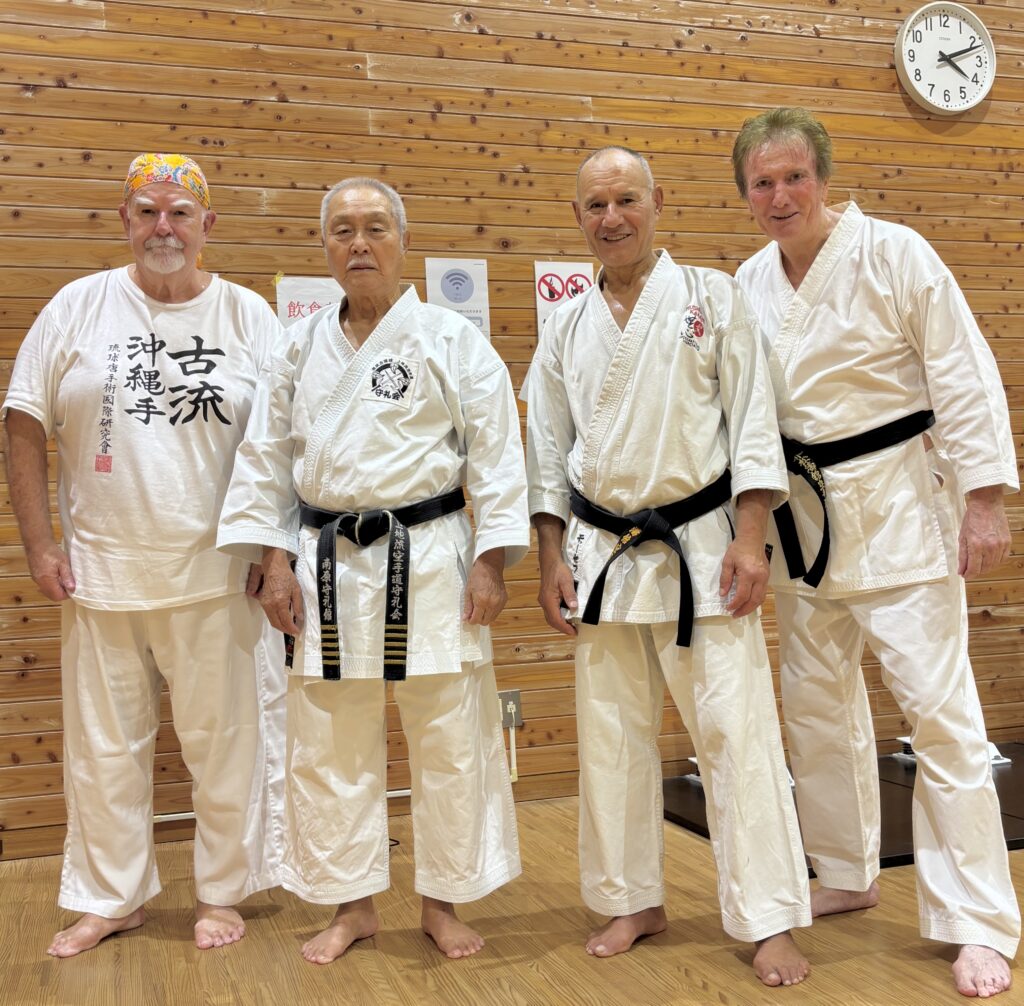
Patrick McCarthy Sensei is visiting us in the “Tanren Dojo” after teaching his class next door.
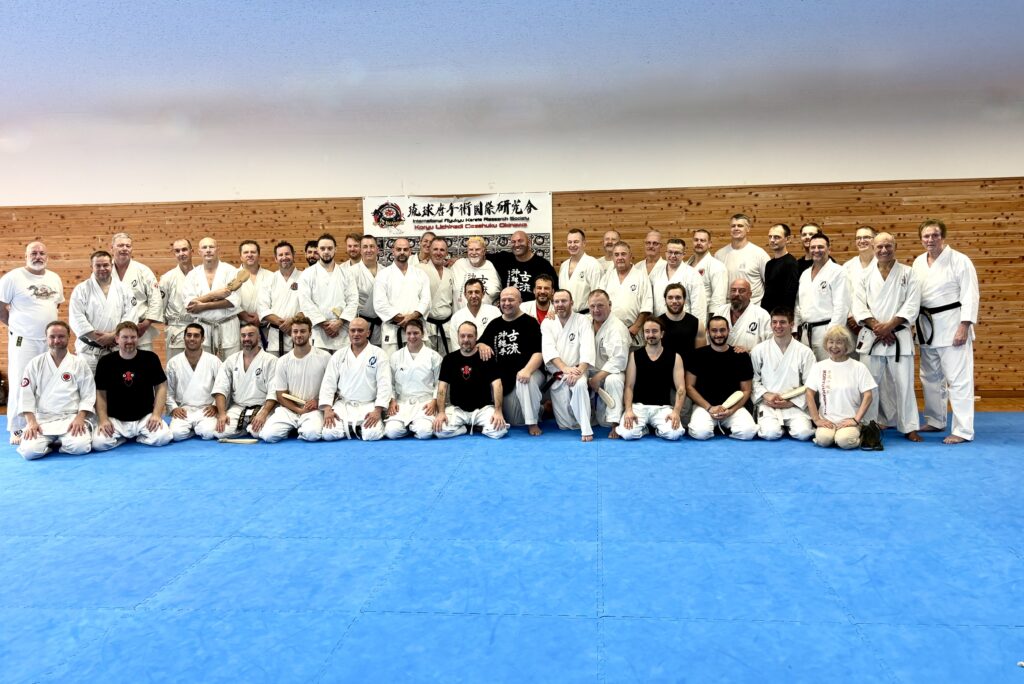
Line-up with Patrick Mccarthy’s group.
The Karate attitude…Karate can be a double-edge knife for the ego!
Karate is still mostly appreciated by the prowesses and the athletic skills that are displayed by the practitioner. Young champions and actors are our role models.
This sadly makes demonstrations and competitions the reference to judge the level of a karateka. Beautiful is often mistaken for effective and there is no place for the average performer and no mercy for the “has been”.
This is in total contradiction with the idea that Karate would not be a sport?
This is also a reason why some ex champions or old Masters will not risk to be laughed at during a demonstration and often refuse to perform on video.
As a therapist, I am talking a lot about the impact of Karate on the body and physical health, but I would like to get into an even more taboo subject; the Karate impact on mental health.
The reason why Karate acts as a double-edged knife for the ego is because the journey demands profound humility and discipline, yet the progression can easily lead to overconfidence and arrogance. Westerners are particularly prone to face this challenge since their cultures don’t teach humility. Many teachers push their students to be perfect and winning is very important in our Occidental cultures. We invented the “Olympics” and the notion of sport is very much connected to the ego. On the contrary, humility is an important and integral part of most Asian cultures. The Senseis always wish that their visitor students can bring home Okinawa Karate, but also Okinawa spirit.
“Reisetsu” is often wrongly translated by “Respect” which is “Sonkei” in Japanese… “Reisetsu” goes beyond, with the idea of adopting good manners and good behaviors that are coming from a pure heart…
No matter where we are and who we are, Karate values should not stay in the Dojo, but must shape daily life, focusing on character development rather than just physical skill.
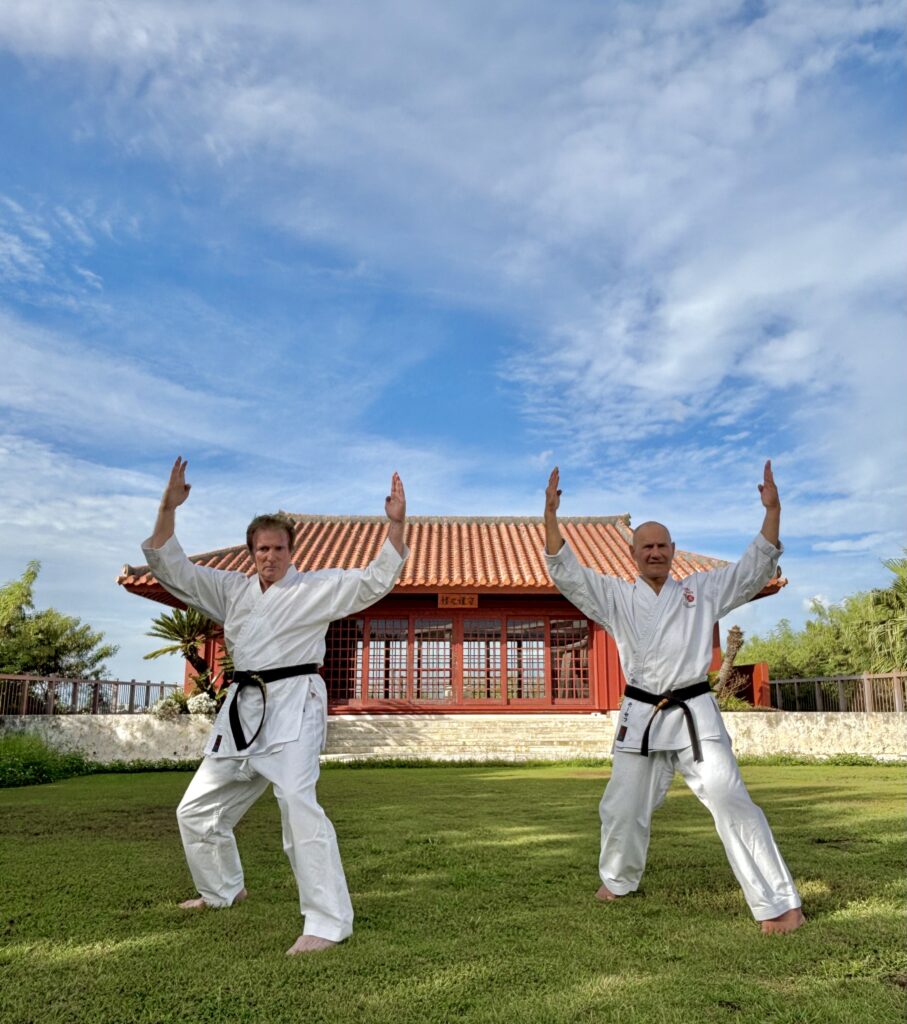
Feeling blessed to be training in Okinawa.
Daniel’s conclusion:
During the last few weeks with my friend’s groups, we were sometimes going daily to the “Karate Kaikan”, a very convenient place built in 2017. Typically, Karateka from abroad (and especially the French), stay in Naha and don’t rent a car… Over the years, they keep coming, but always to the very same Dojo and hotel. Rumor has it that a Karate Sensei would be mad if you visit other Dojos… If I knew such a Sensei, I would not continue to learn from him. This is not in the spirit of Okinawa. Thus, I am glad to introduce my friends to other great Sensei that may be less publicized, but that are respected Karate leaders. Some have a Dojo in a remote place and some others don’t have a Dojo anymore. That is why, the “Karate Kaikan” allows now the Masters to come to you in a very special atmosphere that does remind the European Karate Dojo/gymnasium. It may not satisfy those who are coming for the pure tradition, but many enjoy the mix of several classes going on at the same time. This allowed us to meet other famous Karate figures and we had very friendly encounters with Sensei and their students from different places of the world.
Many thanks to Masters Shimabukuro Tsuneo, Uema Takeshi and Tamaki Tatsuya for their kindness and for having greeted and accommodated the schedule of our French Karate group.
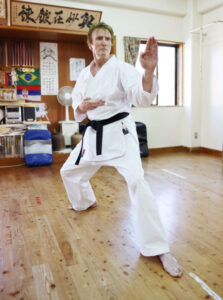
Daniel Mardon; the Karateka-Therapist
Creator of Aromapressure® method and physiotherapist with a valid US license, Daniel Mardon was born in Paris. One of his specialties is to teach and to perform lymphedema and subcutaneous tissue-damage care, after radiotherapy for cancer patients at medical institutions and subcutaneous tissue-circulation stimulation before and after surgery.
He was also a therapist for two famous soccer teams in Paris. Since 2005, he has focused on producing top-class hotel spas in Japan, as well as physiotherapy education and awareness-raising activities for health care professionals. Author of several books, among his major publications includes “The Physiology and Bodywork of Physical Therapy ” (Published by BAB Japan) and DVD “Daniel Mardon Aromapressure® Method ” (Pony Canyon). He regularly appears on television and radio shows, and has featured in numerous media publications.
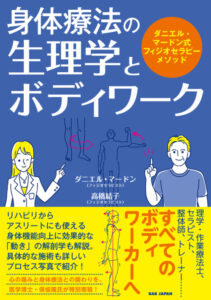
『身体療法の生理学とボディワーク』(The Physiology of Somatic Therapy and Bodywork)
Co-written by Daniel Mardon and Yuko Takahashi
On sale now on the BAB Japan website!