

“The Sword and the Chrysanthemum” by Paul Martin Part6: Japanese Sword Polishing
Text by Paul Martin

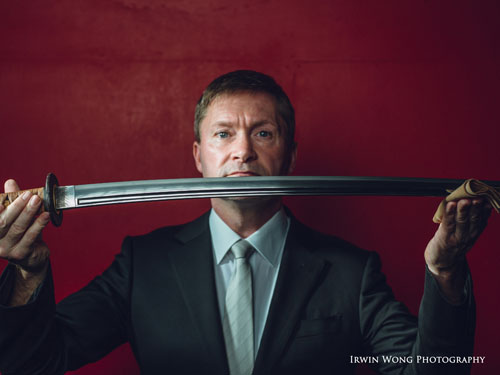
Paul Martin and his Kamon(Photo/Steve Morin)
Each installment of this series is available for a limited time only—don’t miss it!
(Publication period: April 14, 2026 – May 13, 2026)
*Editor’s note. This brief explanation of Japanese sword polishing is in no way shape or form a guide to polishing Japanese swords. It is only an explanation of the Japanese sword polishing process, the training required and the complexities of the profession. Please do not attempt to polish any blades yourself, but send them to a professional Japanese polisher who has completed a full apprenticeship under a recognised artisan teacher. If you would like help in contacting a Japanese sword polisher please feel free to contact the NBSK, or NBTHK.
Japanese Sword Polishing
Once the forging of the blade has been completed and the swordsmith has given the sword a rough polish (kaji-togi) it is then passed to a professional sword polisher. The polisher uses a variety of whetstones and copious amounts water to polish a blade. He does not only hone the blade’s edge, but he must also perfect the overall shape and bring out all of the characteristics of the maker and the intrinsic beauty of the blade.
Japanese sword polishers do not only polish new swords, it is also their job to restore and preserve old blades too. As you would expect, in order to preserve an old blade, you do not want to have it polished very often. This is because every time a blade is polished a small amount of steel is removed. However, it is much easier to care for and preserve a blade that is in good polish and in shirasaya (plain wooden sleeping scabbard) than one in poor condition that is already rusting. As the blade’s preservation is paramount, the polisher’s job is one of extreme importance and responsibility. Every sword is different according to the school, period and characteristics of the maker. The polisher must be able to appraise these points in order to polish the blade accordingly. Therefore, he must also be an expert appraiser. To master such skills, the time required for a Japanese sword polishing apprenticeship is ten years.
This is a basic explanation for Japanese swords. The techniques for polishing art swords, and swords made for martial arts use will vary somewhat. An expensive art polish would be wasted on a sword that is to going to be used for batto-jutsu. Conversely, a lesser polish on an expensive art sword will needlessly remove valuable surface steel, thus shortening the blades life. Many blades have been rendered worthless by amateur polishing attempts degrading it from an intrinsically beautiful, spiritual piece of high art into a mere weapon, or worse. The main aim of polishers is to reveal the beauty of Japanese swords and preserve them for future generations to enjoy.
The Japanese Sword Polishing Process
In broad terms sword polishing is broken into two-parts: foundation work (shitaji-togi) and finishing work (shiage-togi). This division can be discerned by the posture used by the polisher to carry out those stages of the polishing process.
Shitaji-togi (foundation polishing)
When performing foundation polishing, the polisher sits in a crouched position and moves the blade across large polishing stones. From which polishing stone that the process begins depends on the age and condition of a blade. For instance, new blades or very rusty blades would usually begin from the coarsest stones, to remove any deep rust and refine the shape (sugata) of the blade. On the other hand, antique blades may start from a bit further along in the process so as not to remove too much steel. There is an old adage among polishers that says “You can always take steel off, but you can’t put it back on”. Additionally, there are dangers of creating patches (mura) or opening flaws by removing too much steel in an effort to make repairs. The polisher must evaluate whether or not remove some damage in order to decide what are in the best interests of prolonging the life of the blade.
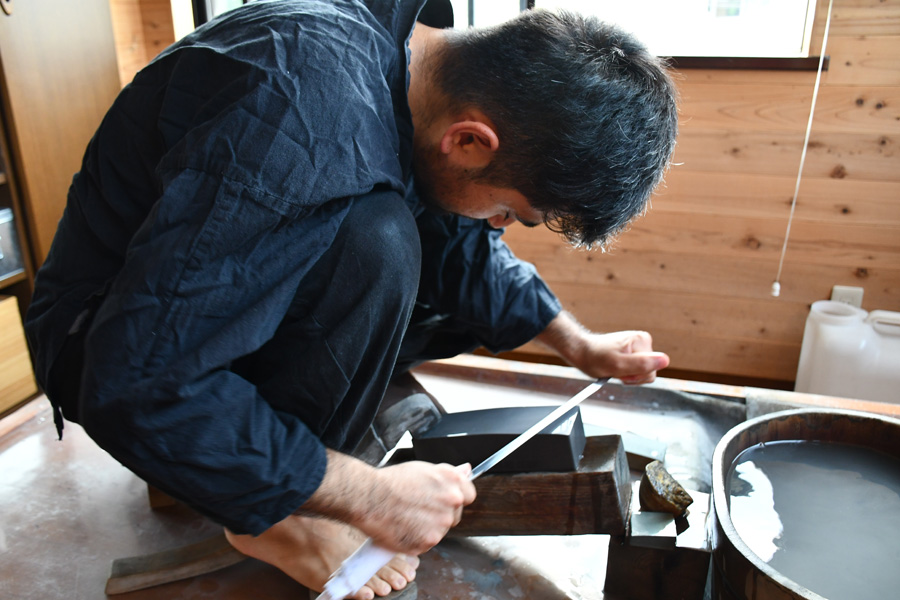
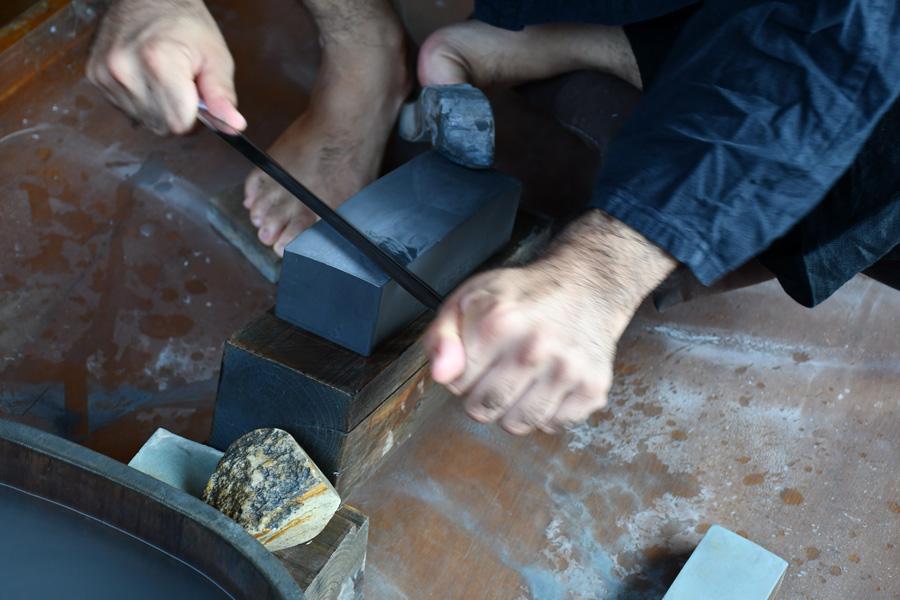
Shitaji-togi
Shaping the blade.
Omura-to is a natural stone, while Kongo-do is an artificial stone that are used to remove rust, large nicks and generally repair shape of the blade. The shape of the blade is then refined using a whetstone called binsui-do. Currently, due to the decline in whetstone mining, natural stones are becoming increasingly rare, and artificial binsui-do tends to be used. In addition to taking care of the amount of steel being removed, the shape and thickness of the blade’s period of manufacture must also be considered, as the overall balance of the shape of the blade is very important. The lines of the cutting edge, the ridgeline (shinogi), the mune and yokote (the dividing line between blade and kissaki) must all be formed correctly with the surfaces of the hira-ji, shinogi-ji and mune all polished evenly.
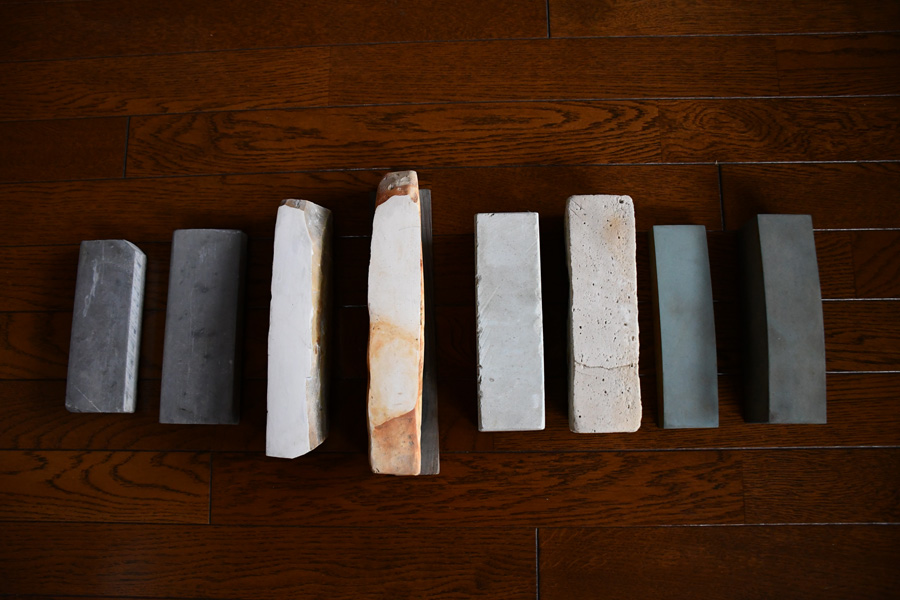
Whetstones used for foundation polishing. From right to left: Arato (Kongō), Binsui (synthetic), natural Binsui, natural Kaisei, Nagura, Koma-Nagura, Uchigumori hazuya (edge stone), and Uchigumori jizuya (surface stone).
Refining the surface of the blade (Hakobi-togi:kaisei, chu-nagura, koma-nagura—natural stones)
In order to perform a suitable polish to the reveal the beauty of a fine hada and hamon, the polishing marks from the previous stages must be completely removed. Hakobi-togi is the process of refining the surface of the blade once the shaping process has been completed. Natural chu-nagura and koma-nagura stones are used for this process. However, depending on the sword, artificial Kaisei-do, chu-nagura-do and koma-nagura-do whetstones can also be used.
Uchigumori: Hato and Jito
Hato is a soft stone mainly used on the hamon, but can also be used on the whole blade. It is used to remove the polishing marks of the koma-nagura stone. The brightness of the nioi-guchi, and visibility of the activities (hataraki) in the ha (between the cutting-edge and the line of the hamon), all depend upon how well the hato polish has been carried out. The polisher must take great care to polish the ha to a uniform standard throughout. Next, a uchi-gumori-jito whetstone is used to polish the jigane, shinogi-ji, and kissaki. Jito is a hard whetstone that is used on the jigane to bring out the hada. As the jigane is varies in accordance with periods and schools of sword manufacture, it is necessary for polisher to bring out the characteristics associated with those schools. Depending on how well this process is carried out will have a major effect on the finished polish.
The hardness of Japanese steel has increased from sword making era to sword making era. Blades of the Koto era are relatively soft, may have utsuri, large and irregular hada, and the possibility of exposing the shingane. Therefore, foundation polishing is not just about making the blade smooth and even. It is important to know when to stop polishing for the greater good of the blade. Blades made from the Shinto era onwards tend to have a more consistent jigane with a fairly uniform hada. However, Shin-shinto era blades are particularly known for their very tightly forged jigane, so it takes a lot of effort to bring out the hada. The swords have already reached maximun sharpness at the third or fourth stage. Thus, the uchigumori process onwards has no relation to the sharpness of Japanese swords, they are polishing techniques that have been developed in order bring out artistic beauty of the blades surface.
Before beginning the shiage-togi (finishing polish) stages, the sword may be passed to a habaki-shi (a soft metal collar between the sword guard and the blade), for a habaki. Then, it can be passed to a saya-shi (scabbard maker) who will either make a shirasaya (plain magnolia wood sleeping scabbard and handle), or if the necessary fittings have been acquired, the foundation work on a full set of mountings.
Shiage-togi (finishing work)
In the case of shiage-togi, the polisher will sit in an upright position resting the blade on his leg or a pedestal and polish it using wafer thin small whetstones on the end of his thumb. This is performed from the mune (back of the blade) so as to reduce the possibility of cutting himself. In the next stage, a compound of iron oxide mixed with sword-oil, called nugui, is applied to the blade. This compound revitalizes the steel somewhat after the constant abrasion by the stones. It also darkens the color of the steel, which can be adjusted to suit the style of a particular school or smith. Following this, the blade may be finished in one of two styles of polish, sashikomi, or hadori. Hadori is refered to as a cosmetic polish that is applied over the hamon making the general shape of the hamon whitish, highlighting the jigane but actually obscuring the details until the blade is pointed towards a light source. With a Sashikomi polish on the other hand, the condition of the polish is equal all the way across the blade, allowing the viewers to see the hamon from the side of the blade, and is said to be convenient for swords on display in showcases.
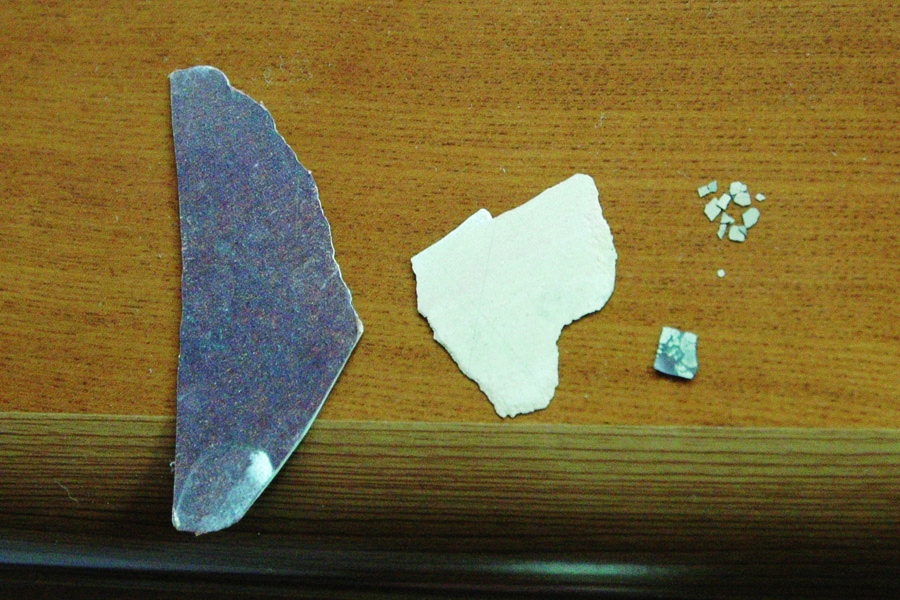
Thinly split whetstones used for finishing polishing (center: a split stone; left: the same stone affixed to Japanese paper with urushi lacquer, viewed from the reverse side).
Jizuya
Jizuya are made from honzan or awase stones, but it is commonly known as natural narutaki-do. There are shita-jizuya (soft foundation) and age-jizuya (hard finishing) stones. Jizuya is an important polishing process that affects the texture and brightness of the hada. Natural stones of the same type can vary in hardness or consistency, so it takes much experience to select a good stone to suit a blade.
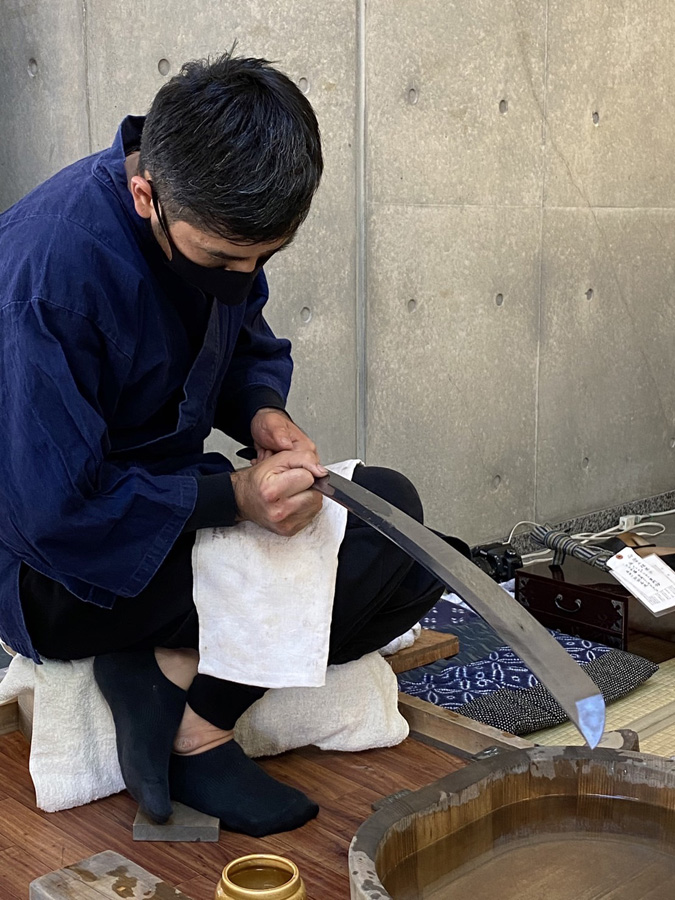
Shiage-togi
Jizuya stones are about 1 cm in diameter and are used on the end of the thumb. Shita-jizuya is about 0.5 mm thick and age-jizuya is about 0.2 mm thick. The soft shita-jizuya is used on the whole of the blade to remove the marks of the uchi-gumori stone from the previous stage and prepare the blade or the next stage of age-jizuya. The brightness of jigane and the fineness of the hada is obtained by the quality and hardness of the age-jizuya used. Bringing out the subtle characteristics of a fine hada is a key point to the finished polish. The polisher has to know whether to stop bringing out the hada as it may become too prominent, or when to continue as to not bring it out enough may leave the hada obscured.
Nugui
Nugui is an iron-oxide powder mixed with choji-oil to make a solution, and applied to the blade with cotton. The application of nugui brings a uniformity to the color of the blade. Nugui applications cannot make the jigane any brighter, but multiple applications can make the blade darker. Therefore, the polisher must take care not to make it too dark. Swords can have a prominent or weak utsuri, so the polisher must take care to create a tone that matches the characteristics of blade well.
Hadori
The hazuya used for hadori is made from thin pieces of uchi-gumori stone that are attached to Japanese washi paper using urushi (lacquer). It is cut into an oval-shapes and used on the end of the polisher’s thumb to polish over the hamon.
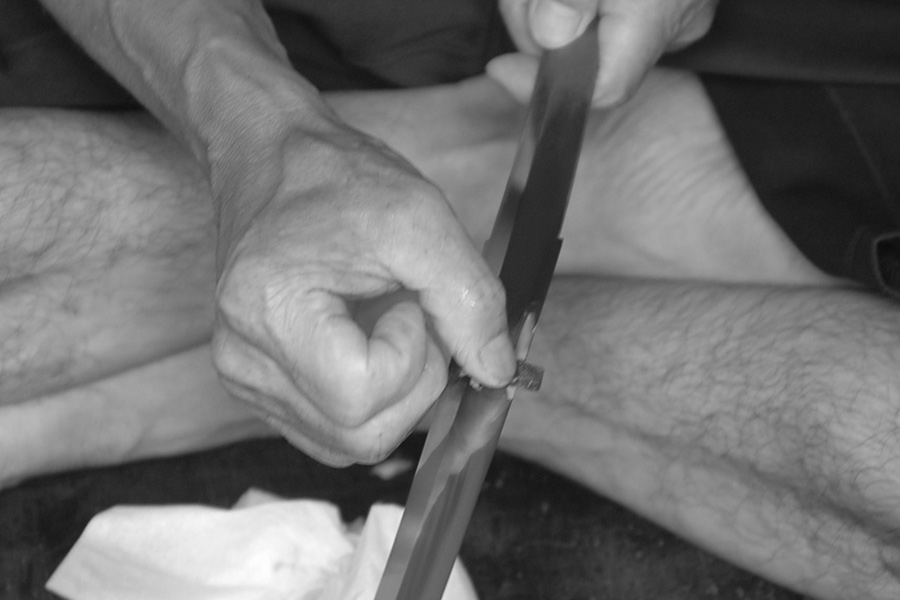
Hadori
The aim of hadori is make a contrast between the jigane and hamon, allowing us to see the beauty of the hada. It also makes the nioi-guchi bright, ashi, and the hataraki clear for appreciation. Every hamon has a certain rhythm that is indicative of the smith that it produced it.
Migaki (Burnishing Process)
The tool used for burnishing (migaki) is a typically a tungsten rod called a migaki-bo. In the past, migaki-bo were made from quenched tamahagane. There are two types of migaki-bo: shita-migaki for foundation burnishing and shiage-migaki for finish burnishing.
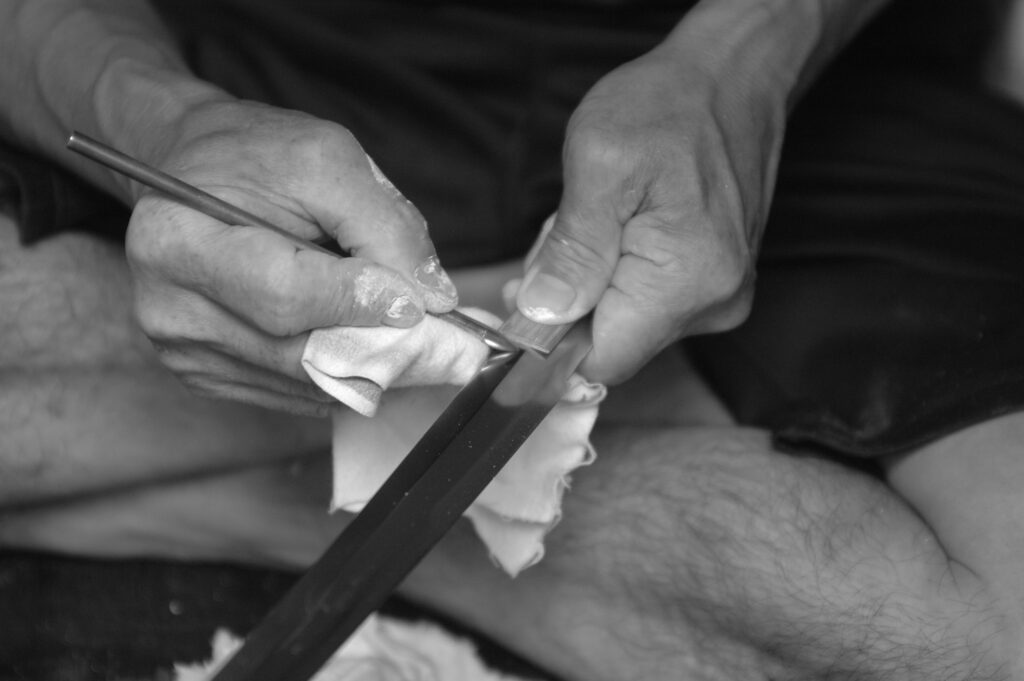
Migaki
First, any oil or impurities are removed from surface of the shinogi and the mune. Next, natural ibota powder is applied to lubricate the surface and allow the migaki-bo to move easily. Lastly, some lines called kesho-migaki are etched at habaki-moto and on the kissaki-mune. In some cases, the number of lines of kesho-migaki may relate to certain schools of polishing, but in the main, as the kasane (blade thickness) varies from blade to blade, this can determine how many lines the polisher can apply.
Sujikiri
Sujikiri is the process making the yokote (line delineates the kissaki from the rest of the blade) with a rectangular piece of hazuya, a ruler and a bamboo spatula.
Narume
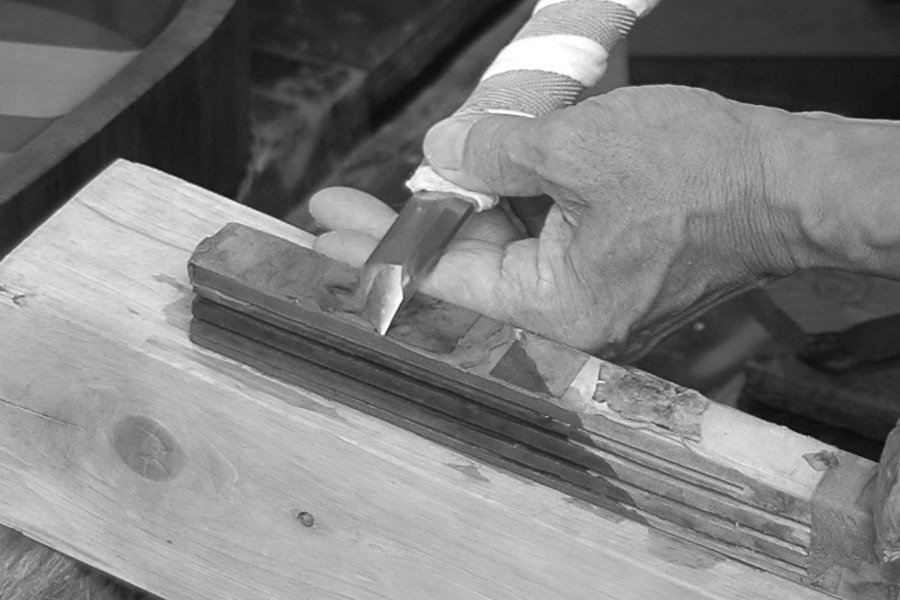
Narume
Japanese washi paper is attached to a hazuya stone and it is set upon a sprung type tool called a narume-dai. This tool is used to polish the kissaki (point section) from the yokote to the tip of the blade.
Paul Martin is from England and resides in Tokyo. A former curator at the British Museum, he is currently a Trustee of the Foundation for Japanese Sword Culture for the Purpose of Public Interest, as well as a recognized specialist for the Ministry of Land, Infrastructure, and Transport.In 2006, he became the first non-Japanese to win the sword appraisal competition at the Japanese sword museum. He went on to win a second time in 2018. Paul has appeared in many documentaries all around the world, translated several major sword books and exhibition catalogs and is quoted by the Osafune Sword Museum as being, “One of the foremost non-Japanese specialists on Nihonto”. A former three-time English Karate Champion, Paul practices martial arts in Japan and holds high ranks in both Kendo and Iaido.
Author: Japanese Swords and Armor, Masterpieces from Thirty of Japan’s Greatest Samurai Warriors (Tuttle ISBN 978-4805318386)
thejapanesesword.com
facebook.com/The.Japanese.Sword
instagram.com/thejapanesesword
https://www.youtube.com/TheJapaneseSword